Visit The Incredible Cave City of Vardzia, Georgia

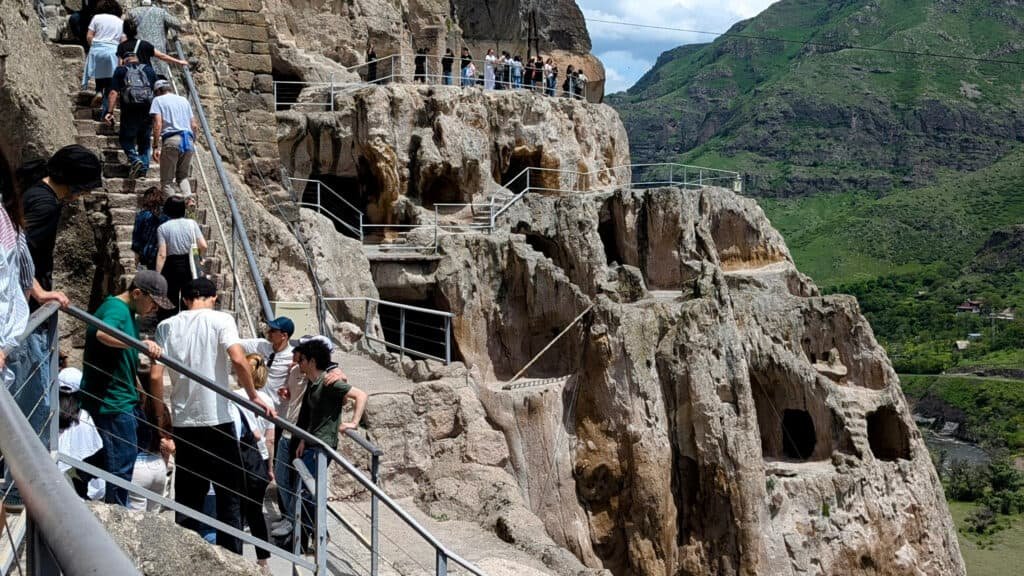
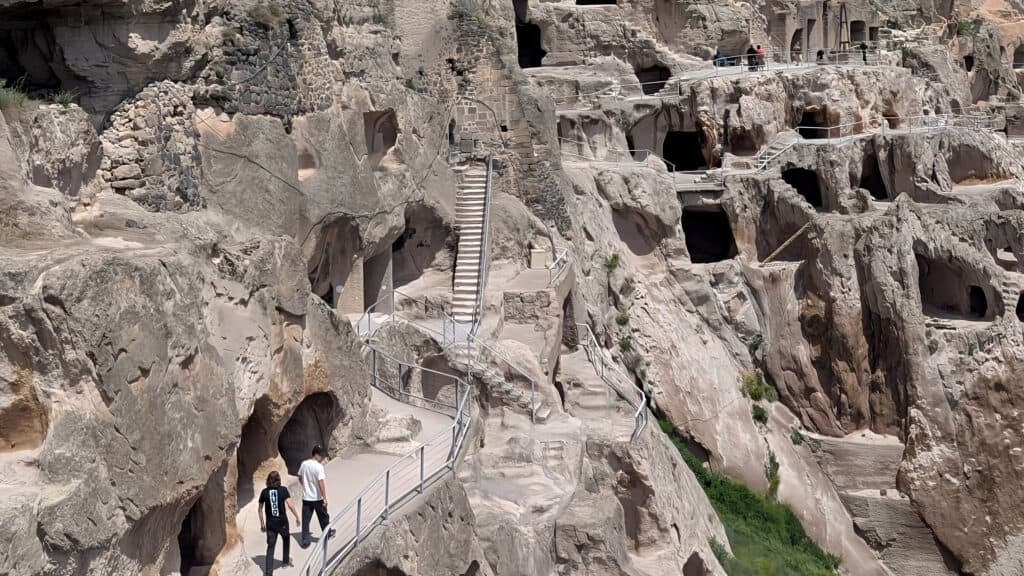
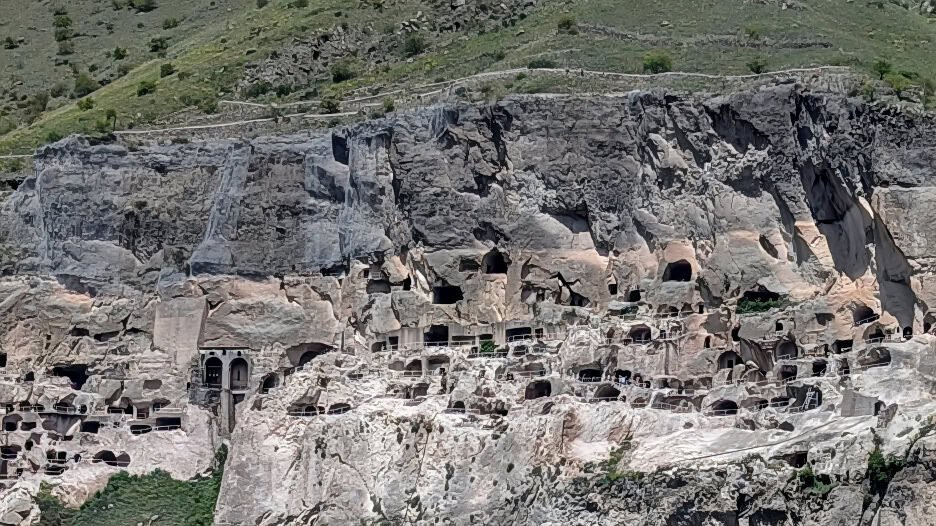
Nestled on the slopes of Erusheti Mountain, near the southern border with Turkey, lies the ancient cave city of Vardzia. This incredible rock-hewn settlement once housed monks, soldiers, and villagers, and at its height, it had over 6,000 caves spread across 19 floors. We climbed stairways tucked into the cliffside, explored hidden tunnels, and found ancient chapels, wine cellars, and meeting rooms. A delicious lunch, with breathtaking views of the Mtkvari River Valley, was a perfect way to end our time in this unique place.
This is the story of our time at Vardzia, plus everything you need to know if you visit, whether you explore independently or as part of a tour, as we did.
This guide may include a few affiliate links. If you choose to buy something through one of them, I may earn a small commission (at no cost to you). Thank you for supporting One Small Bag.
Is it worth visiting Vardzia?
Absolutely. Vardzia is definitely worth visiting. It’s a highlight of Georgia’s Samtskhe-Javakheti region and a rare opportunity to see such an extensive cave city. There’s an astonishing underground cave monastery where monks still live and worship, and it’s also a popular Orthodox pilgrimage site.
When it comes to practicalities, Vardzia might feel remote. Still, it can easily be combined with a visit to Borjomi, a beautiful resort city and spa town, plus Rabati Castle in Akhaltsikhe. I do have one word of warning: a visit to Vardzia does require a certain level of fitness. If you’re visiting in summer, do take plenty to drink, plus sun protection, and wear sensible footwear, whatever time of year you visit.
If you don’t have a car and don’t want to hire one, visiting Vardzia independently could be challenging. Public transport options are limited. The good news is that day-tours offer excellent value and include the invaluable services of a local expert tour guide.
About Vardzia
According to legend, Vardzia is named after a young Queen Tamar, who got lost in the cave complex. When her uncle Giorgi searched for her, she shouted back “ak var dzia” (Georgian: აქ ვარ ძია), which translates to “Here I am, uncle”. The phrase echoed through the tunnels, giving the site its name. She reigned from 1184 to 1213, often considered Georgia’s golden age of political power and cultural flourishing. She is arguably the most celebrated figure in Georgian history and the name most associated with Vardzia.
The rise of Vardzia
Vardzia lies on a site that has been inhabited since the Bronze Age. But in the 12th century, things changed dramatically. King George III and his daughter, Queen Tamar, masterminded a massive expansion. Caves were hewn into the rock to accommodate up to 50,000 people, with the complex serving as both a monastery and a defensive stronghold. Hidden behind the cliffside, thousands of caves were arranged across multiple levels. They included churches, wine cellars, a pharmacy, a throne room, and a sophisticated irrigation system, all designed to secure self-sufficiency. Accessed from a secret tunnel, the cave city was hidden from the valley and from any incoming invaders below.
The fall of Vardzia
All that changed in 1283, when a major earthquake sheared away the facing rock. What we see today is essentially an exposed cross-section of what was once largely hidden.
Things changed again in the 16th century, when the Persians invaded in 1551. Then, in 1578, the Ottoman Turks arrived and conquered the site. Monks were killed, treasures looted, and manuscripts destroyed during these 16th-century invasions. The blackened walls in some of the caves may be the result of fires set during these times.
After that, Vardzia fell into decline, but it was never completely abandoned. Monks have lived in Vardzia since its founding, and they still do today.
More cave cities and monasteries to explore
There is another cave town in Georgia, Uplistsikhe, near Gori, which is more accessible from Tbilisi than Vardzia, but it’s not on the same scale. David Gareji is the least accessible, near the border with Azerbaijan. It is a series of monasteries, including a cave monastery.
Vardzia reminds me of the cave cities of Derinkuyu and Kaymakli in Cappadocia, Turkey, and the monastery and cave complex of Old Orhei in Moldova, which, like Vardzia, still has hermit monks in situ. There are also parallels with Meteora in Greece. The monks of Meteora may have moved out of the caves into beautiful monasteries clinging to the cliffsides, but some of their past cave dwellings are still visible today. All these remote places share one experience: They all helped protect their inhabitants from invaders through the years, and all are truly remarkable.
Visiting Vardzia
There isn’t an official website for Vardzia, but you’ll find some information on the Georgian National Tourism site. Once you‘ve made your way to Vardzia, here’s what you can expect at the site, based on our visit.
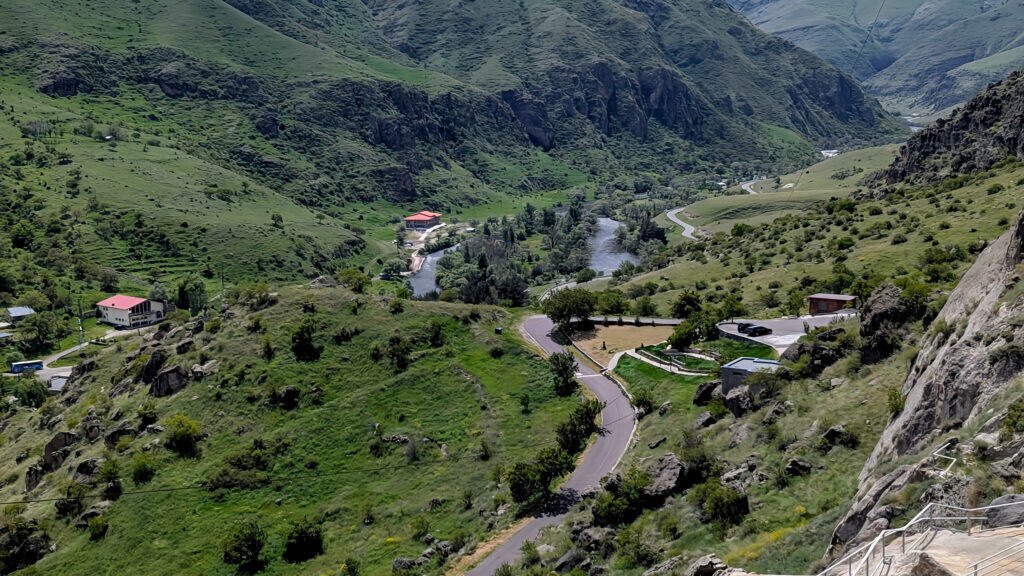
Vardzia Entrance
Entrance Fee: Pay the Vardzia Cave Complex entrance fee at the ticket office at the bottom of the hill near the main parking lot. The entrance fee is 15 GEL, and both cash and cards are accepted.
Shuttle Bus Fee: There’s also an extra 2 GEL for the minibus shuttle, which will save you around 30-40 minutes’ walk uphill to the cave entrance. A good idea to take this, given there’s a lot of walking and clambering once you get into the caves, and especially if the weather is hot.
Optional Audio Guide: There’s a 15 GEL charge for an audio guide, which would be a good idea if you are not going into the complex with a local expert.
Facilities at the ticket office: This is also a good place to use the public bathrooms before you reach the caves.
View the site remotely: Some of the paths in and around the cave complex are covered by Google Street View, so this is a genuinely brilliant way to see the complex, either in preparation for your visit or if you can’t visit in person and want to see some of the sites remotely.
Opening hours: Vardzia is open year-round, every day. The times are 10 am to 7 pm from May 1st to the end of September. Outside these times, Vardzia closes earlier, so do be aware if you are planning to visit in the afternoon. If you’re visiting in the summer, arriving early would be a good move, as it will be cooler and might be less busy.
Time required: That really depends on how much of the complex you want to see. I would say allow at least 2-3 hours.
Best time to go: Very hot in summer and busy with tourists, especially in July and August. Visiting in Spring or Autumn is ideal. I’m sure it’s beautiful in the snow, but the paths and stairs could be slippery. Also, logistically more challenging to get there in the winter months if there is heavy snow.
Dress Code for Vardzia: Comfortable, secure walking shoes are advisable, along with sun protection. Dress should be modest. Don’t wear shorts or short skirts, or leave your shoulders uncovered. Women should cover their hair.
While you can visit Vardzia independently, you can also take a day tour that includes Borjomi and Rabati Castle, as we did.
Exploring Vardzia
As you start exploring, you’ll find many passages and stairs. If you’re tall, you’ll be bending down and watching your head. There are many stairways outside, too. There’s a fairly obvious direction of travel, and you are meant to do the circuit one way. But there’s not much signage, and it’s not always obvious where to go without a guide. Don’t get lost in the caves!
The Bell Tower
This is a stop early on. It’s the square structure you see in many pictures. It was built after the 16th-century invasions and provides an exceptional view over the river valley and the rest of Vardzia. The resident bell is long gone, as are any other objects once kept here. It’s a perfect stop to take it all in and to seek shelter from the elements.
Church of the Dormition
This is roughly the halfway point of the complex. This 12th-century rock-hewn Sanctuary, known as the Church of the Holy Dormition, is one of the highlights of a trip to Vardzia. Look for the barrel-vaulted ceiling, the three windows, a rear tunnel, and a small adjacent shrine.
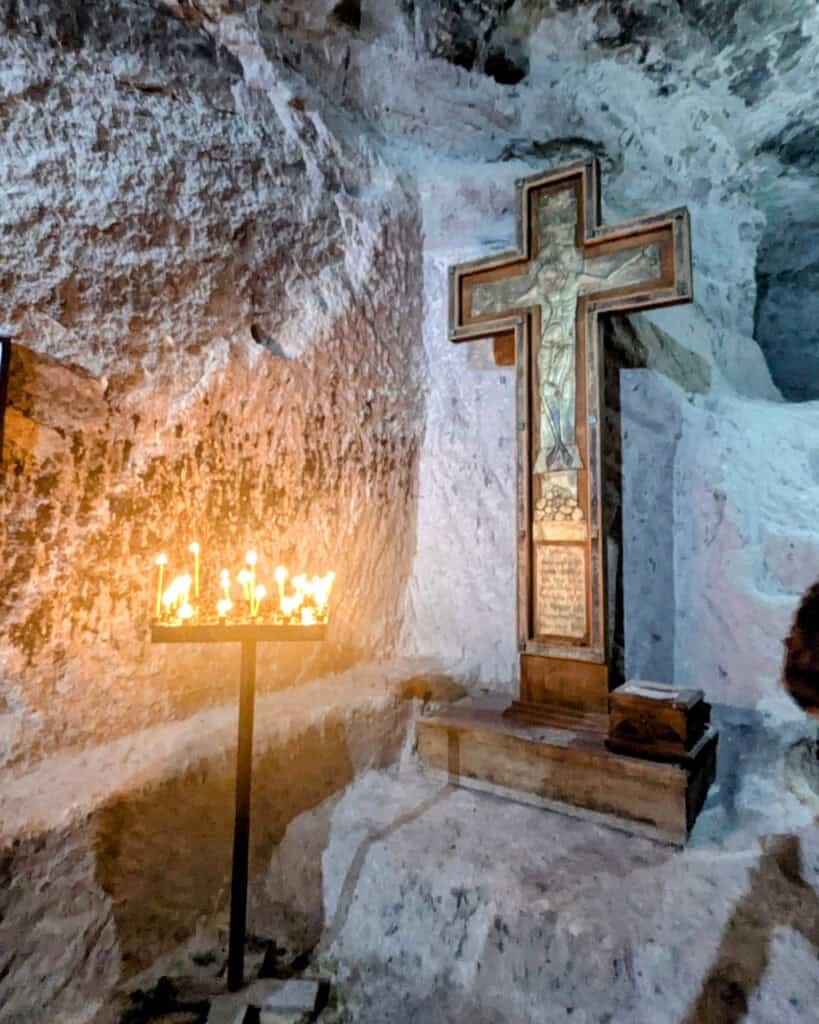
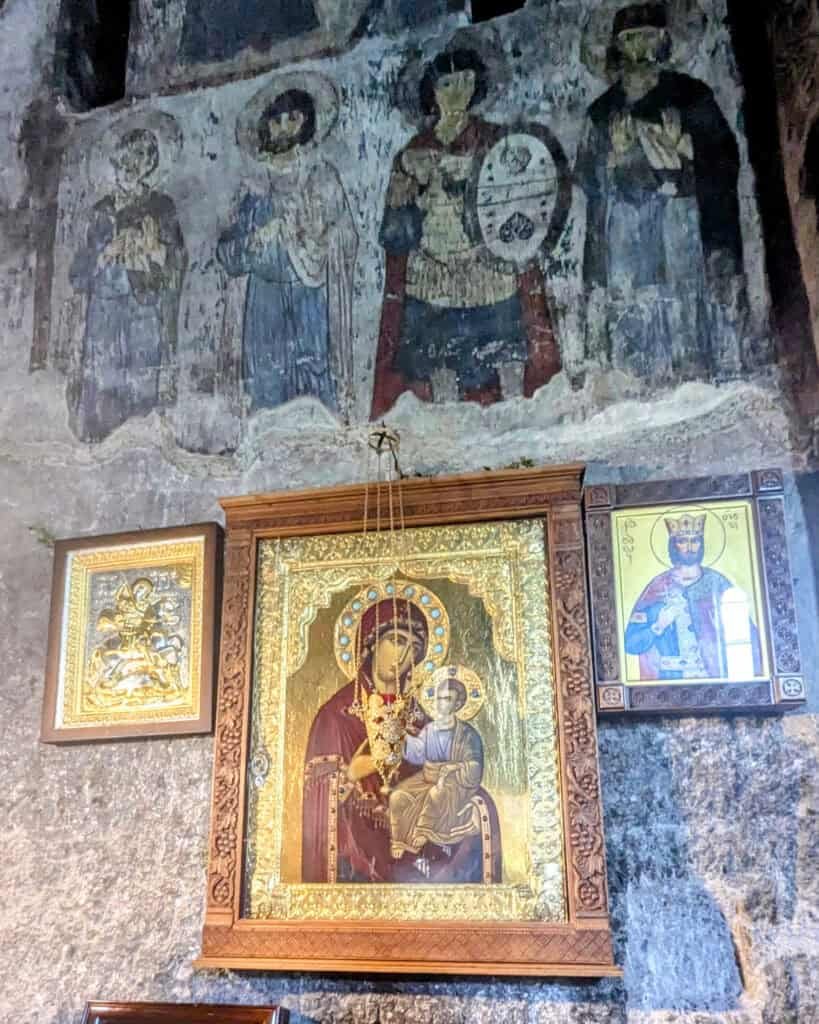
1180s Byzantine-style frescoes depicting scenes of Christ’s life, including the Ascension, Last Supper, and crucifixion, plus the royal portraits of Queen Tamar and King Giorgi III, adorn the walls and ceiling.
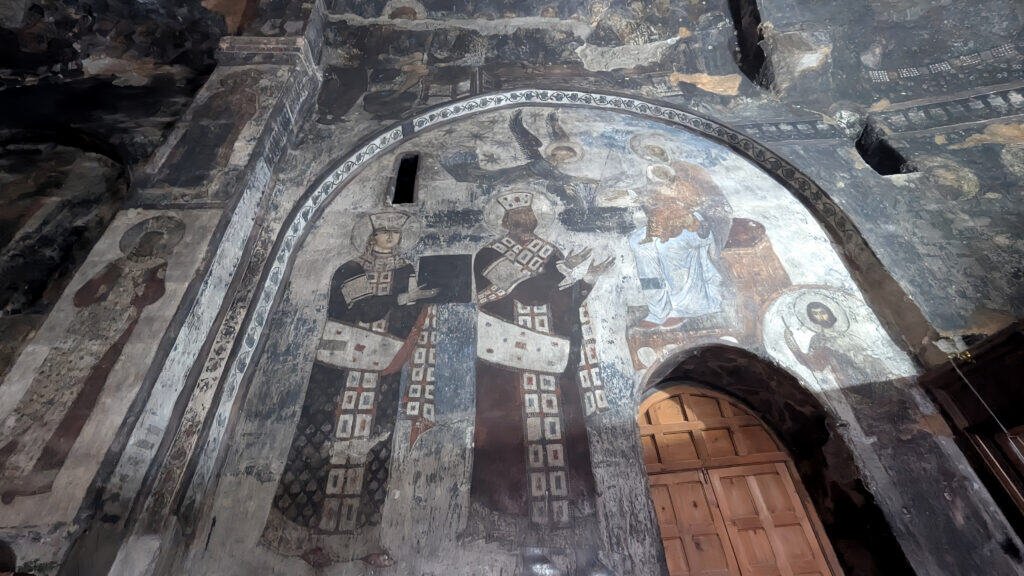
There’s also a picture of Virgin Hodegetria (Virgin and Child) flanked by archangels. The frescoes, dating to Tamar’s reign, are considered among the finest examples of medieval Georgian art preserved today.
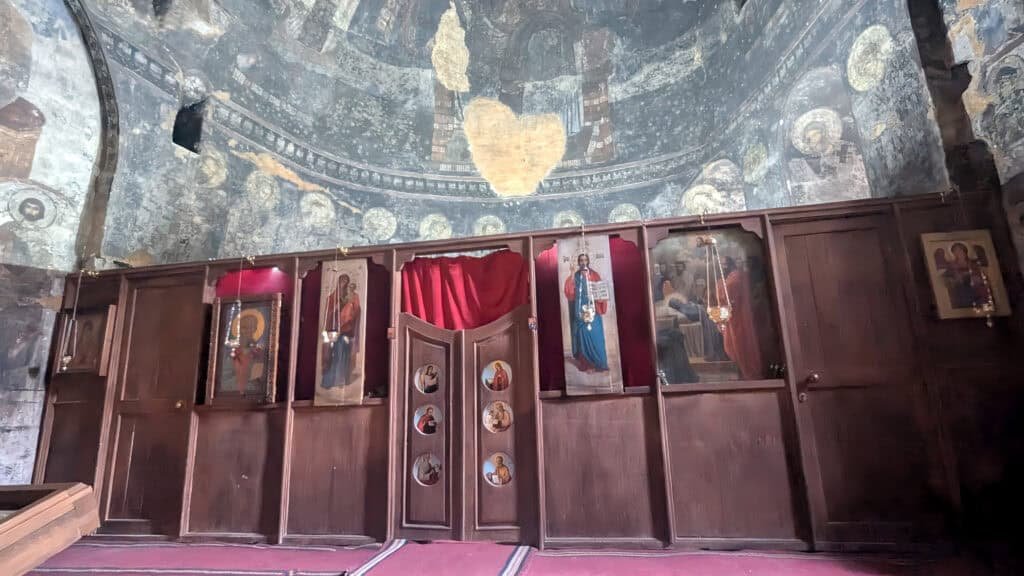
Behind the church, look out for the ‘Tears of Tamar’ Spring. It’s a natural spring that provided water during sieges.
Beyond the Cave Monastery
There’s more to see beyond the cave monastery. Inside, you can see kitchens, dining, and living rooms with bench seating, holes for a fire pit and ovens, plus an apothecary with shelves for bottles. A good dose of imagination is required for this! There are plenty of wine cellars, too. The monks grew the vines on the sides of the mountain. We would expect nothing less in Georgia; it’s the birthplace of wine.
One of the most impressive things I learned was about the irrigation system dating back to the 12th century. This channelled drinking water down to the lower levels through clay pipes embedded in the walls.
Once you’ve explored the cave area beyond the Church of the Holy Dormition, there’s a path you can follow back down to the start.
How to get to Vardzia
Vardzia is around 4 hours by road (approx. 224 km) from Tbilisi, and it’s a similar distance from Kutaisi. Vardzia is 60km from Akhaltsikhe, home to Rabati Castle.
Marshrutka (minibus) services to Vardzia are infrequent from both Akhaltsikhe and Tbilisi, and, in practice, it’s not possible to go there and back from Tbilisi in a day by marshrutka. If you do want to do the journey on public transport, be prepared to stay overnight, and you may need to change in Akhaltsikhe. There are taxis at Akhaltsikhe bus station for the last 60km if there are no marshrutkas for the final leg. As is common with Marshrutkas in Georgia, the best way to find times is to visit the station in advance and ask; the information online may be scant or unreliable.
If you don’t want to drive yourself, it may be better to hire a driver or book a tour as we did.
Where to eat in Vardzia
We ate at Restaurant Vardzia, near the entrance, with beautiful views of the river and Vardzia. I had a plate of Georgian dumplings – Khinkali, delicious!

Where to stay near Vardzia
There’s not an abundance of options. I’d go for Vardzia Resort, a highly rated 4-star hotel with a swimming pool and spa facilities, located about a 30-minute walk or a 5-minute drive from the entrance to the cave city complex.
Where to next
While you are in the area, why not look further afield to the wider Caucasus? Here are some ideas.
- Rabati Castle, Akhaltsikhe: A Guide to Georgia’s Most Controversial Fortress
- Things to Do in Tbilisi: A Guide to the Capital of Georgia
- Best Day Trips from Tbilisi, Georgia: Monasteries, Mountains and More
- Things to Do in Batumi: Georgia’s Unexpected Black Sea Gem
- Things to Do in Kutaisi: A Guide to Georgia’s Ancient City
- Things to do in Yerevan: Armenia’s modern capital and pink city
- Things to do in Gyumri: A guide to Armenia’s Black and Apricot City
- …and more…
I hope you enjoyed reading this. If you have any questions or comments, do let me know in the comments. Thank you for reading my blog.
Unsubscribe whenever you like (Privacy Policy)