Rabati Castle, Akhaltsikhe: A Guide to Georgia’s Most Controversial Fortress
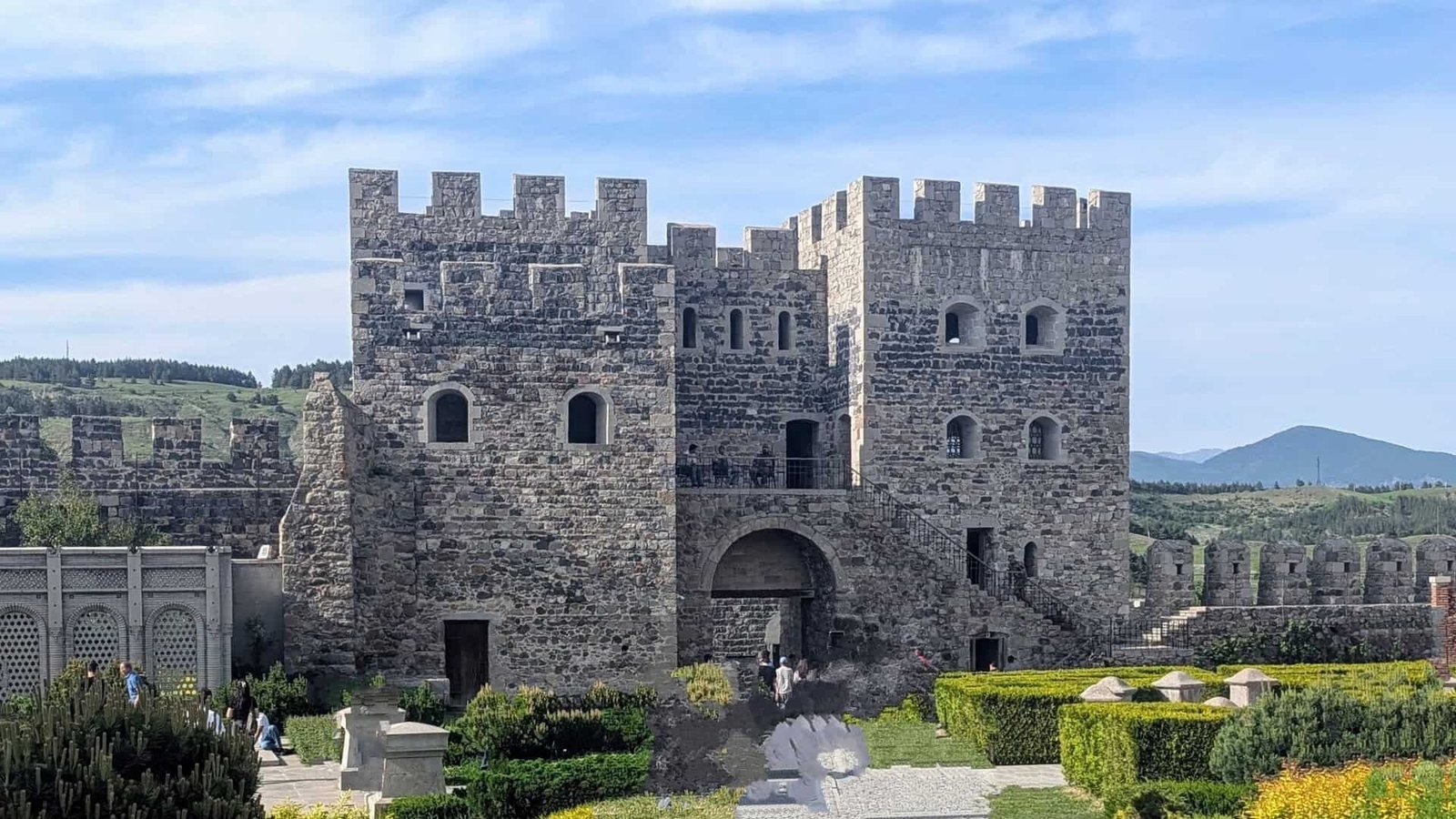
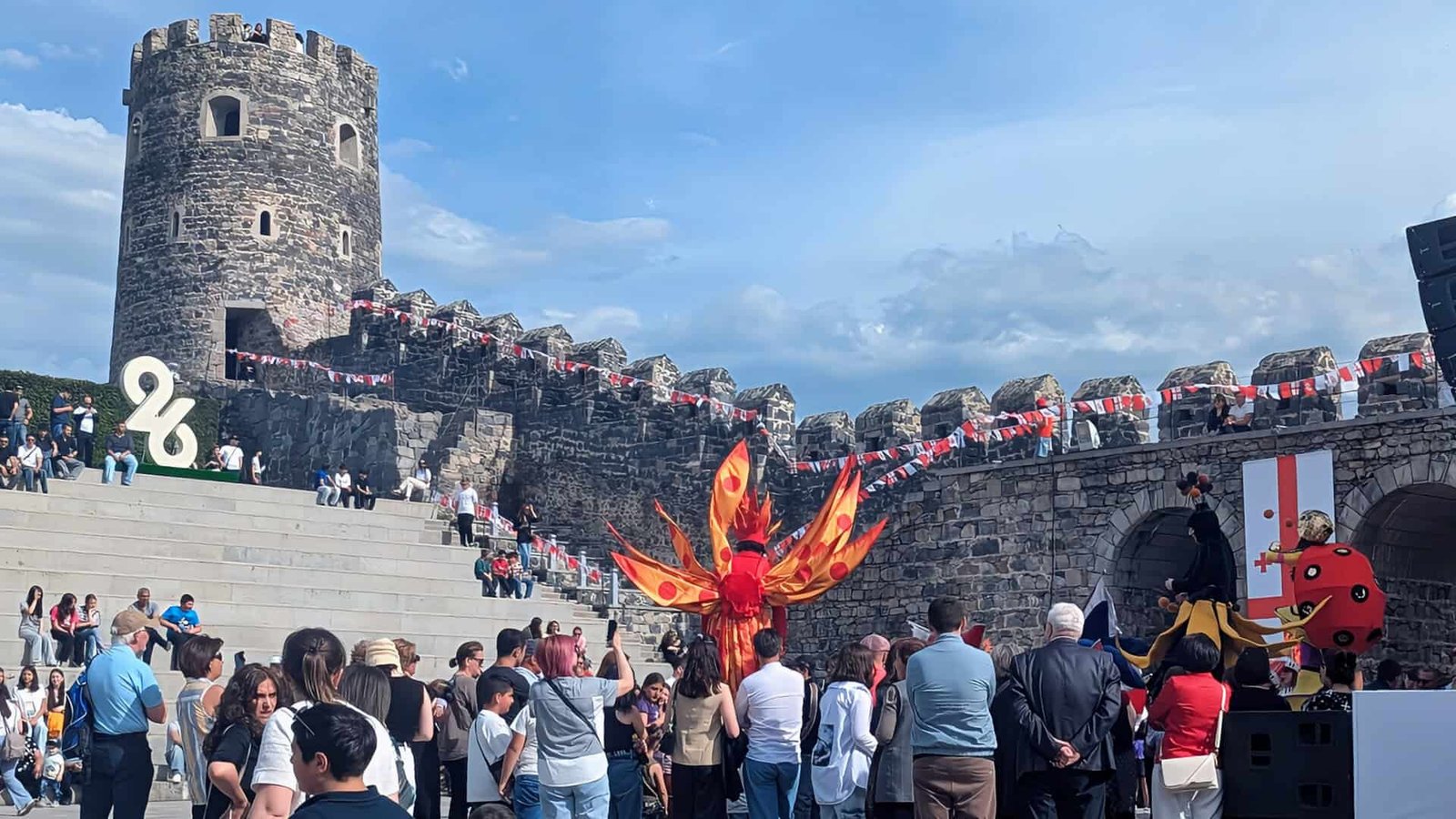
Rabati Castle (also known as Akhaltsikhe Fortress) in southern Georgia is a sprawling, recently restored 9th-century complex. It is best known as a symbol of religious and cultural tolerance, housing a mosque, an Orthodox church, a synagogue, and a historical museum. When we arrived, Independence Day celebrations were in full swing, and the place was buzzing with life, making it a particularly memorable experience.
This is my guide to visiting Rabati Castle, plus everything you need to know whether you visit independently or as part of a day trip from Kutaisi or Tbilisi.
This guide may include a few affiliate links. If you choose to buy something through one of them, I may earn a small commission (at no cost to you). Thank you for supporting One Small Bag.
Why is Rabati Castle Controversial
During its multi-million-dollar restoration in 2011, the Georgian government gave it a heavy “Disney-fication” makeover. Historic preservationists and travellers criticise the reconstruction for erasing the faded, romantic charm of the original medieval ruins by using overly pristine, modern materials.
If you are a purist, you may be horrified. For me, I just saw something totally unique, with layers of history assembled in a slightly random way inside a beautiful double-walled exterior. And all in immaculate condition. It reminds me of Carcassonne, which faces similar criticism yet remains one of the most popular places to visit in France.
Is Rabati Castle worth visiting?
Yes – and it offers something genuinely different from the monasteries and cave cities that dominate Georgia’s southern sightseeing circuit. Rabati is less about spiritual contemplation and more about the messy, layered reality of a region that passed through Georgian, Ottoman, and Russian hands over more than a thousand years. The result is a single complex in which a medieval Citadel, a mosque, a church, and a 19th-century garden pavilion coexist.
Rabati pairs very well with visits to Vardzia and Borjomi, and most day tours from Kutaisi and Tbilisi include all three. Here are some tours you can take:
- Tbilisi: Borjomi, Rabati & Vardzia Adventure Guided Tour
- Borjomi, Rabati & Vardzia – one-day group tour from Kutaisi
About Rabati Castle
Rabati Castle, originally known as “Lomsia”, meaning “Lion” in Georgian, was established in the 9th century. Its position guarding the trade routes between Georgia and Turkey made it strategically vital, and it changed hands repeatedly over the following millennium.
In the 13th to 16th centuries, the nearby palace served as a residence for the Jakeli family, who ruled this part of Georgia as an independent principality. To consolidate their power under Ottoman pressure, the Jakelis eventually converted to Islam and ruled the area as pashas – a pragmatic compromise that kept them in power while permanently reshaping the fortress’s character.
The tower overlooks a mosque, a madrasa, and a hammam, all built between the 17th and 18th centuries during Ottoman rule. Then came the Russians: in 1828, during the Russo-Turkish War, Russian and Georgian forces stormed the fortress, and after the Treaty of Adrianople in 1829, the Ottomans ceded the Akhaltsikhe region to the Russian Empire. Several structures within the complex reflect the imperial Russian period.
Rabati Castle is named after its location in the historic Rabat district of Akhaltsikhe, Georgia. For centuries, Akhaltsikhe was a major hub for Georgian Jews, and the Rabati quarter was renowned as a symbol of religious tolerance, where Jews, Christians, and Muslims lived and traded side by side. Akhaltsikhe literally means “new fort” in Georgian, and with the recent renovations, much of it feels new. There’s nowhere else in Georgia quite like it.
Visiting Rabati Castle
As you pass through the gates and inside the inner wall, you reach a large, open courtyard with several towers in a variety of shapes and sizes. There are restaurants and patios along the edges and even a Hotel (Gino Wellness Rabath) on the grounds. It’s a luxury one with spa facilities. How wonderful it would be to stay here and spend time at the castle when the crowds have gone home?
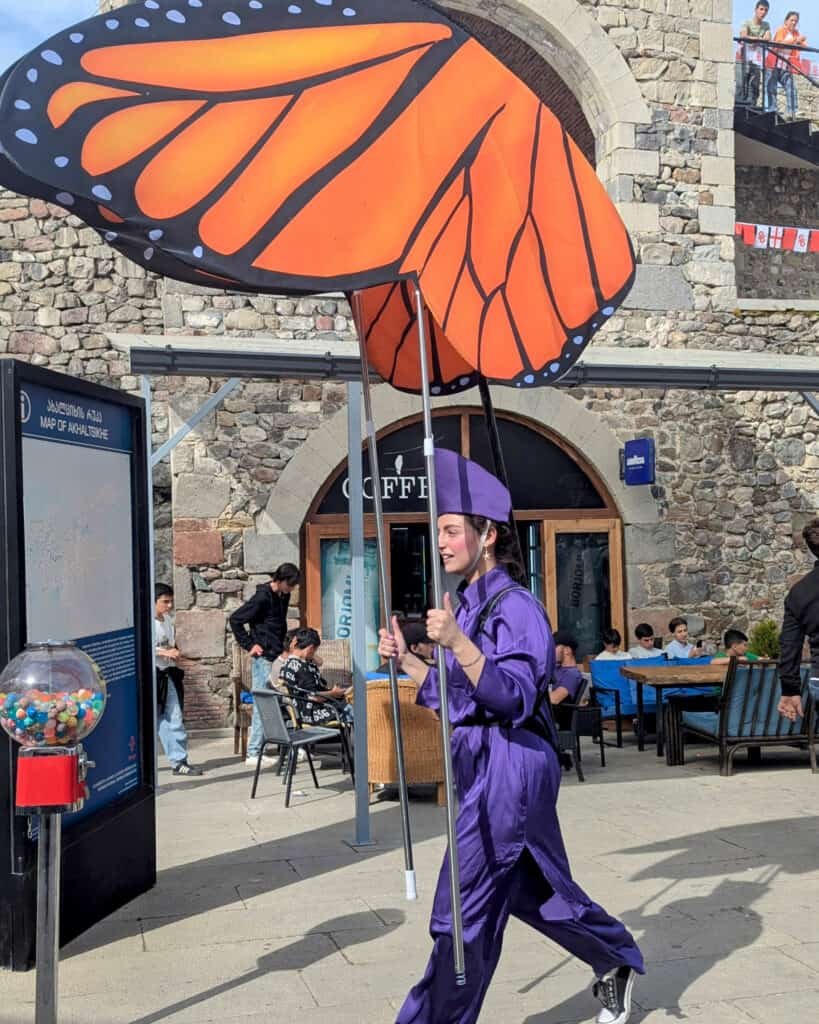
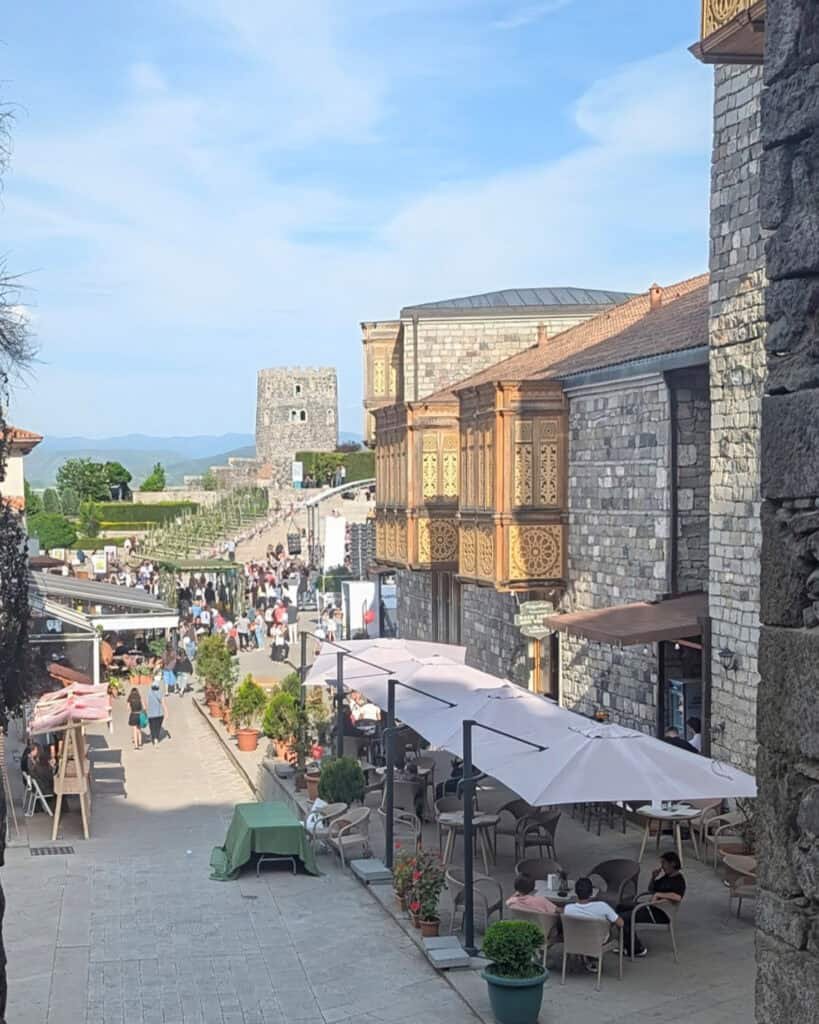
When we visited, the area was full of people, with a stage set up and a music event starting up. The event was a celebration of Georgian Independence Day. There are more events during the year when visitor numbers will be higher and more activities will be laid on.
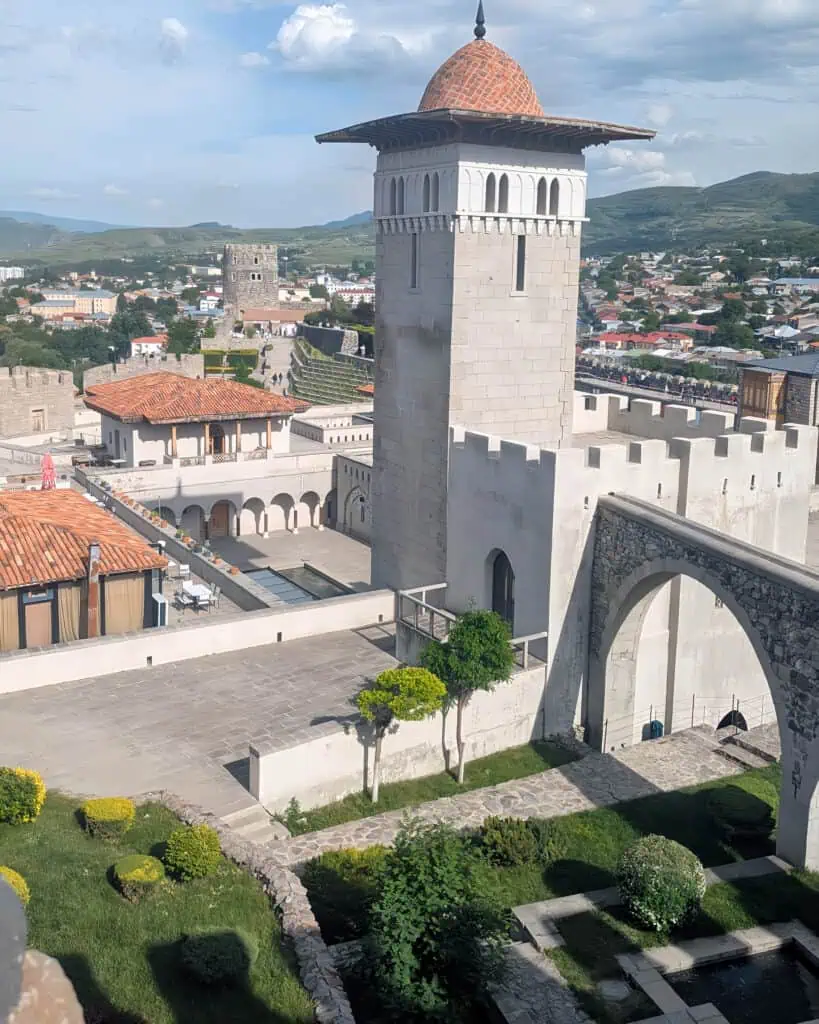
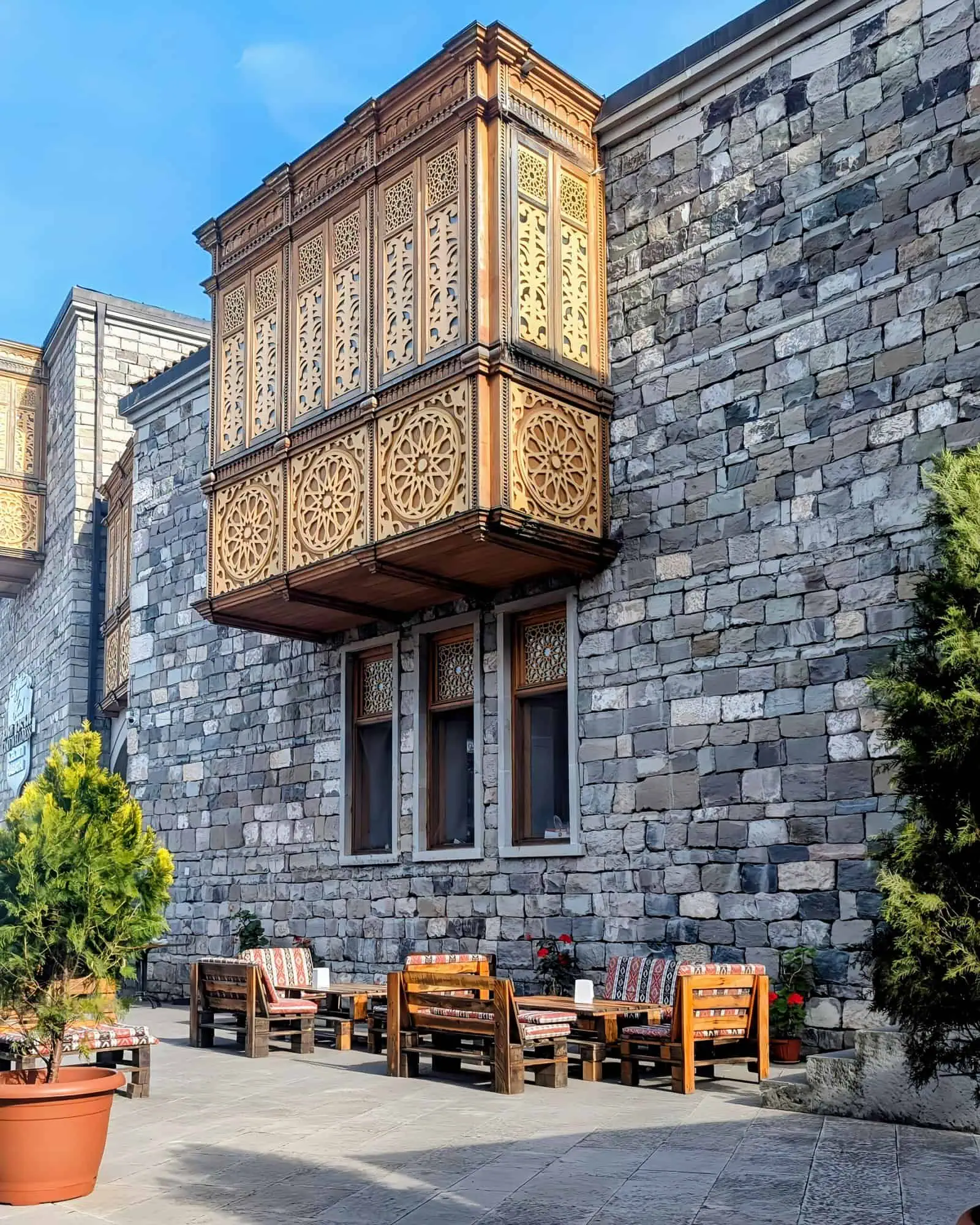
Near the entrance, you will find the tourist information and ticket office. A ticket is required to visit the upper Citadel and the museum. Take your time to wander the grounds; the formal gardens are beautiful, and there are arches, ancient and modern, with surprises around every corner as you pass through.
St. George’s Church (St. Marine Church)
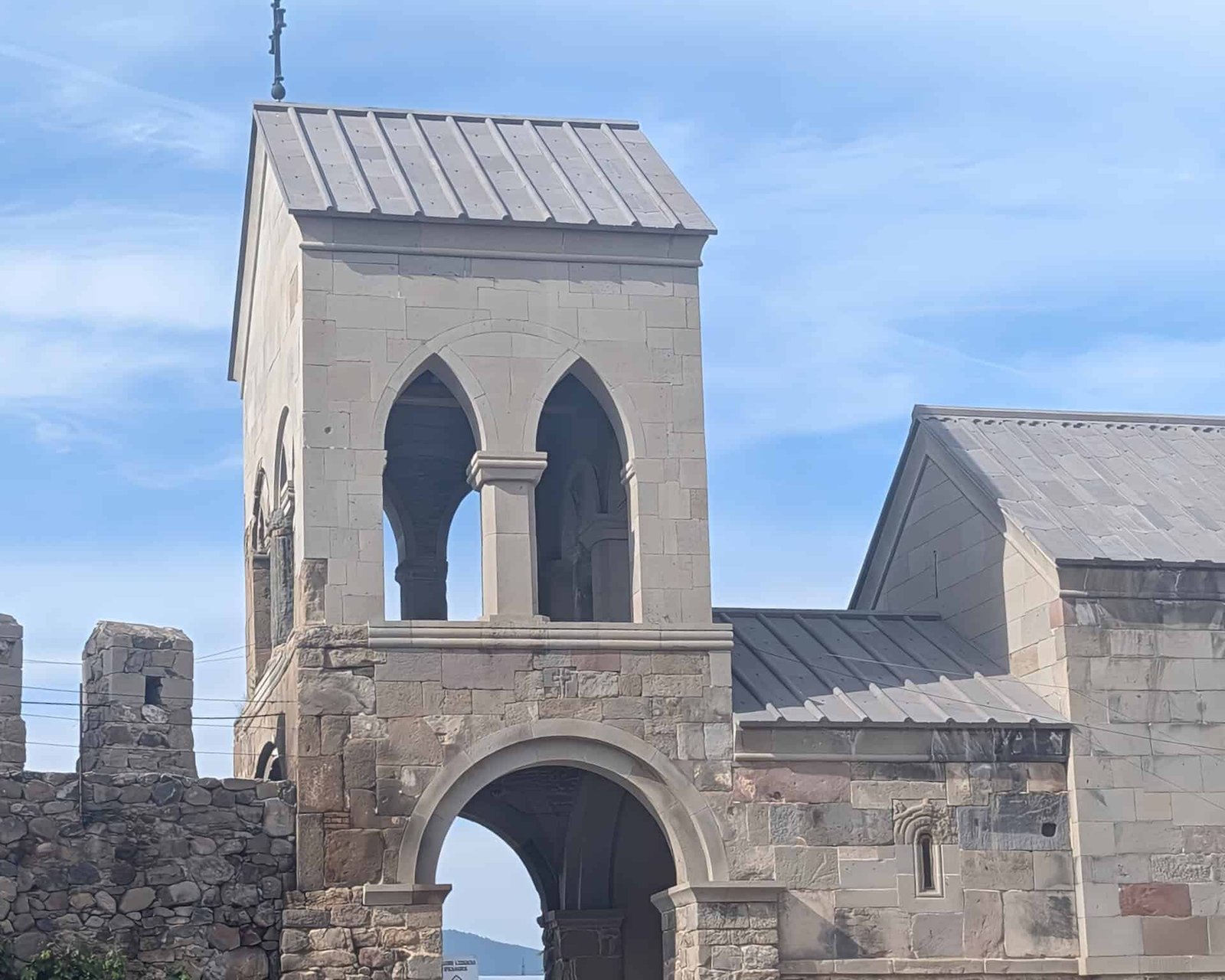
As you wander through the arches and the grounds, you will spot St George’s Church. Also known as St. Marine, the church was originally built as a mosque in 1578 under Ottoman rule, but the architect designed it to keep options open, so it could be easily repurposed into a Christian church if the region’s rulers changed! On the outside, there are bullet holes from centuries of conflict, and elongated creatures, possibly rams, near the entrance. And inside the church, the interior is minimalist.
The Akhmediya Mosque
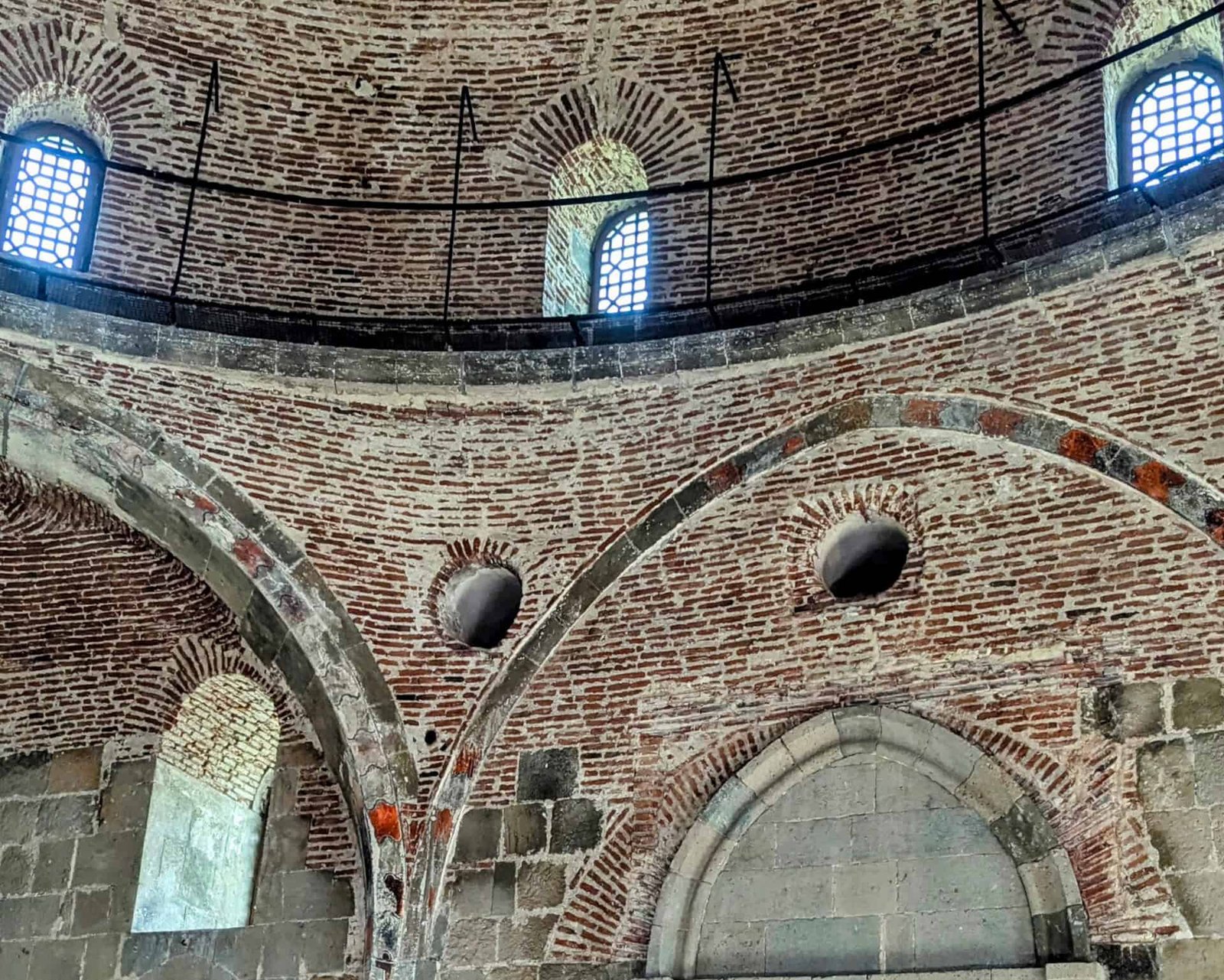
Head towards the Citadel to find the mosque in Rabati Castle, Akhaltsikhe, a beautiful blend of Islamic and Orthodox architectural elements. Built in 1752, it’s more of a museum and a historical monument than an active place of worship. It has a large golden dome and a single tall minaret. Inside, there are mosaics, eight-pointed star motifs, and artefacts from multiple faiths.
The Citadel
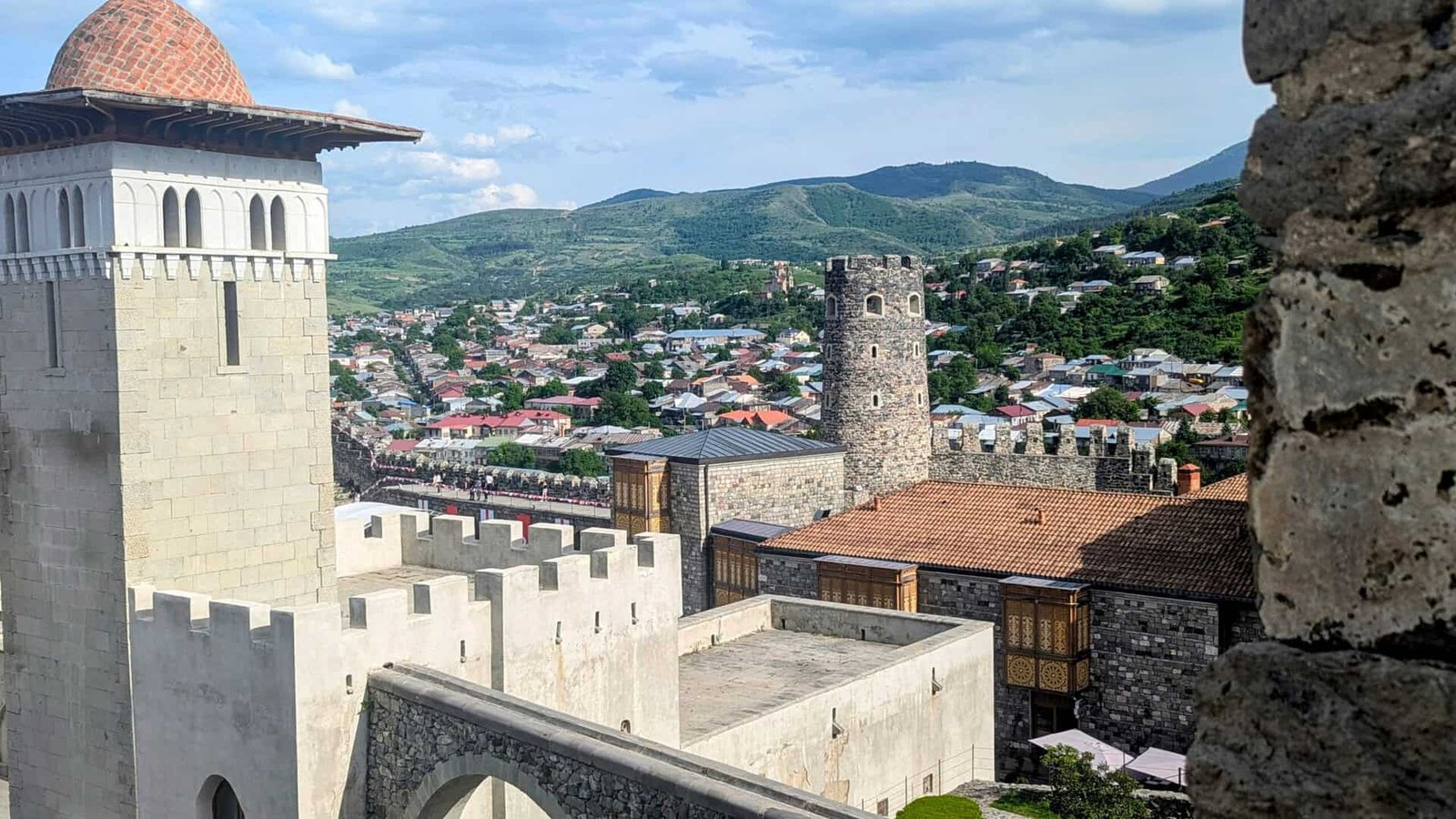
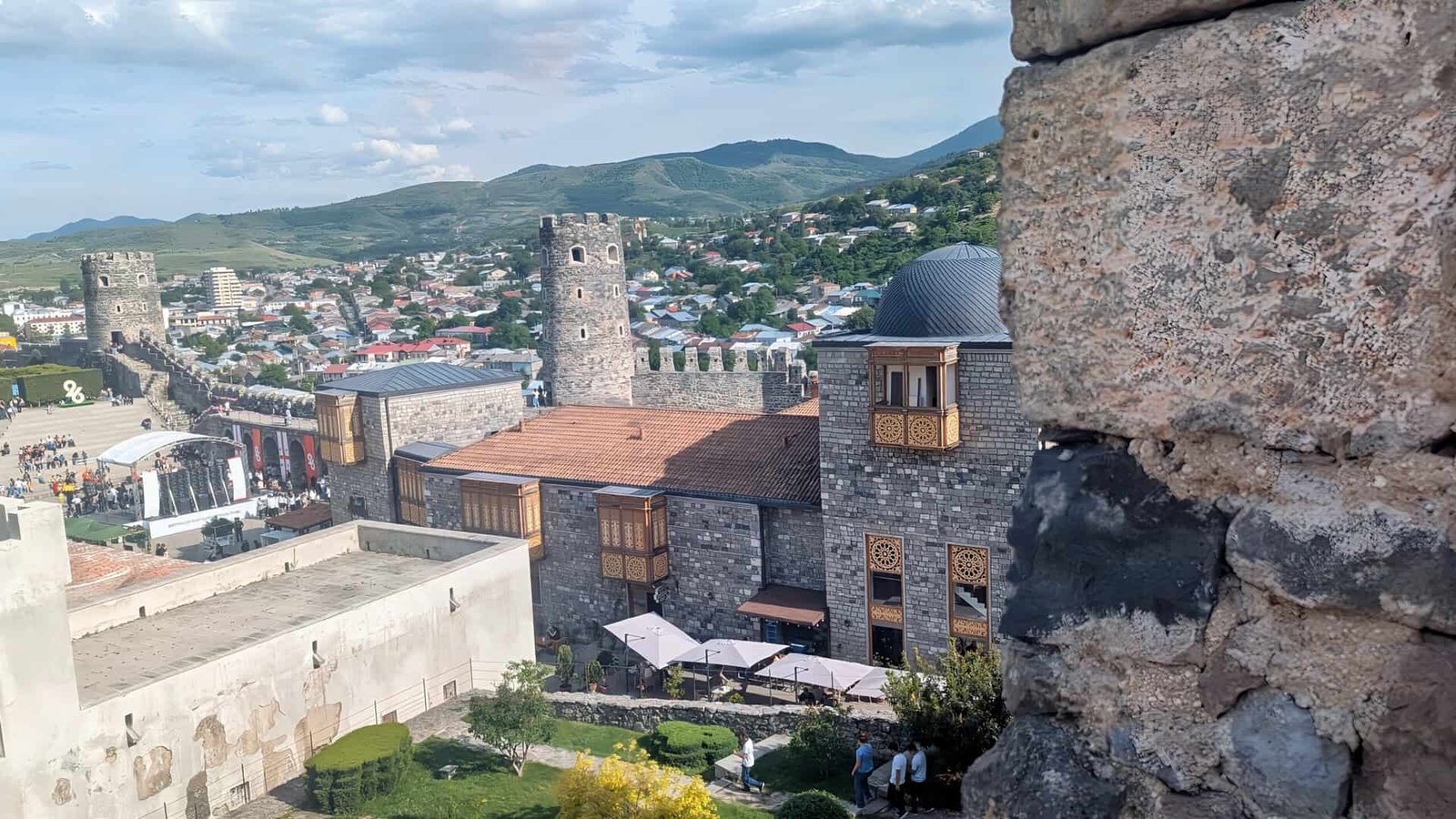
The highest part of the castle, and also the oldest, lies on its western side. It’s also the site of the Jakeli palace, the residence of the Jakeli family, who ruled this part of Georgia from the 13th to the 16th century. It’s part of the fortified medieval stronghold, so don’t expect an opulent royal residence.
The Citadel is one of the best places for views of the whole fortress complex and beyond, over Akhaltsikhe and the surrounding hills. In this picture, you can see the medieval towers, gardens, hotel, and double-walled ramparts. As this picture was also taken on Georgian Independence Day, you can also see the stage for the live music and entertainment.
Samtskhe-Javakheti History Museum
The Samtskhe-Javakheti History Museum, housed in the historical Jakeli Palace within the Upper Fortress of Rabati Castle, features over 25,000 exhibits. It showcases ancient archaeological artefacts, rare medieval manuscripts, and Ottoman-era weapons and costumes, offering a comprehensive look into the rich multicultural history of Georgia’s southern region. Worth visiting if you want deeper historical context. It’s ticketed.
FREE Travel Tech Toolkit
The exact apps, eSIMs, and tools I use to travel smarter – covering transport, translation, money, connectivity, and more. Tested over years of actual travel.
Practical information
Do check the official Rabati Castle website for up-to-date information. Here are some key details:
- Entrance fee: 20 GEL for foreign nationals. This gives you access to the upper Citadel, the mosque, and the museum. Wandering the castle grounds is free. The ticket office is inside the castle walls, on the castle grounds.
- Opening hours: The official opening hours from the website are 09:00 to 20:00, 7 days a week. There seems to be a variety of online suggestions for opening hours, with earlier closures in winter (18:00) and later in summer (22:00), so if you plan to be there beyond 6 pm, I’d check directly with the castle for the days you plan to visit. While specific closure dates aren’t listed on the website, I’d check ahead, especially if visiting during Orthodox/Georgian holidays.
- Time required: Around 2 hours is comfortable for most visitors, longer if you visit the museum.
- Tips: To avoid crowds and get the best light for photographs, weekdays or early mornings work best. Wear comfortable shoes; there’s a fair amount of walking, and the Citadel section involves some climbing.
How to get to Rabati Castle
Akhaltsikhe is about 175km from Kutaisi and 207km from Tbilisi, which you could drive to if you hire a car. If you don’t have a car, here are some options.
Getting to Rabati Castle Independently
If you’re travelling independently, marshrutkas run from Kutaisi to Akhaltsikhe, where the castle is within walking distance of the town centre, or you could pick up a local taxi. A change may be required in Borjomi.
For Tbilisi, there are direct Marshrutkas. Neither service runs very frequently, so if you plan to do the trip in one day, you’ll need to confirm you can get back on time. Alternatively, why not take the opportunity to stay at the spa hotel on the grounds of Rabati Castle, the Vardzia resort, or Borjomi for a truly authentic experience?
Tours to Rabati Castle
Most visitors arrive as part of a day tour combining Rabati with Vardzia and Borjomi. This tour from Kutaisi covers all three, and there’s a similar tour from Tbilisi. This is the tour we took, and I would highly recommend it.
Events at Rabati Castle
Rabati Castle in Akhaltsikhe, Georgia, hosts a variety of vibrant cultural gatherings, folk festivals, and national celebrations throughout the year. The majestic fortress provides a historic backdrop for annual events, including the opening of the tourist season and local folk traditions.
We were lucky enough to visit on Georgia’s Independence Day (May 26), and festivities were in full swing. The castle was packed with live music, costumes, and stalls. And that’s not the only event of the year. Rabati has a busy event timetable. Here are some of the highlights:
- Spring of Rabat Folklore Festival: An annual cultural highlight that brings together international dance and music groups to celebrate traditional folklore on the castle grounds
- Independence Day of Georgia: A prominent public event with historical exhibitions, local food and drink zones, and a gala concert to commemorate the nation’s independence
- International Children’s Day: A dedicated community festival that typically includes interactive workshops, robotics displays, theatre, and child-friendly activities
- Opening of the Tourist Season: An annual launch event that typically falls in mid-May, marking the start of the castle’s bustling summer tourist influx.
Where to next
If you have more time to spend in the area, here are some places to visit:
- Sapara Monastery: Just 10 km from Akhaltsikhe. It’s a 9th-century monastery offering stunning views from its setting in a forested gorge.
- Vardzia: About an hour south. This incredible cave city, carved into the Erusheti mountain, features over 600 rooms and tunnels that remain, and in its day, it was much larger. There’s a well-preserved cave monastery too.
- Khertvisi Fortress: On the way to Vardzia. It is one of the oldest fortifications in Georgia
- Borjomi: About an hour from Akhaltsikhe. Famous in Georgia for its mineral water, it is a pretty spa town with a picturesque central park and sulfur pools.
- Abastumani: A 30-minute drive west of the mountain spa resort, renowned for its pine forests and healing sulfur baths, and home to the Abastumani Astrophysical Observatory. Smaller and less developed than Borgomi.
While you are in the area, why not look further afield to the wider Caucasus? Here are some ideas.
- Visit The Incredible Cave City of Vardzia, Georgia
- Best Day Trips from Tbilisi, Georgia: Monasteries, Mountains and More
- Things to Do in Tbilisi: A Guide to the Capital of Georgia
- Things to Do in Batumi: Georgia’s Unexpected Black Sea Gem
- Things to Do in Kutaisi: A Guide to Georgia’s Ancient City
- Things to do in Yerevan: Armenia’s modern capital and pink city
- …and more…
I hope you enjoyed reading this. If you have any questions or comments, do let me know in the comments. Thank you for reading my blog.
Unsubscribe whenever you like (Privacy Policy)