Iron Fountain Gyumri: Armenia’s Extraordinary Soviet UFO
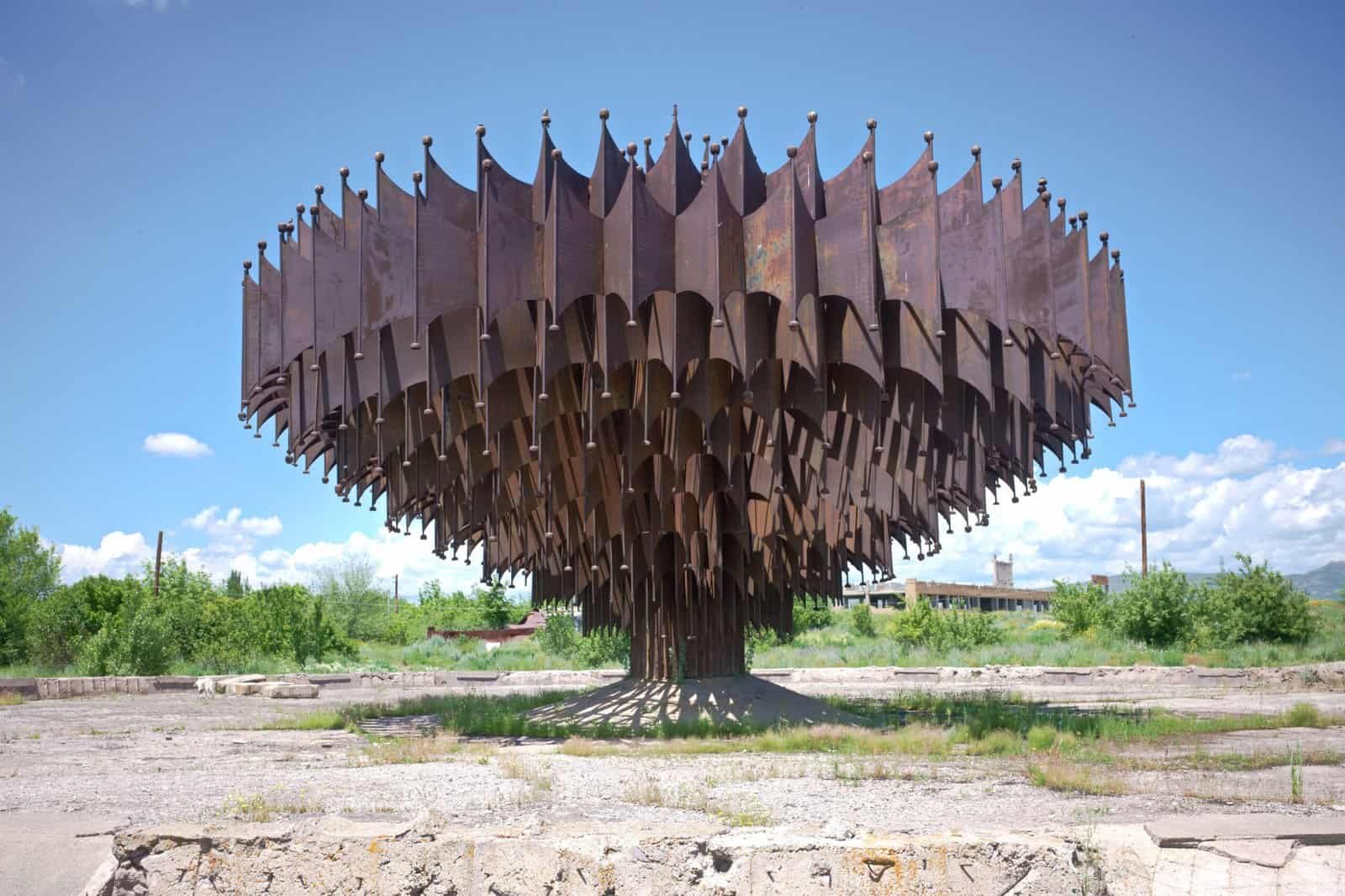
Locals call it the “UFO,” and one look tells you why. A tiered, rust-coloured canopy of metal petals hovers on a single trunk-like column, unfolding like something between a butterfly wing and a flying saucer. Officially, it’s the “Friendship” Fountain. Unofficially, and far more accurately, given the wasteland it now sits in, it’s simply the Iron Fountain, one of the strangest surviving monuments of Soviet modernism anywhere in Armenia.
The Iron Fountain was on our “if we have time” list for Gyumri. After all, was it really worth a Yandex ride to the edge of the city to see a rusty Soviet relic? As it turned out, absolutely.
Is the Iron Fountain worth visiting?
If you’re interested in Soviet architecture, unusual photography locations, or Armenia’s modern history, absolutely. The fountain itself won’t take more than 20–30 minutes, but it tells a remarkable story about Gyumri before and after the 1988 earthquake. It’s one of those places where the setting is as important as the monument itself.
Quick Facts
Who built it, and why does it look the way it does
The fountain was designed by Artur Tarkhanyan, one of Soviet Armenia’s most significant architects, and completed in 1982. Tarkhanyan wasn’t a minor figure: he’s also credited with the Tsitsernakaberd Genocide Memorial in Yerevan and Zvartnots Airport, among other major national projects, so Gyumri got a serious piece of design pedigree for what was, on paper, just a public fountain.
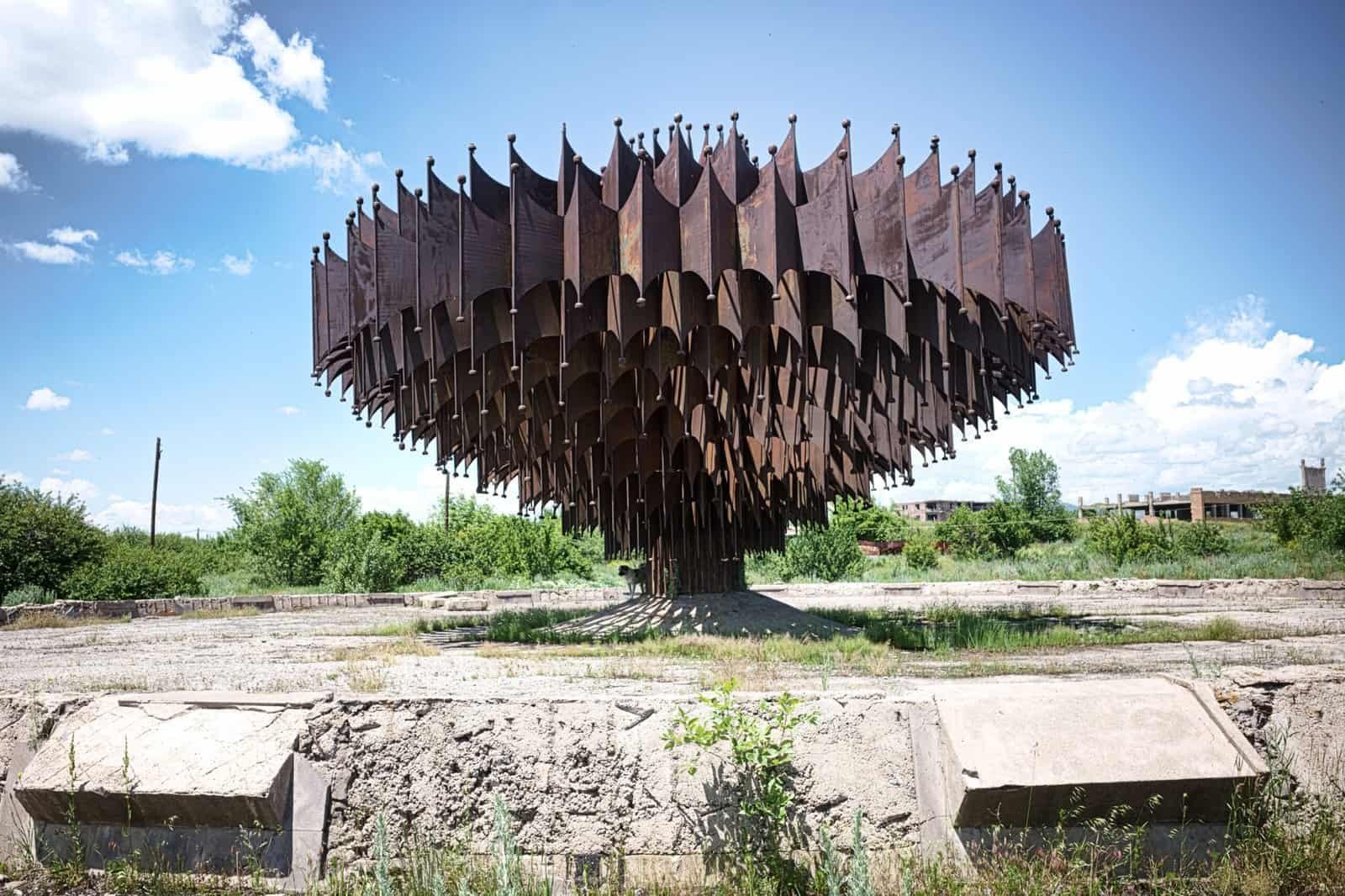
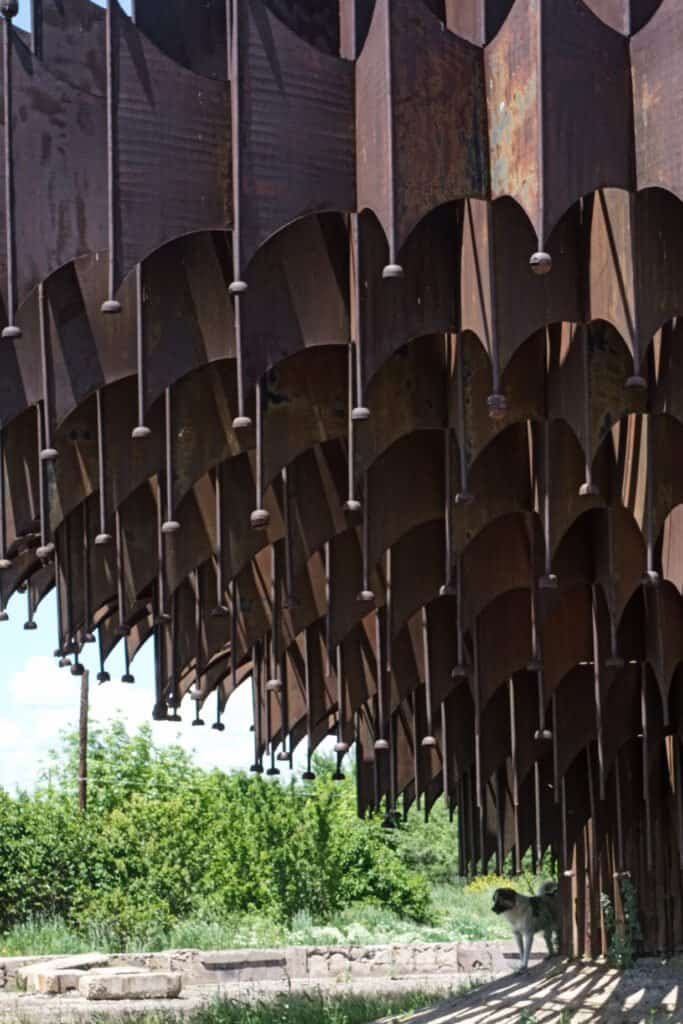
The structure is built from large, layered iron sheets that fan outward and downward in overlapping tiers, evoking unfolding wings or petals. I love the sculptural approach. There’s no pretence of classical fountain imagery here, zero scrolls or cherubs. It’s abstract, industrial, and, depending on your taste, either beautiful or faintly alien. Probably both.
When it worked, and why it stopped
The fountain operated for just six years. It opened in 1982 as the centrepiece of the Gyumri Polytechnic Institute campus. A landscaped, tree-lined space that was, by most accounts, a genuine gathering point for students and residents. Water is spurting from the top and running down through the tiers. When you think of it in those terms, it makes a lot more sense.
That ended in 1988 with the Spitak earthquake. With a magnitude of 6.8, the earthquake devastated the wider region, and Gyumri (then Leninakan) lost around 80% of its buildings. The Polytechnic campus around the fountain was flattened, but the fountain itself, remarkably, survived structurally intact. But with the university gone, the water infrastructure destroyed, and the surrounding neighbourhood in ruins, there was no real reason to turn it back on. It’s been dry and largely undeveloped for the past three decades.
How it looked when it worked
A visit to the Arthur Tarkhanyan Centre in Yerevan provides context for this. A place that explores the legacy of Armenian modernist architects and their approaches to housing and educational architecture, and some of the iconic landmarks of Armenia, including the Iron Fountain of Gyumri and the memorial statue of Dilijan,
Here are videos of their 3D recreations of the Iron Fountain, shown both during the day and at night, to help imagine it in its former glory.
Visiting the Iron Fountain Today
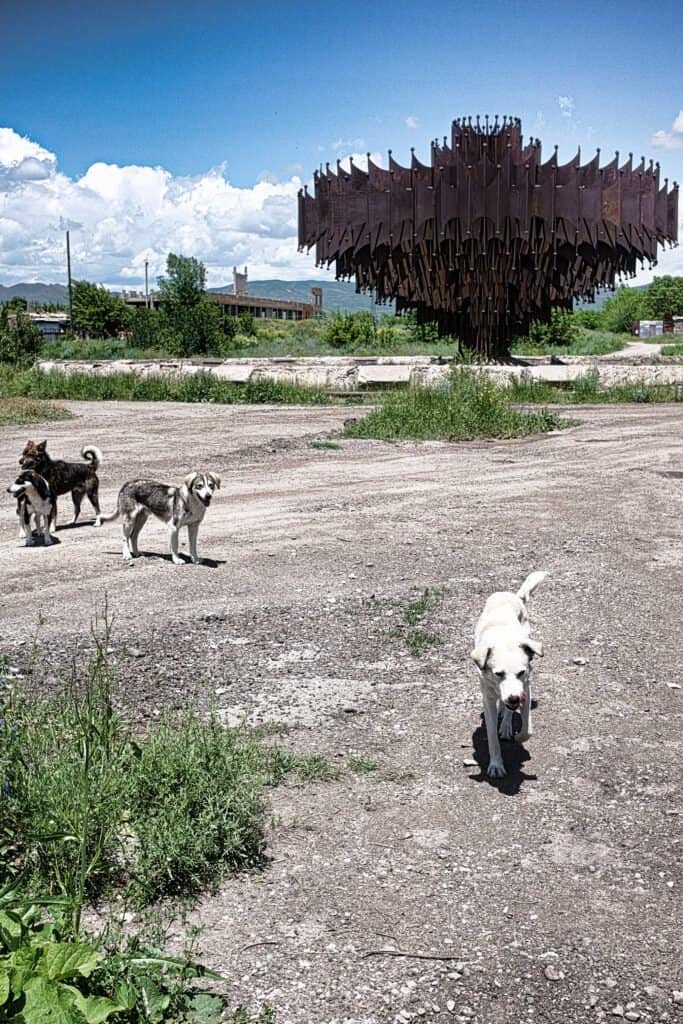
We rode a Yandex to the edge of the city to find our Armenian UFO. Our driver didn’t speak English, but took the trouble to use Google Translate to tell us how beautiful the spot used to be. His face said it all. Sadness at what the area had become and surprise that two tourists had taken the trouble to visit. So our driver left us for his next pick-up, and before long, the self-appointed canine guardians of the fountain came over to investigate us. I felt a little guilty that we hadn’t brought anything for them.
What we saw wasn’t just edge-of-town scrappiness and a city petering out; the desolation felt palpable. A circle of broken concrete blocks and rusty pipework marked the edge of the original pool, with the iron fountain standing in splendid isolation in the centre. The empty, weedy plain and the crumbling institutional buildings visible in the background are all that’s left of what would have been the central hub for young students in Armenia’s second city.
There have been periodic calls for restoration, notably from Tarkhanyan’s own family, who have pushed authorities to fund a revival, so far without success. For now, the fountain remains dry, rusting attractively, with the odd tourist making the detour to visit it.
How to Visit the Iron Fountain
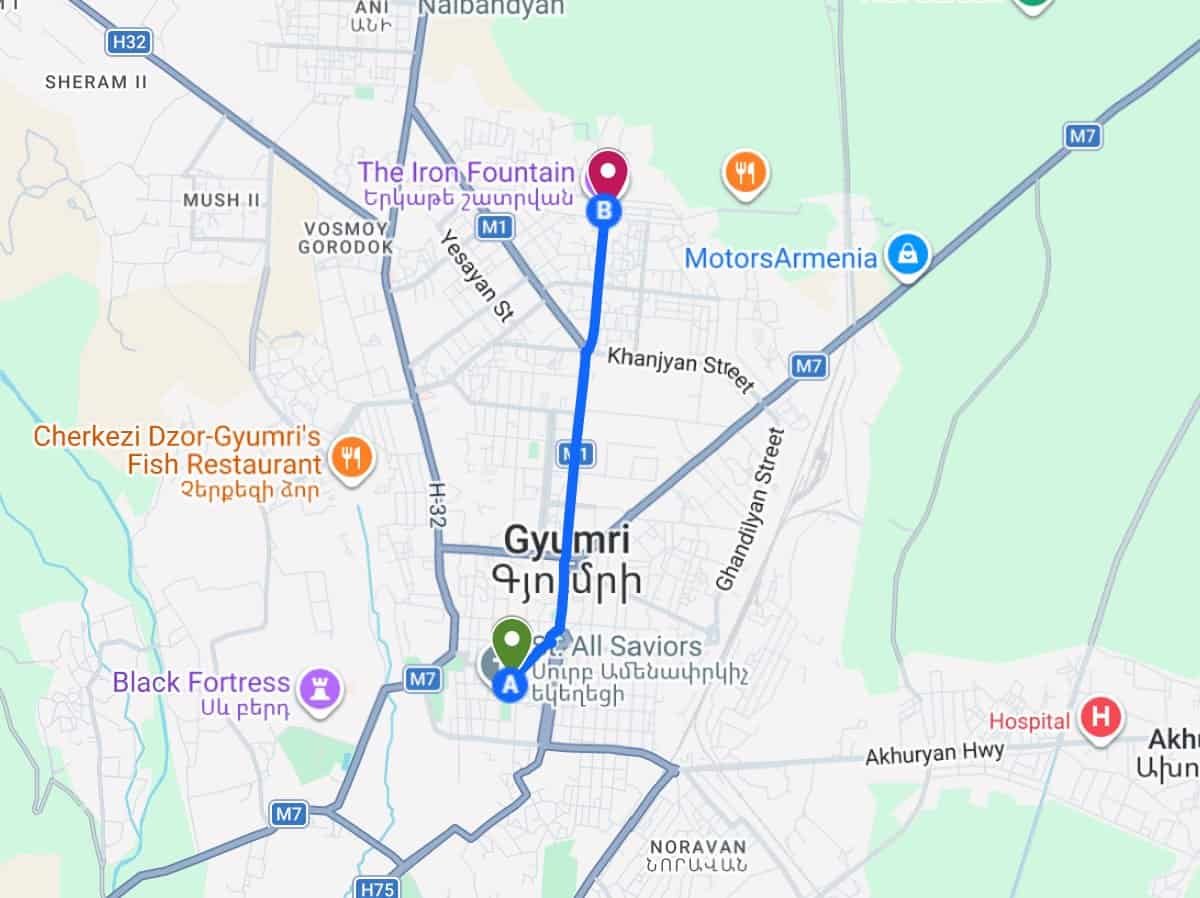
If you would like to visit too, it’s 4Km from the centre of Gyumri. To get there, head north from Independence Square, along Garegin Nzhdeh Avenue and then Manushyan Street.
If you don’t have a car and don’t want to walk, Yandex rides are readily available. Drivers take cash, so there’s no need to worry if you have trouble connecting an international credit card, as we did. Finding a second driver to pick us up and take us back to the centre proved to be no problem either.
You’ll also be added to an occasional newsletter. Unsubscribe as you like (Privacy Policy)
The Iron Fountain isn’t Armenia‘s grandest or most famous monument. Yet standing alone in an empty field, surrounded by the ghosts of a vanished campus, it became one of the places we talked about most after leaving Gyumri. Sometimes the quietest places leave the deepest impression.
Favourite Brands & Offers for One Small Bag Readers
- CABIN ZERO: 15% OFF travel bags & accessories. Use ONESMALLBAG at checkout.
- SAILY (NordVPN): 10% OFF international eSIMs Use ONESMALLBAG at checkout.
- PEBBLEBEE: Exclusive Savings on rechargeable trackers (Android & iOS). Discount automatically applied at checkout.
Where to Next
Once you’ve explored Yerevan, why not look further afield into the wider Caucasus? Here are some ideas.
- Things to do in Yerevan: Armenia’s modern capital and pink city
- Things to do in Gyumri: A guide to Armenia’s Black and Apricot City
- Things to Do in Tbilisi: A Guide to the Capital of Georgia
- Things to Do in Batumi: Georgia’s Unexpected Black Sea Gem
- Things to Do in Kutaisi: A Guide to Georgia’s Ancient City
- Visit The Incredible Cave City of Vardzia, Georgia
I hope you enjoyed reading this. If you have any questions or comments, do let me know in the comments. Thank you for reading my blog.
Unsubscribe whenever you like (Privacy Policy)