Things to Do in Tbilisi: A Guide to the Capital of Georgia

With its dramatic mountains, diverse history, and legacy as the birthplace of wine, Georgia is truly irresistible. Tucked between Europe and Asia, this culturally rich nation is famous for its warm hospitality and world-class cuisine. Where better to start any Georgian adventure than with its captivating capital, Tbilisi? A place where you could easily spend a week unwinding in historic sulphur baths, sampling local dishes, or simply wandering the streets. And when you’ve had your fill of the city highlights, why not stay longer and discover the many attractions of Georgia, beyond the city limits?
Here are my recommendations to help you navigate this unique city, whether you have as little as 24 hours or much longer.
This guide may include a few affiliate links. If you choose to buy something through one of them, I may earn a small commission (at no cost to you). Thank you for supporting One Small Bag and helping keep this resource ad-free and independent.
Tbilisi Essentials
- Luxury: Radisson Blu, Ivara (Republic Square) or Blue Fox Hotel (iconic hotel in the heart of Old Tbilisi)
- Midrange: Citadel Narikala Hotel (for city views) or Blue and White Hotel, built into the City Walls
- Budget: Fabrika Hostel and Suites (Creative Indie Quarter)
- Tbilisi: City Highlights Guided Walking Tour
- Tbilisi: Mtskheta Jvari Bazaar, Chronicles of Georgia & Wine
- Tbilisi: Borjomi, Rabati & Vardzia Adventure Guided Tour
- Discover Cars (Car Hire: Best Regional aggregator deals)
- Welcome Pickups (Hassle-Free Airport Transfers & Personal Drivers)
Map of Things to do in Tbilisi
Things to do in Old Tbilisi
Start just north of Old Tbilisi at Freedom Square (Liberty Square), walk south through Old Tbilisi’s most picturesque and iconic streets, onto Abanotubani for the traditional sulfur baths, and end with the views from Narikala Hill.
1. Start in Freedom Square
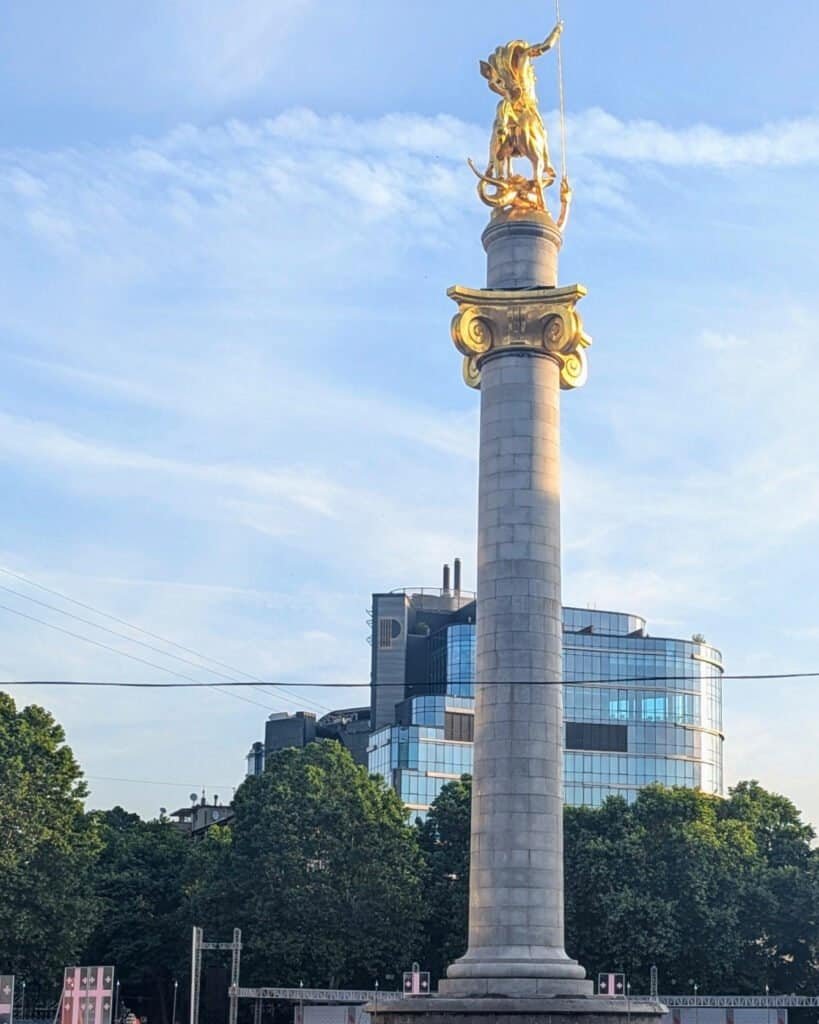
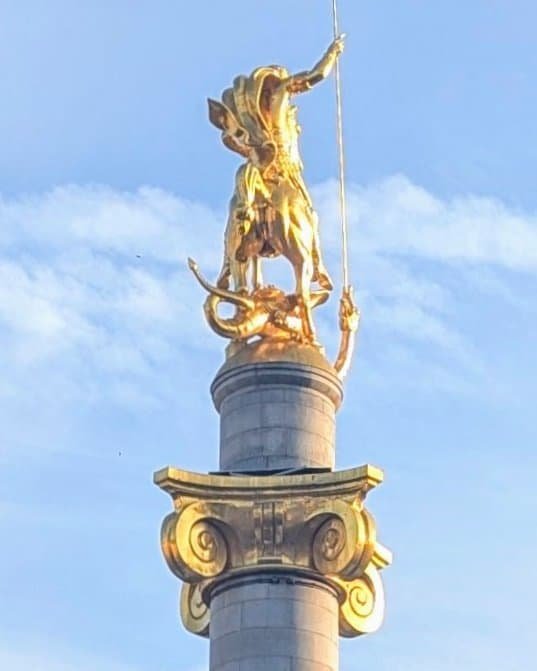
Located at the heart of the city, Freedom Square (Liberty Square) is hard to miss, with its towering column topped by a gleaming gold St George, slaying a dragon. Also known as Liberty Square, it’s the connection between the historic Old Town’s grandest street and the city’s more modern parts.
Normally bustling with activity, we found it eerily quiet, first thing in the morning on Georgian Independence Day, with Georgian security setting up and sweeping the area. That all changed later in the day, when the celebrations started.
2 Discover the old City Walls
As you head south, into Old Tbilisi, look out for the city walls. The most striking section (on Shota Nishnianidze) has curved blue-and-white wooden balconies, which were added to the ancient walls in the 19th Century. There’s a hotel built into the walls in one section, plus street art too.

3 Find the Puppets at the Clock Tower
Once past the walls, you’ll soon find the Clock Tower. Well-known for its whimsical, fairytale-like design and charming, animated puppet shows. The clock might look ancient, but it certainly isn’t; it was installed in 2010. With an intentional tilt to one side, it looks like it’s come straight out of a storybook. Look out for the beautifully decorated ceramic-tile mosaics on the side, designed and hand-painted by Gabriadze, the founder.
Atlas Obscura features the clock as one of the world’s most popular architectural clock monuments, which might explain why it was so busy around performance time. If you’re interested in more quirky clocks, here’s an article I wrote about another one on the list,

The Clock with puppet shows in Old Tbilisi 
The handmade mosaics on the side of the clock
4 Visit the Anchiskhati, the oldest church in Tbilisi
There are many churches in Tbilisi, and it’s going to take a long time to visit even a small fraction of them, so it’s worth being selective. I’d recommend visiting the Anchiskhati Basilica because it’s the oldest surviving church in Tbilisi and because you will be walking right past it. No photos allowed inside.

5 Explore Ioane Shavteli Street
Continuing on, Ioane Shavteli Street, enjoy a rich blend of old-world architecture, lively café culture and tourist shopping. As you leave this street, you can either head east away from Old Tbilisi, over the Bridge of Peace to Rike Park and the cable car or continue through Old Tbilisi.
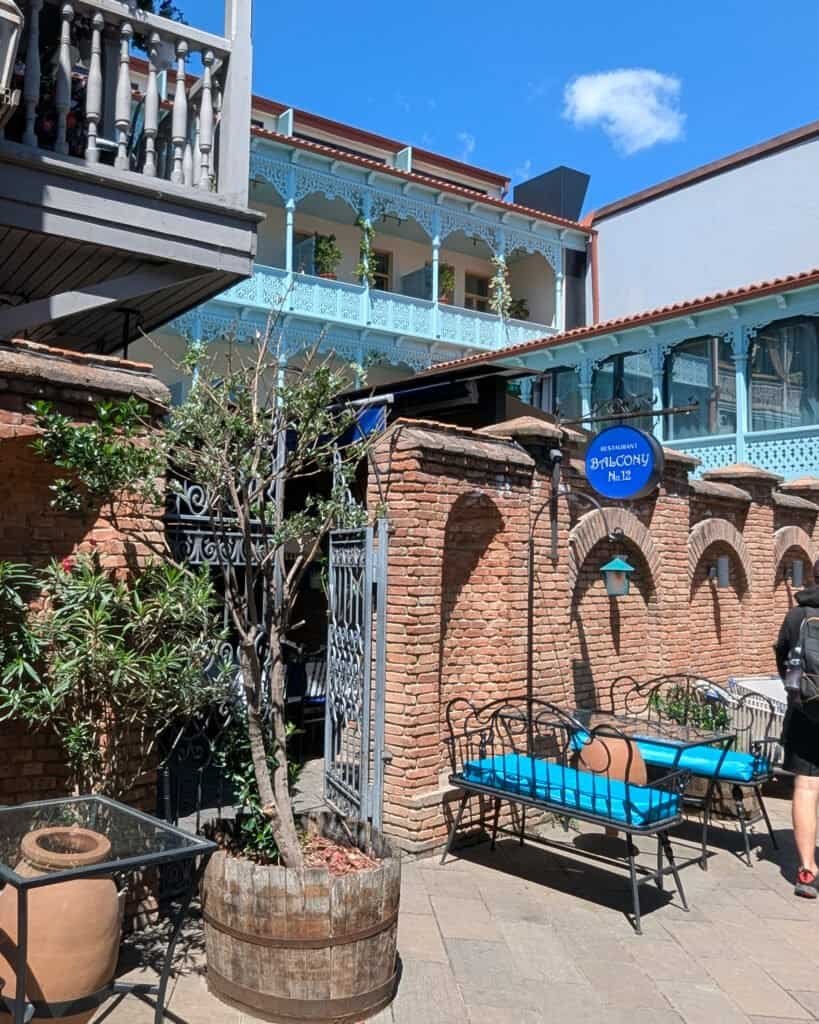

6 Have a drink on Erekle II Street
Ioane Shavteli Street blends seamlessly into Erekle II Street, a bustling commercial dining and drinking strip that gets busier later in the day. It had a touch of the ‘morning after the night before’ about it, when we wandered through, fairly early in the morning!
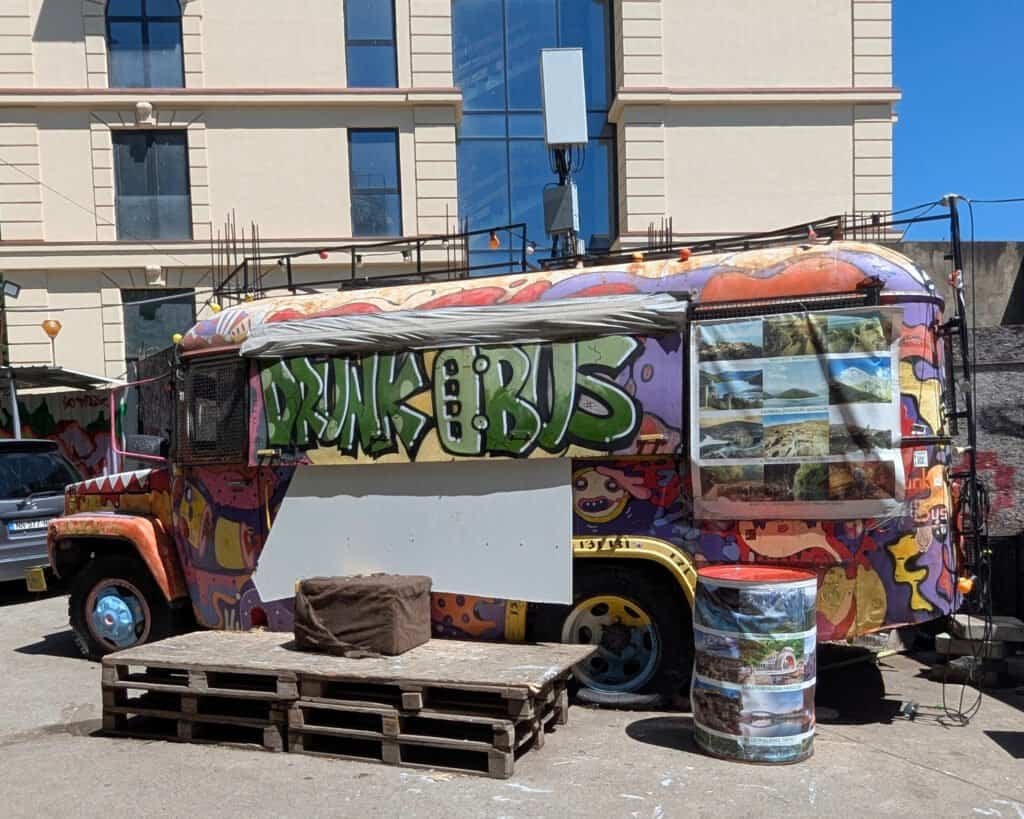
7 Learn about the Tolerance Quarter
If you continue, you’ll be struck by the contrasts within such a small space. The cafés and bars on Erekle II Street continue into the Tolerance Quarter. Here, the Georgian Orthodox Sion Cathedral, the Great Synagogue, the Armenian Cathedral of St. George’s and the Central Mosque (Juma) are all close by. The four faiths coexist within a few hundred metres of each other – and have done for centuries.
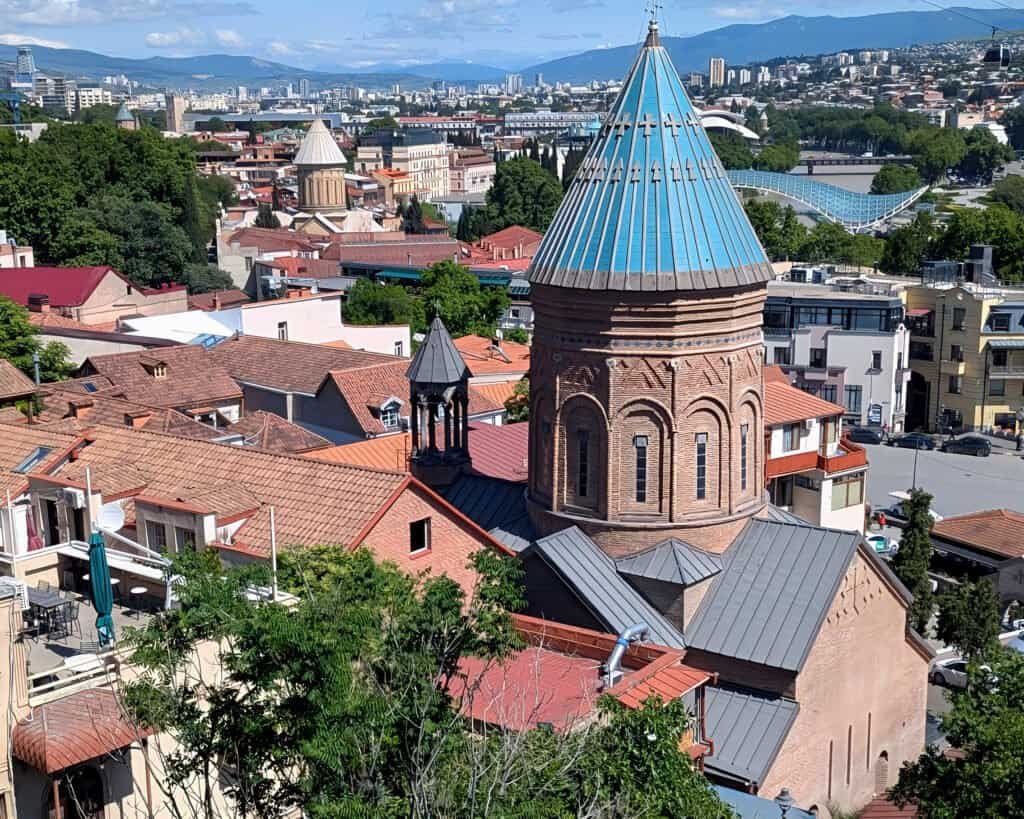
8 Go underground at Meidan
Continue to Vakhtang Gorgasali Square (also known as Meidan Square). Stroll through the snaking lanes that crisscross among traditional houses with wooden balconies and enjoy the streets lined with souvenir shops and local restaurants. It’s a perfect photo spot to capture the Old Town of Tbilisi, with Narikala fortress in the background.
Look out for a stairway down to the underground shopping area of Meidan Bazaar, a popular meeting point for traders on the Silk Road for centuries. Purchase Georgian wine, cheese, and other traditional souvenirs. Spot churchkhela, the popular Georgian candy made of nuts covered in fruit syrup, hanging in colourful, sausage-like strings.
There’s more underground at Meidan. We had our first introduction to the Georgian staple, Khinkali (dumplings), in the cellars of Khinkali Pub, on the square.

Vakhtang Gorgasali Square, with a view of Narikala Fortress and Sy George’s Cathedral 
Metekhi Bridge and the remains of the old city with the statue of King Vakhtang Gorgasali
9 Check Out Metekhi: The birthplace of the city
On the opposite bank of the river lies Metekhi, one of the oldest and most historic neighborhoods in Tbilisi and widely considered to be the birthplace of the city. Look out for King Vakhtang Gorgasali on horseback, on the Metekhi bridge.
And, if you’re wondering why the Mtkvari runs brown and looks so dirty, it’s carrying sediment down from the Caucasus mountains; it flows east into Azerbaijan and the Caspian Sea.

10 Soak in a Sulphur Bath in Abanotubani
At the foot of Narikala Hill lies Abanotubani, the district known for its natural hot springs, distinctive domed brick roofs, and therapeutic, mineral-rich waters. It’s also where you’ll find Bridge of Love, a picturesque footbridge spanning the Abanotubani gorge, and yes, you guessed it, it’s full of padlocks.
I’ll admit I was happy with the hotel bath, so I didn’t partake, but if you like spas and traditional treatments, a visit to a traditional bathhouse in Old Tbilisi is a must.
- Orbeliani Baths (Chreli Albano): The striking blue, Persian-style mosaic facade and arched entrance could be mistaken for a mosque. Book a private room to soak in the natural, warm sulfur waters and enjoy a traditional scrub and massage treatment (locally called a kisi)
- Gulo’s Thermal Spa
- Bathhouse No. 5
- Royal Bath
11 Take in the views from Narikala Hill
We stayed at the Citadel Narikala Hotel, a little way up Narikala hill, from Vakhtang Gorgasali Square, which I highly recommend. It was a great spot for views of the city. If you keep going up the hill, you’ll reach Narikala Fortress (currently closed). From there, you can walk along the ridge to the Mother of Georgia statue and the cable car.
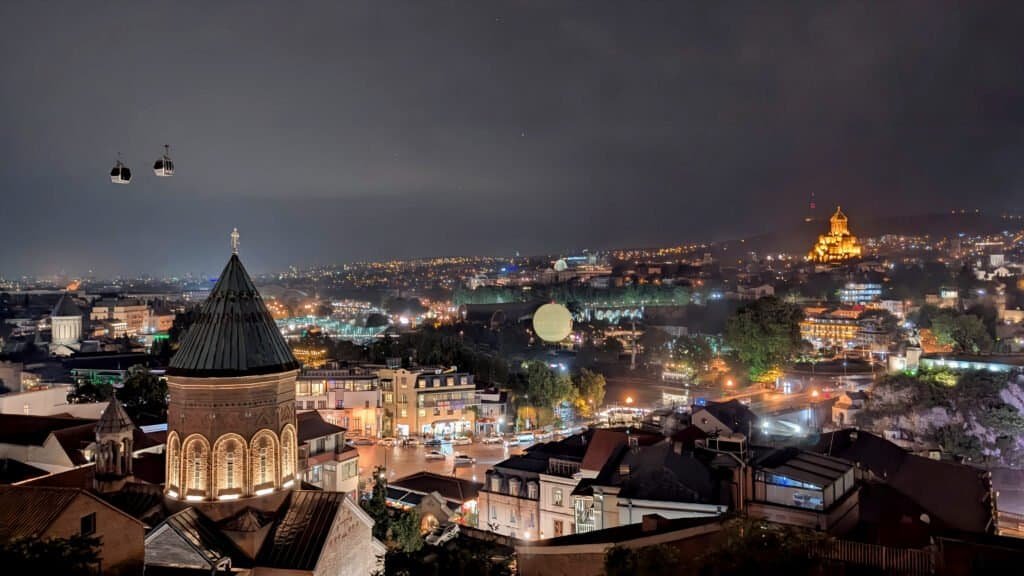
Things to do in Modern Tbilisi
While Old Tbilisi is relatively compact, the rest of the city sprawls for miles beyond this area. The population is 1.33 million, a third of the country’s total, so unless you are spending a long time in Tbilisi, it would be hard to cover the modern city comprehensively. I’ll start with some of the popular places to visit, and the ones we managed to visit ourselves. There’s much we ran out of time for.
Let’s start with the Bridge of Peace, which bridges Old Tbilisi with the newer parts of the city.
12 Cross the Bridge of Peace
This bow-shaped glass-and-steel pedestrian bridge stretches 150 meters across the Kura (Mtkvari) River, connecting the historic Old Town with the modern Rike Park. Designed by Italian architect Michele De Lucchi and French lighting designer Philippe Martineau, it opened in May 2010.
The bridge is high-tech, fitted with solar panels and over 10,000 LED lightbulbs. The displays utilise Morse code to broadcast the chemical elements of the human body (such as Calcium, Hydrogen, and Carbon). This is to make the point that all human beings are made of the same fundamental matter, regardless of nationality or faith. On a lighter note, the locals have nicknamed this bridge ‘Always Ultra!’.
Expect to find buskers, hawkers and peacocks on the bridge. The peacocks are there to extract money from tourists. This peacock kindly posed for me, without its owner spotting me.


Entrance to the Bridge of Peace 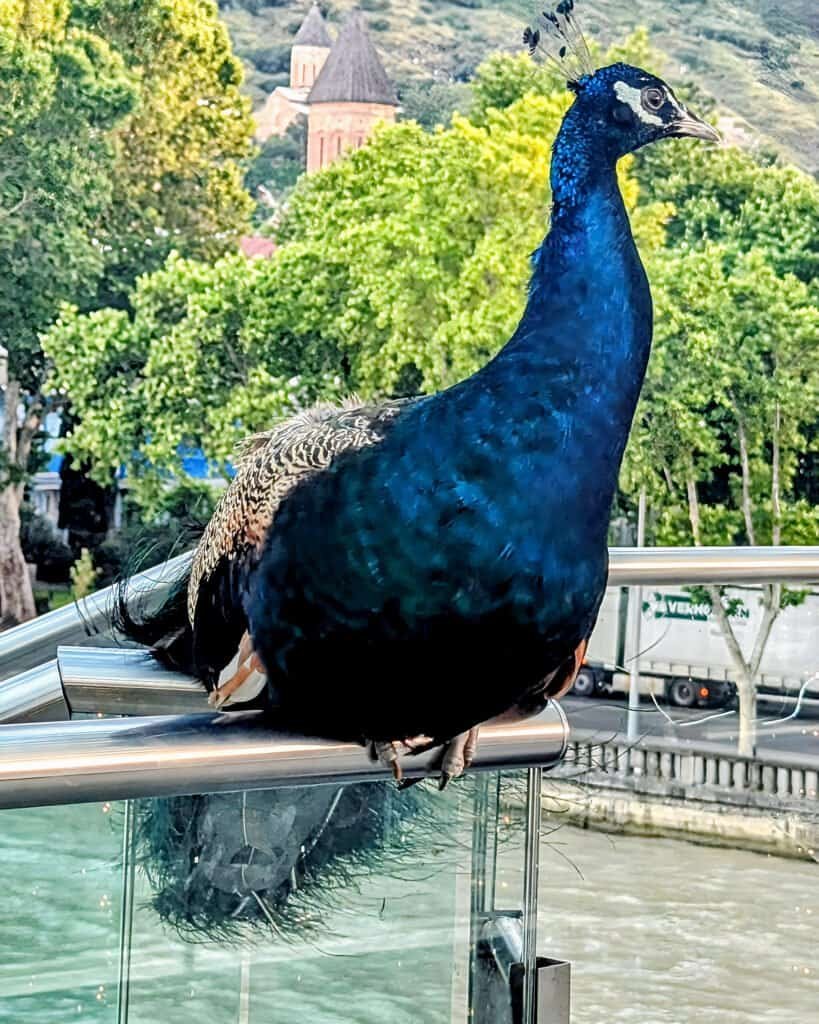
One of several peacocks on the bridge
13 Wander through Rike Park
The Bridge of Peace connects Old Tbilisi to Rike Park. Well cared for and with beautiful landscaping, plenty was going on. People of all ages are out and about. including groups of girls singing and practicing their dance routines. Cafés and ice cream stalls are dotted about, giving people reason to stay longer.
Look out for the futuristic Fuksas Tubes. Two large metallic tubular structures were intended as a concert hall, but were left unfinished as a statement piece of modern art. There’s also a massive piano and a chessboard. and a musical fountain with dancing lights. The huge white hot air balloon is hard to miss, and yes, you can ride in it over the city. The park is also an entertainment space, with an amphitheatre and the popular October Tbilisioba Festival is held here annually.
Rike Park is also home to the lower Aerial Tramway station, which will take you to the Mother of Georgia statue and the fortress. Our next stop.

14 Ride or hike to Mother of Georgia (Karlis Deda)
Perched atop Sololakis Hill, the Mother of Georgia (Kartlis Deda) overlooks the capital and is visible across Tbilisi. This 20-meter aluminium statue holds a bowl of wine symbolising hospitality, and a sword representing resistance to invaders. Originally crafted from wood in 1958, she later received a full-body aluminium makeover.
3 Ways to Mother of Georgia Statue
To beat the massive sunset crowds for the cable car, mix and match your routes. Here are your three best options:
- Option 1 (Best for Sunset): Walk up the Betlemi Street stairs from the Old Town (~20 minutes), catch the views, and take the cable car back down (ahead of the queues).
- Option 2 (The Ridge Walk): If you are already near Narikala Hill, take the steep walking path up past the Citadel Narikala Hotel to the fortress, then follow the flat, scenic ridge line straight to the statue (~20 minutes)
- Option 3 (The Easy Way): Take the Rike Park cable car straight up (expect queues from 4 PM onwards).
A driver may be able to take you to the Botanical Gardens or partway up Narikala Hill, but possibly not as close to the foot of the statue as the cable car does.
At the top cable car station, browse local stalls selling Georgian crafts, souvenirs, and snacks while taking in panoramic views of the city. Follow the scenic ridge path to walk between the statue and Narikala Fortress (currently closed). From the fortress, a path and steps lead to the National Botanical Garden, which is open daily (closes 6 pm) and also down Narikala Hill.

Mother of Georgia (Karlis Deda) at sunset 
Mother of Georgia (Karlis Deda) with sword and wine bowl
15 Visit Holy Trinity Cathedral (Sameba)
Dominating the skyline from Avlabari hill, the largest Georgian Orthodox cathedral is one of Tbilisi’s most recognisable landmarks, and its scale is staggering. This huge honey-toned church, topped with a gold dome, is new, not ancient. Built in the 1990s during a period of civil war, construction progressed erratically for over a decade, with intense debates over its lavish scale during an economic crisis.
Take time to wander the grounds to enjoy the views of Tbilisi from this elevated position, and look out for the monastery and the huge bell tower.
Inside Sameba, the scale hits you first. What surprised me was the restraint – whitewashed walls and relatively understated decoration create a very different atmosphere than you might expect from a cathedral of this ambition. If you’ve visited the great Orthodox cathedrals like Saint Sava in Belgrade or Alexander Nevsky in Sofia, you’ll notice the difference immediately. Those interiors dazzle with gold and heavily decorated iconostases. The ancient Georgian Orthodox tradition maintains its own distinct character, separate from the Russian-influenced Byzantine Revival style that shapes so many of its neighbours.
How to reach the Holy Trinity Cathedral on foot
Around 30 minutes from Old Tbilisi. Cross to the east side of the river. Cross the Nikoloz Baratashvili Bridge for the best views of the wavy Bridge of Peace to the south and the mushroom-layered roof of the Public Service Hall to your north.
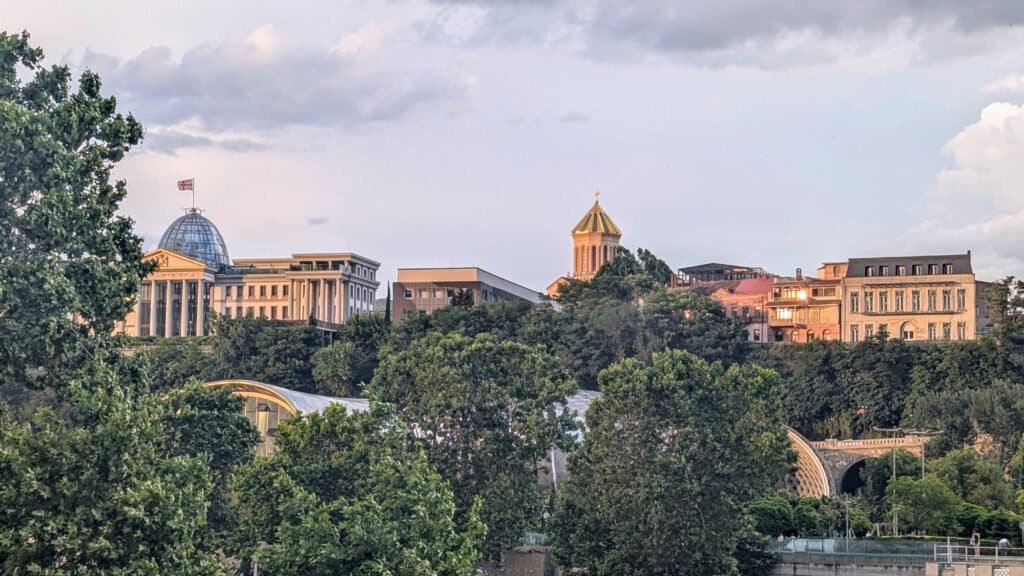
Then head past the Presidential Palace, a vast neoclassical building topped with a glass dome, to get to the Holy Trinity Cathedral.
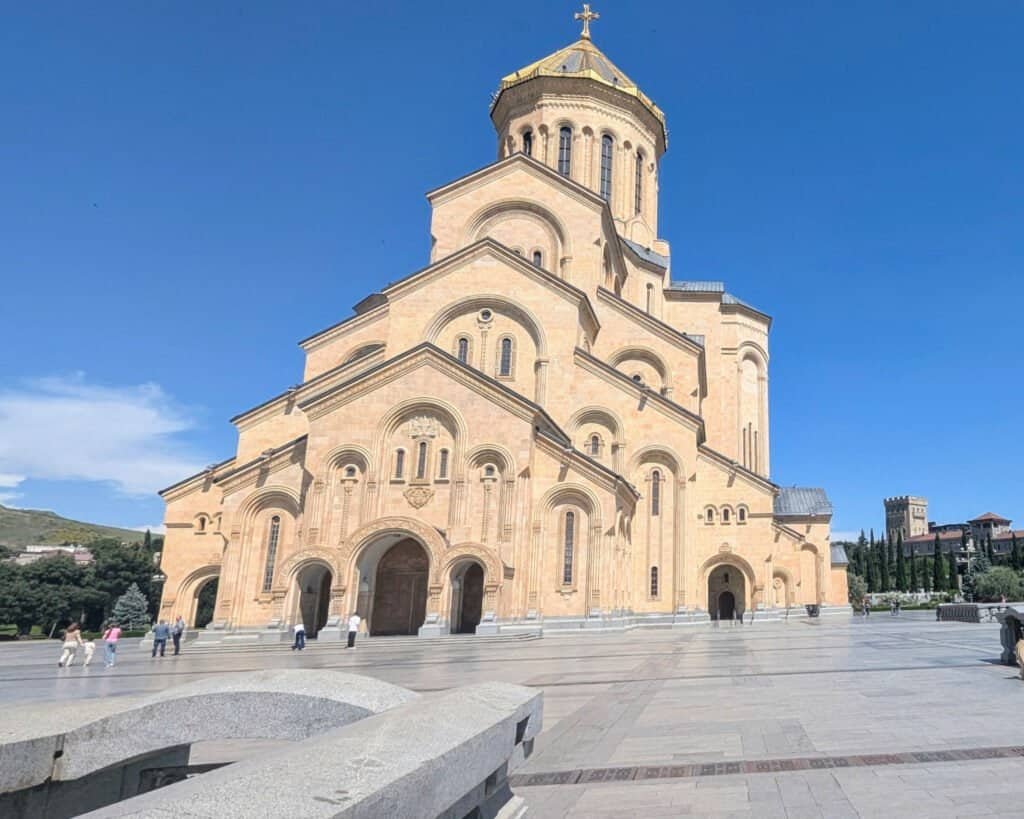

View of the bell tower and the city beyond from the steps of the cathedral 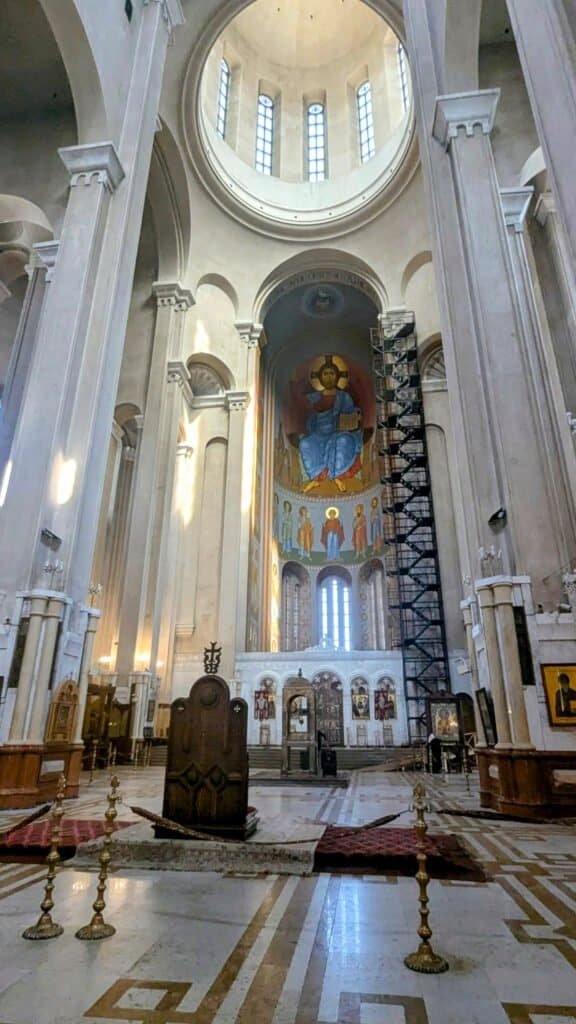
Inside Holy Trinity Cathedral, Tbilisi
16 Discover Dry Bridge, Market
This open-air bazaar is best known for its chaotic and eclectic mix of antiques, Soviet-era relics, and handmade Georgian crafts. Vendors lay their wares on blankets along the sidewalk and bridge and into the adjacent Dedaena and 9 March parks. Expect to find everything from century-old artifacts to retro trinkets. It’s a place for locals as much as tourists. And you won’t be wondering why the bridge is called Dry Bridge (Mshrali Khidi) for long. The Mtkvari River does not run under it; instead, it’s diverted to protect the city from flooding.
Honestly, we aren’t really shoppers, so while we found the displays interesting, we found the area around Dry Bridge more compelling. The adjacent Giorgi Leonidze Park is delightful, and the neighbourhood is well served with coffee shops and restaurants. Look out for Café Daphna, Plus One Restaurant, Wine Bridge Cocktail bar, and Coffee 22—a less touristy and more authentic side of Tbilisi than Davit Agmashenebeli Avenue or Old Tbilisi.

17 Walk down Rustaveli Avenue
Rustaveli Avenue is named after the medieval Georgian poet, Shota Rustaveli. We walked its length from Freedom Square for 1.5 Km up to Rustaveli Metro station. A tree-lined boulevard, known for its grand European architecture, bustling cafés, and significant landmarks, including the National Opera House, theatre, and the Parliament of Georgia.
I loved the small bronze statues of old Georgian characters that line both sides of the avenue for much of its length, as well as the Giant Bike Monument, which reminds Tbilisi residents of the importance of a healthy lifestyle. With two sets of handlebars, though, it’s also a reminder that sometimes in life, we can be pedalling hard, but not actually getting anywhere!

One of the statues by Levan Bujiashvili is dotted along the avenue 
Kashveti Church of St. George, opposite the Parliament of Georgia
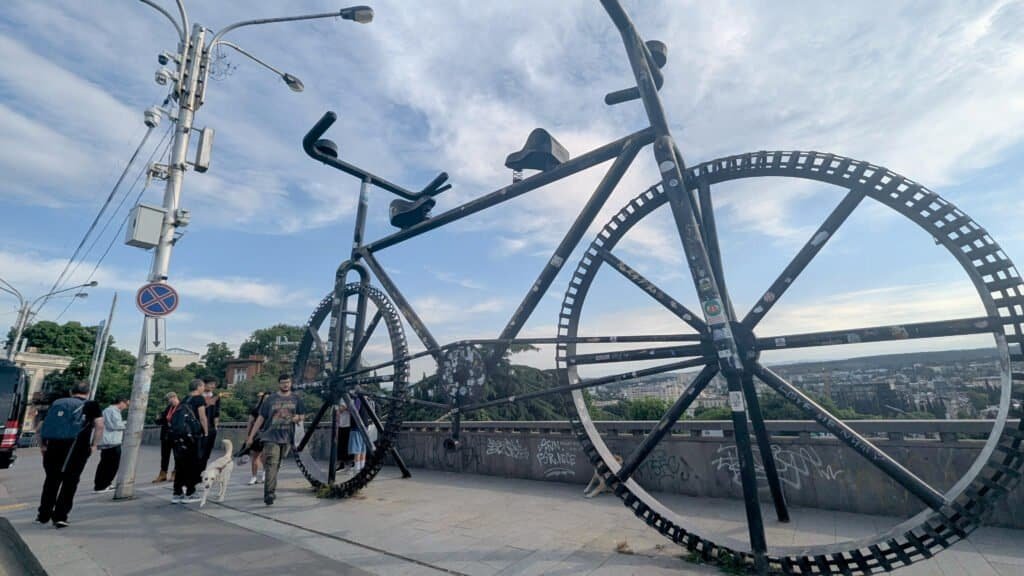
Once you’ve passed the Giant Bike monument and reached the end of Rustaveli Avenue at Rustaveli Metro, you’ll be in the right place to find the cable car to take you to Mtatsminda Park or head into Chugureti District.
18 Ride the Cable Car to Mtatsminda Park
With two cable cars in Tbilisi, there’s a choice. Take the relatively new one up to the Mother of Georgia, or try the more historic one that connects the city centre with Mtatsminda Park, or you could do both. We only had time for one cable car, so we skipped Mtatsminda Park, but it looks like a great thing to do in Tbilisi, if you have time. The lower cable car station is close to the Rustaveli Metro station, making it an obvious place to go after walking along Rustaveli Avenue.
At the top, expect to find an amusement park complete with a giant Ferris wheel. There’s the Funicular Restaurant, which is famous for serving the best ponchiki (traditional cream-filled donuts) in the city. Beyond the amusement park, Turtle Lake is a popular summer spot and just below it sits the Open Air Museum of Ethnography, featuring traditional wooden houses and watchtowers transported from every region of Georgia.
19 Be Creative in Chugureti District
If you are at the Rustaveli metro station, cross over the river onto the Eastern side to explore the Chugureti district. This city neighbourhood might not contain the major landmarks and ‘must-sees’ of Old Tbilisi, but if you have time in your schedule, I’d recommend it.
Davit Aghmashenebeli Avenue is the district’s grand thoroughfare, featuring beautifully restored 19th-century classic European facades and a highly popular, vibrant pedestrian zone packed with open-air cafés. It’s a very different feel to Old Tbilisi. On the surface, the traditional Georgian styling is gone, although if you look, you will find backstreets and passages with the traditional wooden balconies and communal courtyards. Davit Aghmashenebeli Avenue may not be unique; it feels like being in any number of Eastern European cities, but it would be easy to while away a few hours here very enjoyably.
Head to Fabrika, the centre of Tbilisi’s indie youth culture. It’s a massive, multifunctional creative zone built inside an abandoned Soviet sewing factory and is a popular part of the city to stay in.
We passed through Dezerter Bazaar (Dezerterebi) on our way to the Tbilisi railway station for our train to Batumi. A huge sprawling, chaotic, open-air marketplace, and one in which I managed to lose my phone! The memory of hastily trying to retrace my steps through endless stalls and second-hand phone shops is still raw, but the kindness of strangers led to my phone being found. In a world full of stories of bad people and bad news, the generosity of so many across the world is truly humbling. My phone now lives on a lanyard. If you are scatty like me, just buy one!
20 Visit the Chronicles of Georgia
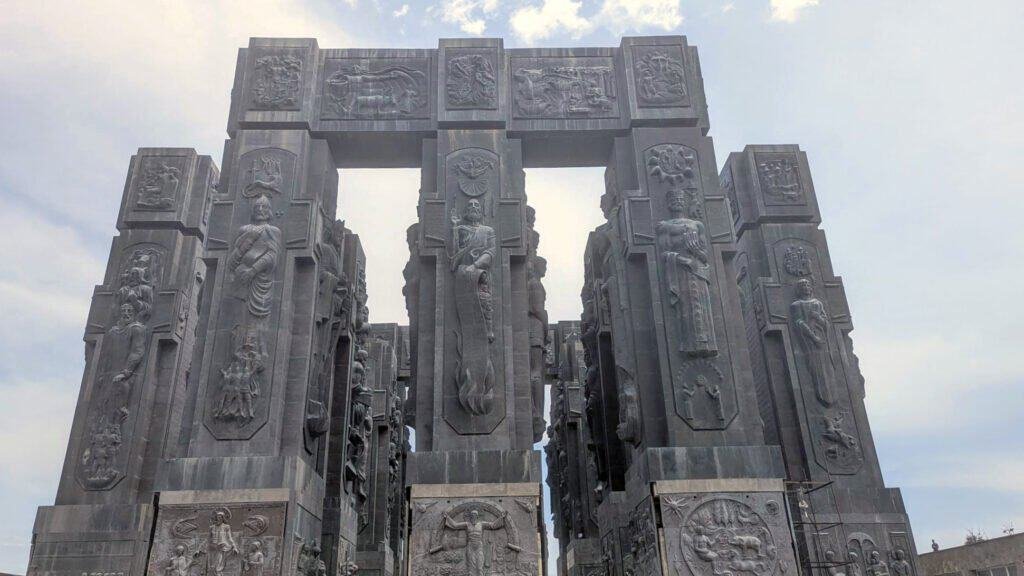
Sometimes called Georgia’s Stonehenge, these towering pillars, arranged at the top of the hillside on the edge of Tbilisi, are a highlight of any trip to Georgia. While you can visit the Chronicles of Georgia by public transport or taxi from central Tbilisi, I’d recommend combining a tour with a trip to the ancient city of Mtskheta, the Jvari Bazaar, and Georgian wine tasting. With a late flight leaving Tbilisi, this half-day trip worked well for us on our last day.
21 Take a Day Trip
With plenty of great day-trip options close to the city, allow plenty of time for your stay in Tbilisi. I’ve written them separately:
My personal favourite is a trip to the astonishing cave city of Vardzia. It’s one of the longer day trips, stopping in the spa town of Borjomi and Rabati Castle, and it’s totally worth it. I’d also recommend a day trip to Armenia if you don’t have time for a longer trip in the region. And of course, if you like wine, you will definitely want a trip to visit the wineries of Kakheti.
How Long Should I spend in Tbilisi?
Can you “do” Tbilisi in a day? No, not really. I’d recommend at least two nights in the city itself, and longer if you want to use Tbilisi as a base for day trips. Here’s my suggestion as to how to use your time.
Tbilisi in One Day: Suggested Itinerary
- Take a city tour so you can efficiently pass through some of the main sites in about 4 hours with someone who knows the city.
- Eat a traditional Georgian meal. Zodiaqo, just off Rustaveli Avenue, was the best place we ate in Tbilisi, if this isn’t too much out of your way.
- Head for a View for sunset. You may have time for one of the following:
- Chronicles of Georgia (by taxi)
- Holy Trinity Cathedral
- Narikala Hill
- Rooftop bar in the Old Town in Ioane Shavteli Street or Erekle II Street
Tbilisi in Two Days: Suggested Itinerary
- Day 1 – Visit Old Tbilisi, eat your first Georgian meal, and visit Holy Trinity Cathedral.
- Day 2 – Half-day tour to Mtskheta and the Chronicles of Georgia. Explore Rike Park and the Bridge of Peace, and visit the Mother of Georgia
Tbilisi in Three Days or More: Suggested Itinerary
- Day 1 – Visit Old Tbilisi, eat your first Georgian meal, and visit Holy Trinity Cathedral.
- Day 2 – Half-day tour to Mtskheta and the Chronicles of Georgia. Visit Rike Park, the Bridge of Peace, and the Mother of Georgia
- Day 3 or more – Explore more of Tbilisi, including Rustaveli Avenue, Dry Bridge Market, Mtatsminda Park, and Chugureti, and add some day trips.
Visiting Tbilisi: Practical Information
Where to stay in Tbilisi
We chose to stay at Citadel Narikala Hotel, which deserved its reputation for great rooms with fabulous views over the city and an excellent breakfast. Well located in Old Tbilisi, just a few minutes from the Sulphur baths and Meidan, but its location a few minutes up the hill meant it was peaceful too. The hill was steep, though, so I was glad I packed light with my one small bag and didn’t have to drag a suitcase up the last few metres from the taxi drop-off.
If you’d like to stay in some iconic Tbilisi buildings, tucked in and just within the old city walls, then the Blue Fox Hotel and the Blue and White Hotel would be obvious choices. For a budget stay, the Fabrika Hostel and Suites is a popular choice in the heart of Fabrika, Tbilisi’s indie quarter.
Here’s some more live booking information and recommendations below:
How to get to Tbilisi
We arrived in Tbilisi on the UK budget airline EasyJet, direct from London Luton. We also travelled on the Tbilisi-Batumi train, connecting the capital with the Black Sea Coast resort, which took around 5 hours and took the Tbilisi-Kutaisi coach to reach the old capital of Georgia. Here are some other options for reaching Tbilisi, depending on your starting point:
How to get around Tbilisi
There’s a metro and bus service, as well as the cable cars to Mother of Georgia and Mtatsminda Park. You can swipe your card / mobile wallet for metro and bus services, although if you are planning more than a handful of journeys, it pays to get a 2GEL metrocard available from metro stations. Your tickets will be a little cheaper if you use this instead, and you can get a refund of the MetroCard if you hand it in at the end of your trip (within 30 days).
Bolt and Yandex Go are also operational. With Yandex Go, you can order a car and pay in cash, just as you would with a traditional taxi. If you are not of a nervous disposition, you can also hire a car.
Where to next
If you’ve found this guide to Tbilisi useful, you can be the first to receive it as part of my mailing list. In the meantime, here are links to help you plan your stay.
Exploring more of Georgia? Here’s some more you might be interested in:
- Best Day Trips from Tbilisi, Georgia: Monasteries, Mountains and More
- Things to Do in Batumi: Georgia’s Unexpected Black Sea Gem
- Things to do in Kutaisi: A Guide to Georgia’s Ancient City
- Visit The Incredible Cave City of Vardzia, Georgia
- Rabati Castle, Akhaltsikhe: A Guide to Georgia’s Most Controversial Fortress
- Visit the Chronicles of Georgia in Tbilisi (And Why It Beats Stonehenge)
- Georgia: Travel Information
Thank you for reading my guide on Tbilisi.