Visit Sinaia: Home to Peleș, Romania’s Most Spectacular Royal Castle
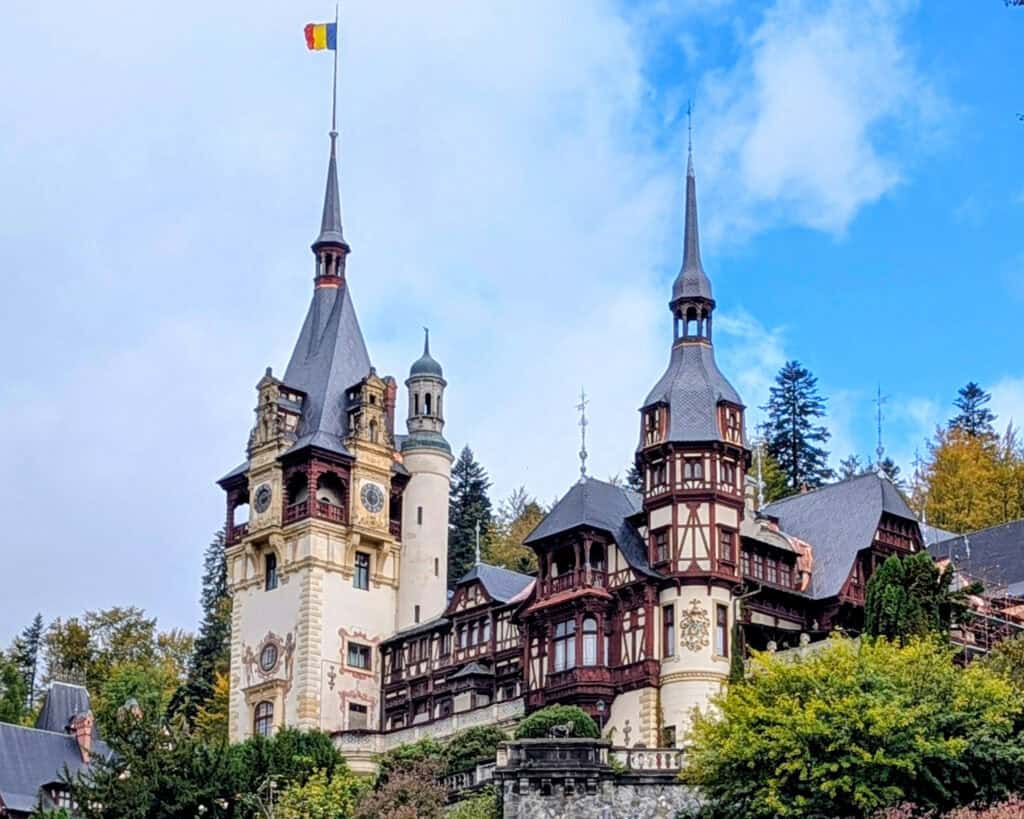
Tucked into the forested slopes of the Carpathian Mountains in the small resort town of Sinaia, sits Peles Castle, which is, by almost any measure, the most beautiful castle in Romania. But, there’s more to Sinaia than the castles; it’s a mountain resort town filled with grand villas, beautiful parks and a show-stopping monastery. So do stay longer, if you can, to explore beyond Peles and the accompanying smaller Pelisor Castle. Take time to try some traditional Transylvanian food or stay a night, to enjoy the place once the day trippers have gone.
This guide covers everything you need to visit Sinaia and Peleş independently from either Brasov or Bucharest, or as part of a wider Transylvanian itinerary. I’ve also covered ticketing options and day tours for both Peles and the accompanying Pelisor Castle, along with all the other things to see and do in this regal mountain resort town. Here’s how to make the most of a visit.
This guide may include a few affiliate links. If you choose to buy something through one of them, I may earn a small commission (at no cost to you). Thank you for supporting One Small Bag and helping keep this resource ad-free and independent.
Why Visit Sinaia
Sinaia sits in the Bucegi Mountains, about 120 kilometres north of Bucharest. Developed as a royal retreat in the late 19th century, the history is visible at every turn. King Carol, I built Peleş Castle here between 1873 and 1914, and the town that grew around it has never quite lost its elegant, slightly rarefied feel.
The castle is the obvious draw, but Sinaia has more to offer. There’s the smaller Pelisor castle, a 17th-century monastery, a gondola up into the mountains, grand architecture, pleasant parks, and a genteel town centre. While Sinaia works as a day trip, if you have time, an overnight stay would be a very worthwhile option.
Map of Things to Do in Sinaia
I’ve added a map of the main things to do in Sinaia for you to keep and share (for personal use). It includes the walking route to the castle from Sinaia rail station, the main arrival point, if you are visiting from Brasov or Bucharest.
Visit Peleş Castle

Commissioned by King Carol I of Romania and built between 1873 and 1914, Peleş Castle is a striking example of Neo-Renaissance architecture. This style sits somewhere between a Bavarian fairy-tale castle and an Austro-Hungarian palace. The King had grown up in Germany and brought his tastes with him; the result is a building that feels almost theatrical in its ornamentation, and yet entirely at home in its mountain setting.
Used as a royal residence until 1947, when the communist government came to power and forced King Michael I into exile, the castle was closed to the public for decades. It reopened as a museum in 1975. Today, it is one of the most visited sites in Romania, and rightly so.
The interior is extraordinary – over 160 rooms, filled with weaponry, paintings, carved wood, stained glass, tapestries, and furniture from across Europe. It feels less like a museum than a place preserved exactly as it was.
Arriving at Sinaia Train Station
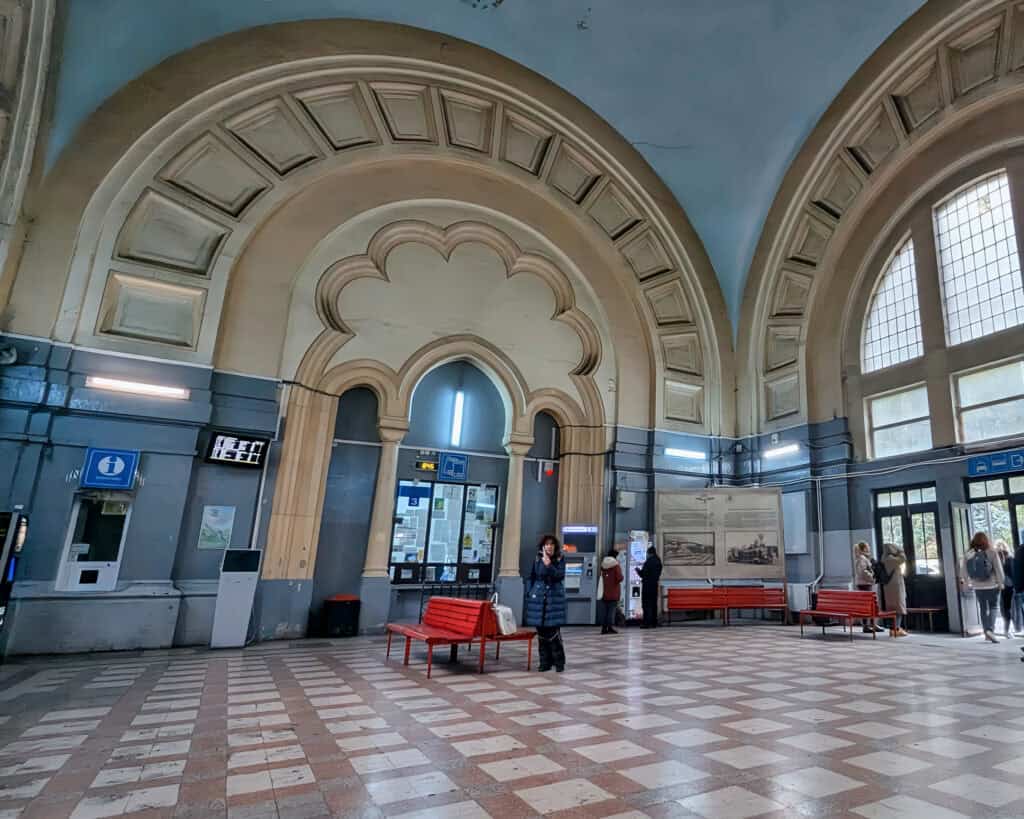
As you step off the train at Sinaia train station, you will instantly feel you’ve arrived somewhere special. Built for royalty in 1879, it’s an elegant structure, totally in keeping with the setting. With mountains rising behind it and clean, fresh mountain air, it sets the tone perfectly for what follows.
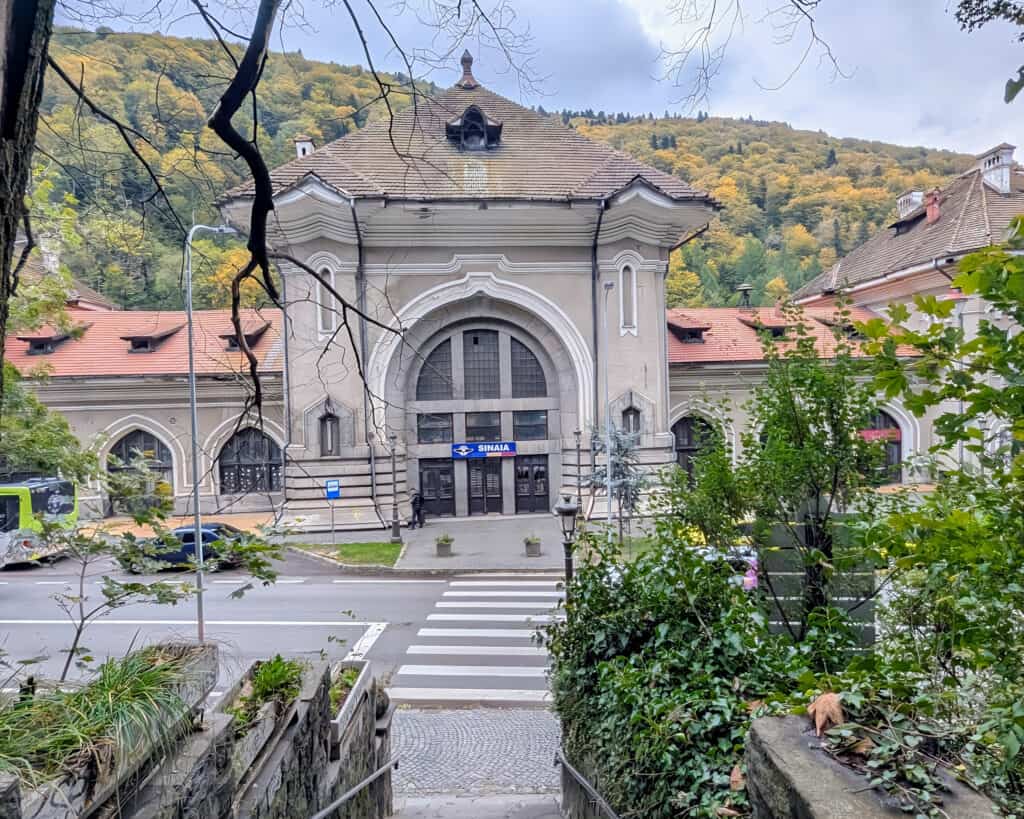
For us, the sunshine was welcome after a series of rainy days exploring Transylvania. And while Transylvania in the rain had a certain brooding atmosphere, the sun picked the right day to make an appearance. The blue sky was a perfect backdrop for Peles, even if it did vanish as soon as we left the castle.
From Sinaia Rail Station to Peleş
From the station, Peleş Castle is about a 30-minute walk uphill through the town. I’ve marked the route on my map.
Head up the main boulevard (Bulevardul Carol I) through the town centre, then follow the signs uphill into the wooded park. Signposts lead the way, so you are unlikely to get lost. It is uphill, but honestly, this is less of a hardship than it sounds, because you’ll want to stop every few minutes to take in the views and the elegance all around you.
By taxi or Uber: If you don’t want to walk, taxis are usually available outside the station. Make sure to use a metered cab or agree on a price before you set off. Alternatively, Uber operates in Sinaia, but it might be worth booking in advance during busy times.
By bus: The T1, T3, and T4 buses depart from the road outside the station (the bus stop marked on the map) and provide regular service, dropping you near the entrance to the Peles estate. From there, it’s a 15-minute walk up through the grounds to the castle itself.
I’ve linked day tours from Bucharest and Braşov, which include transport to the door. A great option, if you want to pack more castles into your day, including Bran (Dracula-themed castle) and even Cantacuzino Castle (Netflix Wednesday Castle)

Walk Through the Grounds to Peles
The walk from the entrance of the estate up to the castle takes about 10 minutes uphill along a wooded path. Suddenly, Peles appears through the trees. I’ve marked the viewpoint on the map for your first picture of Peles Castle from a distance. Be sure to stop here.

The Formal Gardens of Peleş Castle
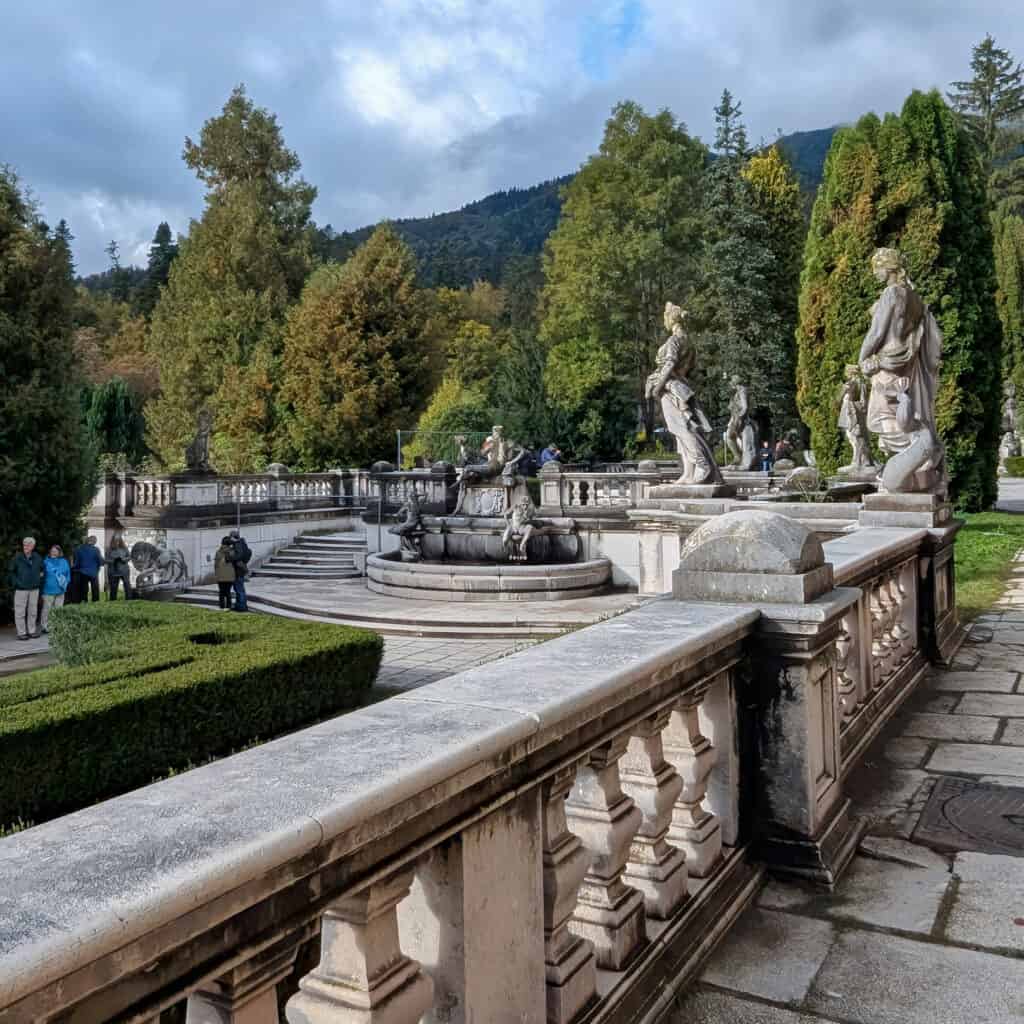
As you approach the castle, the grounds become more formal. They are a riot of statues, steps, fountains and different levels. A little over the top, for sure, but that’s what you’ve come for. Allow plenty of time before and/or after your visit inside to explore and take photos.

You’ll find planned gardens, gorgeous fountains, sweeping stairways, carved statues, and picture-perfect views of the royal residence. And all set within a spectacular forested mountain setting. There are so many angles to take pictures from.
Beyond the formal gardens, there are paths to Pelisor Castle, the smaller and still impossibly cute neighbour; paths through the forest; carparks; estate buildings; and several restaurants and hotels.

Tickets for Peleş Castle
If you are travelling independently, you’ll need to book tickets to Peles from the Peles Castle official website. Ticket prices are 100 RON (20 EUR) for adults (March 2026), with various concessions available. There are also ticket machines in the grounds, which dispense tickets for inside (if there is still availability).
Visitors purchase tickets for a timed-entry slot. These are generally non-changeable and non-refundable. The ticket price includes the services of a guide, though you can also go round the interior without one if you prefer. The guides are knowledgeable and happy to answer questions. Tours are available in multiple languages.
We visited out of the main season in October. The castle was very busy, so prepare for a very crowded experience at peak times. There was a queue to enter (een with a timed ticket), so I would get there in plenty of time.
While photography is permitted inside, any photos and videos must not be reproduced on social media or in any other publication, for any purpose other than personal use. For that reason, I have not published my own photos of the inside of the castle. More details on Pele’s official website.
There are more important practicalities worth knowing before your visit. I have an FAQ Section.
Peleş Castle: Ground floor & first floor
I guess King Carol must have been super keen to impress his guests. The entrance definitely makes a statement. You’ll walk up to the grand main hall (Hall of Honour), via an ornate staircase, laid with bright crimson carpet. The Hall of Honour is a soaring 16-metre space. Look around and up, beyond the huge grand archways and intricate walnut carvings. There are paintings, statues, chandeliers and more in this full-on maximalist interior. Spot the statue of King Carol himself welcoming guests to his residence. As you look up and beyond the ornate balconies, you’ll notice a beautifully decorated glass ceiling. This glass rooftop retracts. What a perfect way for the King’s guests to view the moon and stars on warmer evenings?
Beyond the Hall of Honour, the tour takes you through around 35 rooms, many of them themed, across the ground and first floors.
Here are some more rooms to look out for:
- Florentine Room: Italian Renaissance-inspired, with its mustard colour, ornate bronze doorways and a grand marble fireplace. Looking up, you can see a gilded linden-wood ceiling and Murano glass chandeliers.
- Music Room: Carved teak furniture, a gift to King Carol I from the Maharaja of Kapurthala in India. The centrepiece is a beautifully crafted harp.
- Moorish Hall: Inspired by the Alhambra;
- Turkish parlour: An ornate smoking lounge for gentlemen
- Royal Dining Room: Luxurious, for state dinners. To talk about history and art (not politics!)
- Small theatre: With early murals by Gustav Klimt.
The first floor is more intimate and includes the Imperial Apartment, prepared for an Imperial visit that never happened, and the Queen’s private rooms.

And I’m sure you know the drill: you leave through the gift shop, which is well-stocked with souvenirs covering all the usual bases. There’s also a chance to see the interior courtyard, another highlight.
Peleş Castle: Floors 2 & 3
These floors are currently closed for renovation (March 2026). There is no confirmed reopening date at the time of writing; check the official website before you visit.
When accessible, the upper floors contain the castle’s ceramics collection, over 5,000 pieces of European porcelain and tiles assembled largely by Queen Marie, as well as further guest apartments. There’s also a Royal Library with a collection of rare books and manuscripts, decorated in gold and stored in gold-gilded bookcases. There’s a secret doorway so the King could come and go in private.

Peleş – Frequently Asked Questions
Is Peleș Castle open every day?
No. Peleș is closed on Mondays and Tuesdays. While access to the grounds is from 09:15- 17:00 (with a later start on Wednesday), the last entrance to the inside of the castle is 16:00, with guided tours winding down earlier than that. Hours may vary seasonally, plus there are additional closures on certain public holidays. Always check the official website before you travel.
Do I need to book tickets in advance?
Highly recommended, especially in peak season (July and August) and on busy weekends. Places are capped for each time slot and can fill up. Queues for the interior tour can be long.
Can I take photos inside Peleș Castle?
Photography is permitted but without a flash. There is a fee for professional photographers. Any photos or videos taken (even if you pay the professional photographer’s fee) are for personal use. Any photos you take are for personal use only, and you are not permitted to publish them on social media, even on personal accounts.
Are the grounds free to visit?
Yes – the grounds around Peleș are free to enter. The ticket is required only for the castle interior.
Can I visit floors 2 & 3 of Peles?
Not currently. The upper floors are closed for renovation with no confirmed reopening date at the time of writing. The available ticket covers the ground and first floors. Check the official website for the latest situation before you visit.
Visit Pelişor Castle

Pelişor means ‘little Peleş’ in Romanian, and the castle sits just a short walk from its more famous neighbour in the same wooded estate. Built between 1899 and 1903 as a residence for Crown Prince Ferdinand and his wife, Princess Marie, as their home. Where Peleş is grand, Pelişor is lighter and more intimate, but both have similar external styling.
Queen Marie was a woman of considerable taste and independence, and she stamped her personality on the interior. The Art Nouveau style is visible throughout, with golden rooms, flowing organic forms, and decorative ironwork. It’s more personal with smaller, cozier rooms, compared to Peles.
The two castles together make for a natural pairing, and visiting both on the same day is perfectly manageable. I’d suggest starting with Peleş and walking across to Pelişor afterwards.
Tickets for Pelişor Castle
Purchase tickets from the Peles official website. Tickets are 30 RON and are for 3 time slots: 9:15 – 12:00, 12:00 – 2:00 and 14:00- 16:15. Like Peles, Pelisor is closed on Monday and Tuesday. Pelişor Castle tends to be less crowded than its larger neighbour.

Like Peleş, while photography is permitted inside, any photos and videos must not be reproduced on social media or any other publications, not exclusively for personal use. For that reason, I have not published my own photos here. More details on Pele’s official website.
The Peles – FAQ section also applies to Pelisor.
Tour of the Inside of Pelişor Castle
The visitor enters a home filled with early 20th-century Viennese furniture and refined stained glass. Queen Marie’s private rooms are the highlight: richly decorated in gold leaf, with Byzantine and Art Nouveau influences woven together in a way that feels genuinely original. These are the highlights. The golden room, in particular, is extraordinary.
- The Gold Room (Camera de Aur): As the name suggests, the walls are gold. The furniture, designed by Marie herself, is decorated with stylized lilies and Celtic crosses. There’s also a heart-shaped cask that is a commemoration of the Queen’s heart after she died in the room!
- Queen Marie’s Bedroom: Decorated with lilies and featuring furniture made of lime wood.
- King Ferdinand’s Office: A room dominated by German Neo-Renaissance style, featuring dark walnut furniture carved with symbols of the royal castles (Peleș, Pelișor, and Foișor).
Allow around 45 minutes for the tour, plus time to explore the exterior and the surrounding gardens.
Food, Drink and Hotel Options at Peles

There’s a cafe at the castle itself, but there are more options on the Peles estates, and some high-quality ones too. At first sight, the restaurants seemed very touristy, but we wandered into Carol Gastro Bierhaus. It’s located in one of the beautiful, traditional estate buildings. And there I ate possibly the best apple strudel of my life (sorry, Germany). So I would definitely recommend it. There were a few places to eat and drink, too. So well worth extending your day at the castle, with a stop for a drink or a bite to eat on the estate.

Carol Gastro Bierhaus Carol Gastro Bierhaus – Apfelstrudel


If you’d prefer to eat in the centre of Sinaia, I have a recommendation here too.
It’s possible to stay overnight on the grounds, allowing you to enjoy the surroundings once the day trippers have gone home and be ready, in situ, for the first morning timed ticket slots, where the palaces may be less crowded.
Some of the hotels are grand and set up within existing royal buildings on the estate. This includes Complex La Tunuri – Vila Economat, a luxury hotel.

Explore Sinaia
The castles and the monastery are Sinaia’s main draws, but the town itself is worth a wander. At its heart, it’s a 19th-century resort, and the broad, tree-lined boulevard, the elegant villas, and the unhurried pace give it a very distinct character, quite different from other towns and cities in the Carpathians, like Brasov.
These are some of the main things to do in Sinaia, beyond visiting Peles Castle. The locations are on my map of things to do in Sinaia.
Visit Sinaia Monastery
Sinaia takes its name from the monastery founded here in 1695 by Prince Cantacuzino. He named it after Mount Sinai in Egypt. Today, Sinaia Monastery is one of the most important religious sites in Wallachia, the region in Romania including Bucharest. Sinaia is on the northern fringe of Wallachia, with Transylvania to the north.
The monastery is a short walk from the centre of Sinaia and can easily be combined with a visit to the castles on the same day. It’s active and open to visitors. Entry to the grounds is free.

The larger new church is the first church you see upon entering the complex. Added in 1846. When we visited, the monastery was under renovation, but we were still able to go inside.

Inside the Larger New Church The Archway leading through to the smaller Old Church


We spotted an archway opposite, and we were glad we went through and explored beyond. The monastery complex also includes an old church from 1695.

The small church is as cute as pie on the outside and has particularly beautiful frescoes on the inside.

Take the Gondola for the Best Views
Sinaia’s gondola (telecabina) runs up into the Bucegi Mountains to an altitude of around 2000 metres. The views from the top are exceptional – the Carpathian plateau, the peaks, and the valley below with Sinaia laid out beneath you.
The other thing I understand is that it’s well known for its unreliability. It wasn’t open on the day we visited. I’d suggest phoning ahead or asking before making your way there. It’s about a 45-minute walk from the station on the edge of town. There’s also a T2 bus running in that direction, or it may work better to take an Uber.
Relax in Dimitrie Ghica Park

Dimitrie Ghica Park sits in the heart of Sinaia, between the train station and the town centre. It’s an attractive green space with benches, fountains, and elegant landscaping. At the furthest end from the station stands the wonderfully ornate Casino of Sinaia.

Spot Sinaia’s Grand Villas
As you walk from the centre to Peles, you’ll pass many elegant villas, which seem to get bigger and more ornate as you approach Peles Castle itself. Here’s just a couple we spotted, but there were many more.

Vila Emil Costinescu Villa on Avenue Furnica


Enjoy Traditional Romanian Cuisine
Sinaia has a range of restaurants, on the Peles Estate and in Sinaia centre. Many specialize in traditional Romanian and Transylvanian dishes. Look out for ciorbă (a sour soup, often with meatballs or vegetables), sarmale (stuffed cabbage rolls), mămăligă (polenta, often served with sour cream and cheese), and grilled meats.

We found the restaurant reviews in Sinaia to be a mixed bag and opted for Bistro 27, which proved to be an excellent choice. Frequented by locals and tourists alike, it was exceptionally friendly and served delicious food. We ate:
Bulz – A traditional Carpathian mountain dish Ciorbă – served in a bread bowl


- Bulz — a traditional Transylvanian/mountain dish of baked polenta (mămăligă) with cheese (brânză – a salty Romanian sheep’s cheese) baked inside. Served in a traditional clay pot
- Ciorbă (Beef/vegetable) served in a bread bowl – a hollowed-out round loaf used as the vessel for the soup. Ciorbă is Romania’s beloved sour soup. The bread soaks up the broth as you eat, and then you eat the bread. Nothing goes to waste.
Hearty mountain food – exactly what you want after a day spent walking around castles in the Carpathians.
How to Get to Sinaia
Sinaia sits on the main railway line between Bucharest and Braşov, which makes it exceptionally easy to reach independently. I’ve written about these routes here.
- From Bucharest: Trains run regularly from Bucharest Gare de Nord (Bucureşti Nord). The journey takes around 1 hour 20 minutes to 1 hour 45 minutes, depending on the service. Check the CFR (Romanian Railways) website.
- From Braşov: Sinaia is around 45 minutes by train, making it an easy addition to any Transylvania itinerary.
- By tour: If you’d prefer a guided option, day tours to Peleş Castle run regularly from both Bucharest and Braşov.
A car gives you more flexibility to explore the surrounding area, but it is not necessary for Sinaia itself, where the main sights are walkable from the station.
Where to Stay in Sinaia
Sinaia has accommodation options at a range of price points, from budget guesthouses to upmarket hotels in elegant historic buildings. The town centre is the most convenient base – it keeps you within walking distance of the monastery, the gondola, and the uphill route to the castles. Alternatively, you could stay at one of the hotels and lodges on the Peles Estate.
Here’s a map with live availability for hotels in Sinaia.
For those visiting as a day trip from Bucharest or Braşov, accommodation in Sinaia isn’t necessary – the train connections make it easy to get there and back in a day. That said, staying overnight allows you to see the town without the day-trip crowds, particularly around the castle in the morning and evening.
Frequently Asked Questions
When’s the best time to visit Sinaia?
Peleş is open year-round (check current seasonal hours), but the busiest period is July and August and on weekends. Spring (April–May) and autumn (September–October) offer the most pleasant conditions: the mountain scenery is at its best, and the crowds are thinner. In autumn, particularly, the forested hillsides around the castle take on spectacular colour.
Note that Peleş is typically closed on Mondays and Tuesdays – confirm current closure days before you travel.
In winter, Sinaia becomes a ski resort, and the town has a very different atmosphere. The castle is open, but the gondola is the main draw. Visiting in the snow is genuinely beautiful if you don’t mind the cold.
How long do you need to visit Sinaia?
A full day is enough to see the main sights, both castles, the monastery, and a wander through town. If you’re coming from Bucharest or Brasov, the train journey makes a day trip perfectly feasible: an early departure gives you six to seven hours in Sinaia before the return journey.
To add the gondola and have time for a proper lunch and a relaxed wander, you’re looking at a longer day or, better still, an overnight stay. If you’re building a wider Transylvania itinerary, Sinaia works well as a stop between Bucharest and Braşov.
Where to Next?
Sinaia sits on one of the most rewarding rail routes in Romania. From here, Braşov is less than an hour away – a lively city with a medieval old town, the famous Black Church, and easy access to Bran Castle and Libearty, the largest bear Sanctuary in the world. If you’re travelling up from Bucharest, stopping in Sinaia en route to Braşov is an entirely natural itinerary.
Within Transylvania, Sighisoara – the medieval citadel town and birthplace of Vlad the Impaler – is one of the most remarkable places I’ve visited. Its narrow medieval cobbled streets and spooky towers are believed to have inspired Bram Stoker’s Dracula.
Have you visited Sinaia, or are you planning a trip? Does Peleş Castle appeal? Let me know in the comments.
If you enjoyed this article, why not sign up for my monthly newsletter? Or follow my Facebook Page for more European travel ideas.
Thanks for reading!