15 Best Things to Do in Sighisoara: Dracula’s Birthplace in Transylvania
Sighișoara’s citadel is one of those places that genuinely earns the word remarkable. Perched on a hilltop in the heart of Transylvania, it’s one of the best-preserved medieval citadels in Europe. And one of only a handful of places people still actually live in, as they have since the 12th century. UNESCO recognised its outstanding universal value in 1999, and it’s easy to see why.
I arrived on a dark, rainy autumn day, the mist low and the cobblestones glistening. The narrow, winding streets gave Sighișoara an otherworldly feel – brooding, atmospheric, and ever so slightly spooky. Which, as it turns out, is entirely appropriate. This is the birthplace of Vlad the Impaler (Vlad Țepeș) – the figure who inspired Bram Stoker’s Dracula. He was born within these walls in 1431 and spent the first years of his life here.
Very little prepares you for just how special Sighișoara is. While it’s possible to see the highlights in a day, I’d thoroughly recommend an overnight stay in the citadel itself for the full experience. Here’s everything I’d suggest to make the most of your visit.
Map of Things to Do in Sighisoara
Sighisoara fits neatly into three parts, and knowing this, makes it easy to see the main sights. The medieval citadel, with its walls and watchtowers, is the main attraction for visitors. But there’s more up the Scholar’s Stairs, including the Church on the Hill, Saxon Cemetery and the best views from Sighisoara. Beyond the walls, there’s a newer part too, and I’d recommend you allow some time to explore here as well.
I’ve added everything I’ve covered in this article, on a map for you to use and share for your personal use.
We begin our exploration of Sighisoara in the ancient fortified citadel. Built by Saxon craftsmen and merchants who were invited to settle here by Hungarian kings, looking for help to protect the area from invaders. Today, it’s easy for the visitor to imagine how prosperous Sighisoara must have been and to wander between the medieval watchtowers that still define its skyline.
1 Climb the Clock Tower
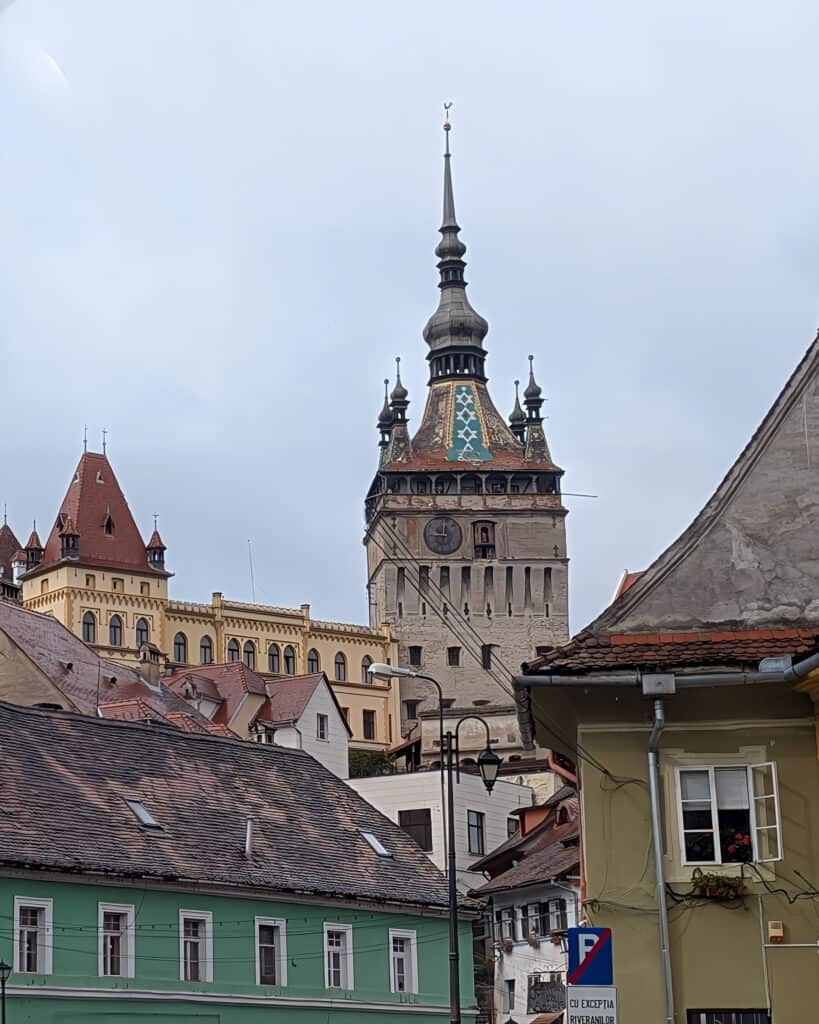
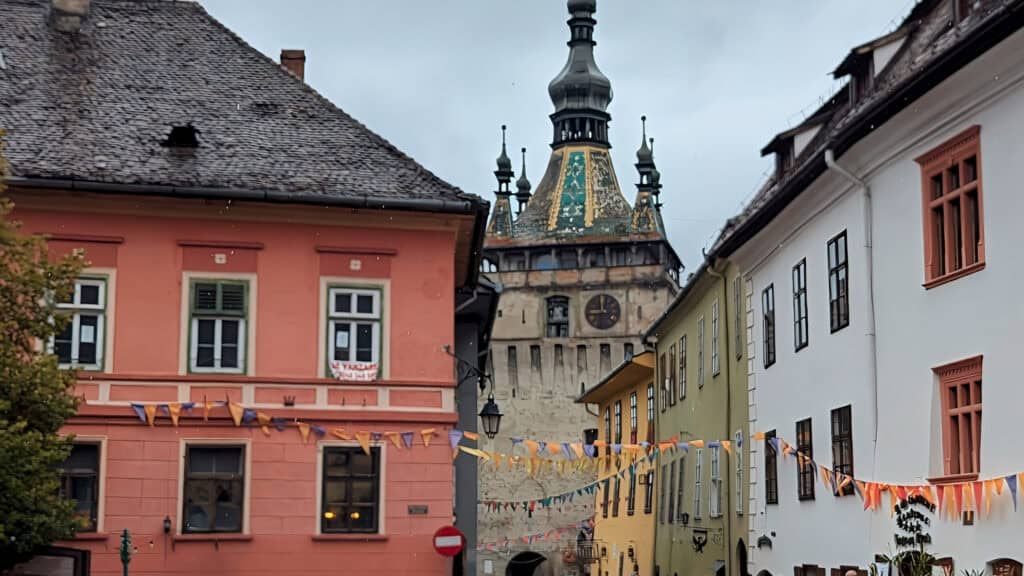
The Clock Tower is the most striking of all the watchtowers in Sighisoara and one of its most recognisable landmarks. It’s adjacent to the main square, Piața Cetății (The Citadel’s Square). Rising 64 metres above the Citadel’s main gate, it’s been watching over Sighișoara since the 14th century, and it remains one of the best-preserved medieval towers in all of Transylvania.
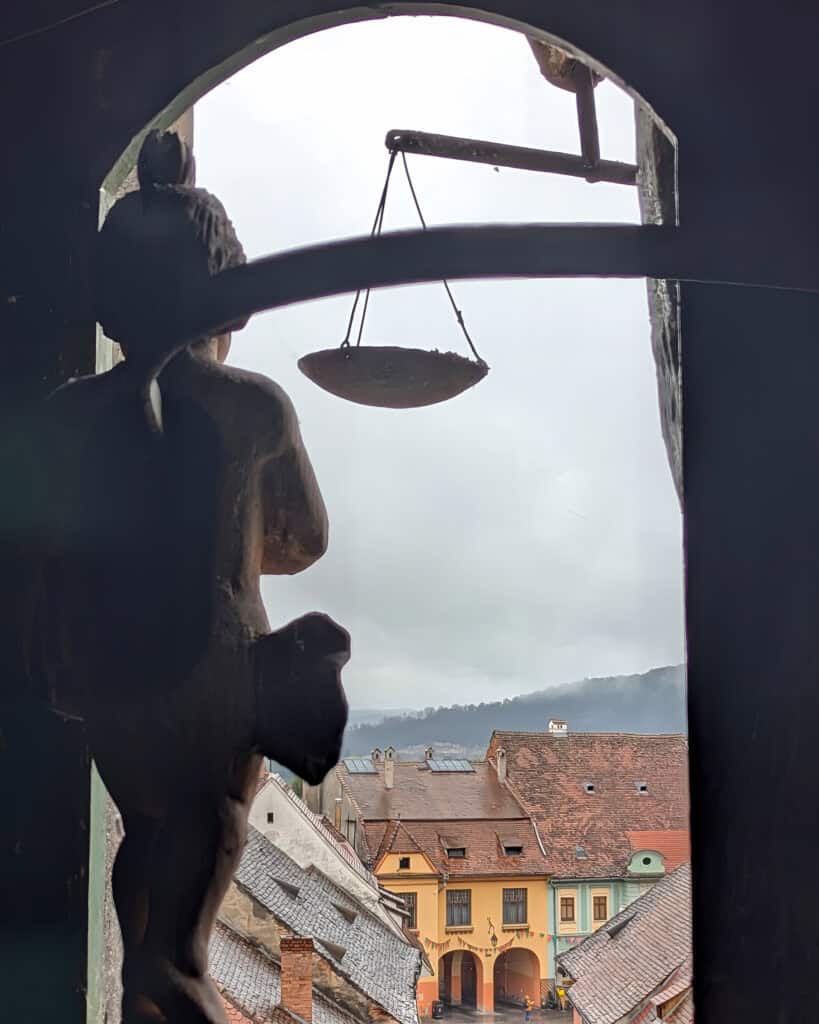
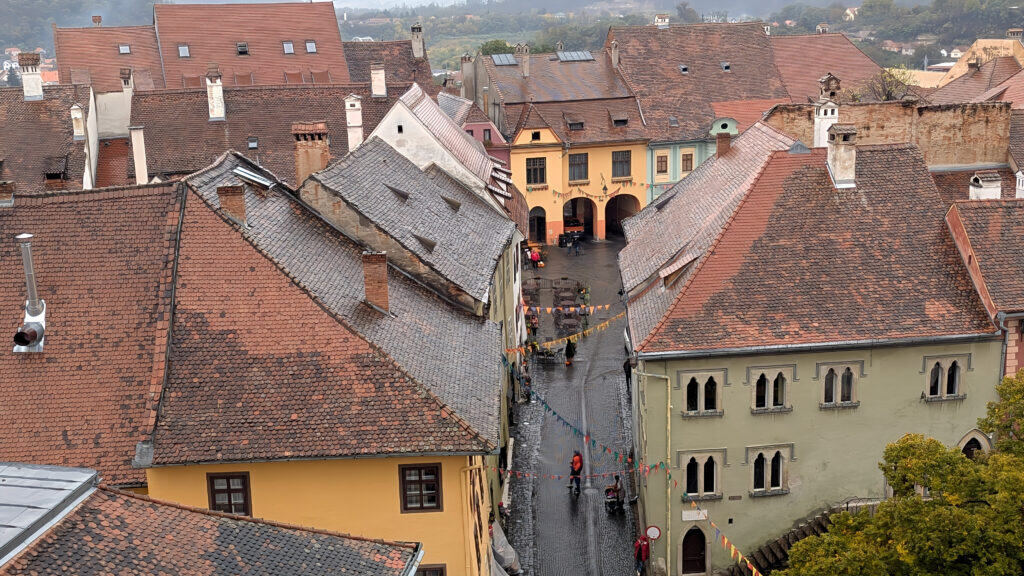
Climb the steep wooden staircase inside for sweeping views across the terracotta rooftops of the old town and out towards the hills beyond. You can break your climb at each floor as the Tower also houses the town’s history museum, with exhibits covering Sighișoara’s Saxon past. Once at the top, you should see the Church on the Hill and the school at the top of the Scholar’s Stairs. It’s also a good vantage point to spot some of the other towers, including Tanner’s Tower and Tinsmith’s Tower.
Opening hours: Tuesday–Friday 9 am–6:30 pm | Saturday–Sunday 9 am–6:30 pm | Monday 10 am–3:30 pm Admission: Check locally for current prices, as these change seasonally.
2 Find the Watchtowers of Sighișoara

Tailor’s Tower Blacksmith’s Tower 
Bootmaker’s Tower Furrier’s Tower
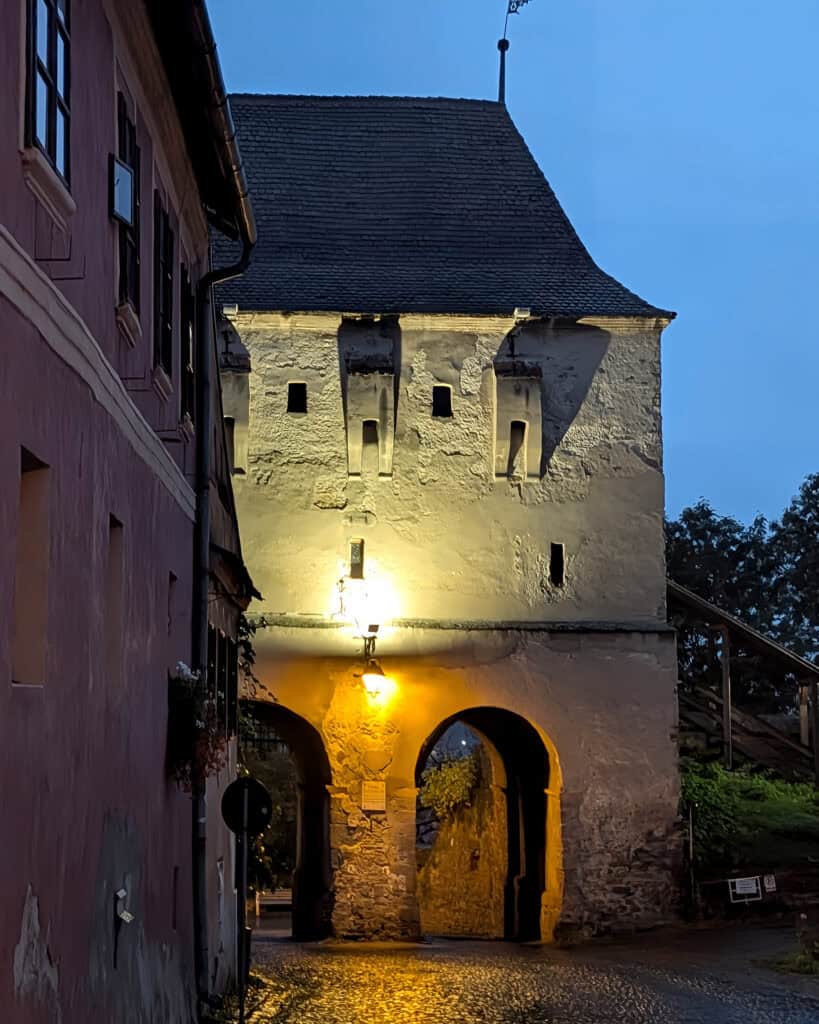
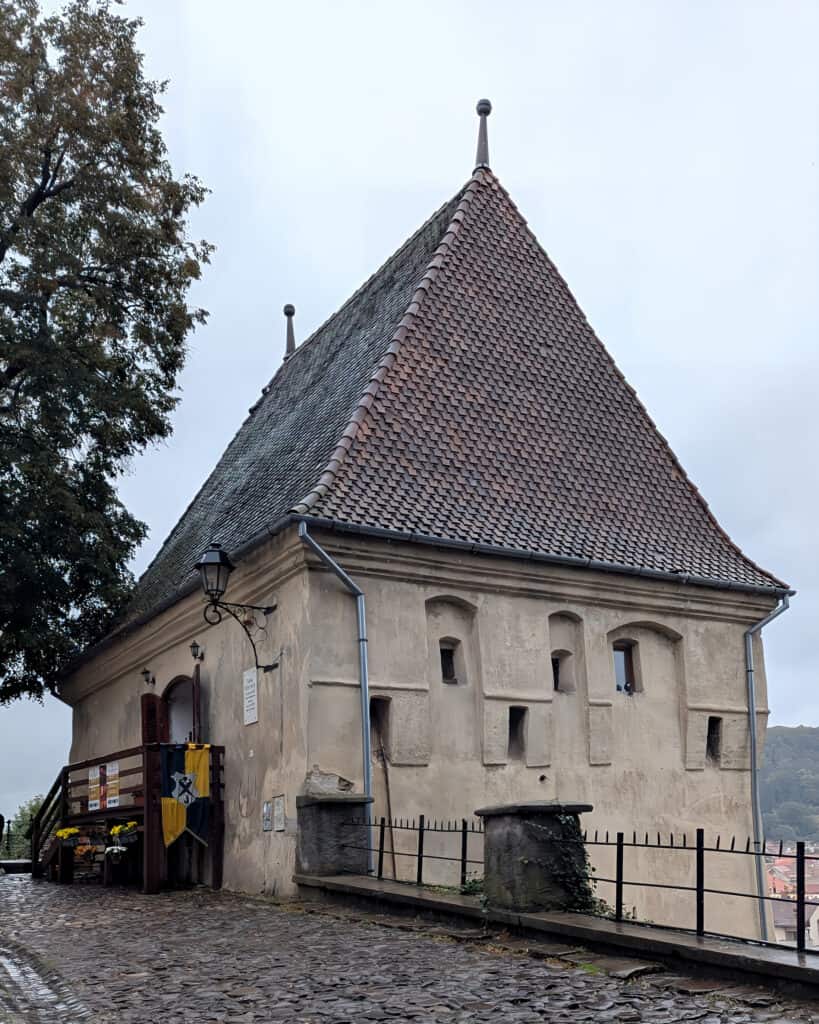
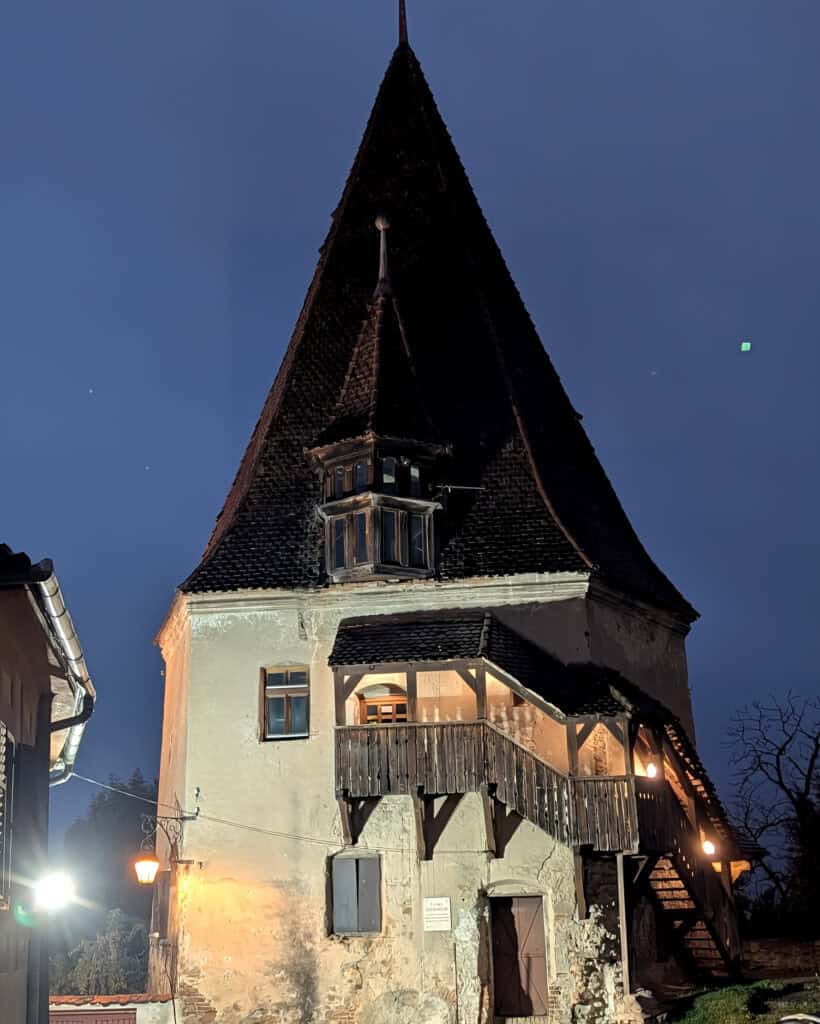

Fourteen towers once defended Sighișoara’s medieval walls, each maintained and funded by a different guild, and nine of them still stand today. Tracking them all down is a wonderful way to explore. You’ll find each one is different.
We’ve already covered the Turnul cu Ceas (The Clock Tower). For the remaining eight, here’s what to look out for:
- Turnul Croitorilor (The Tailors’ Tower): The main gate tower stands out for its two openings, which once allowed traffic to circulate through the walls.
- Turnul Fierarilor (The Ironsmiths’ Tower): Converted into a small museum where you can see authentic blacksmith tools on display. (Open Monday–Friday 10 am–6 pm; Saturday–Sunday 10 am–8 pm | Admission: 15 lei)
- Turnul Cizmarilor (The Bootmaker’s Tower): Architecturally distinct from the others, thanks to the pair of lookout turrets perched on its roof – keep your eyes up as you approach.
- Turnul Cojocarilor (The Furriers’ Tower) houses a small leather shop and a free museum, so take a look inside.
- Turnul Măcelarilor (The Butchers’ Tower) is an unusual hexagonal tower built along the northwest stretch of the wall.
- Turnul Tăbăcarilor (The Tanners’ Tower) holds the distinction of being the oldest Tower in Sighișoara. A tower with a single aspect sloping roof – most easily spotted from the top of the clock tower. It’s just in front of the Tinsmith’s Tower.
- Turnul Cositorarilor (The Tinsmiths’ Tower) rises 25 metres but isn’t open to the public and impressive from the outside.
- Turnul Frânghierilor (The Ropemakers’ Tower) is a smaller, square-based tower. It’s on the hilltop at the top of the Scholar’s Stairs.
Butcher’s Tower Tanner’s Tower
(in front of Tinsmith’s Tower)Tinsmith’s Tower Ropemaker’s Tower
(next to the Church on the Hill)
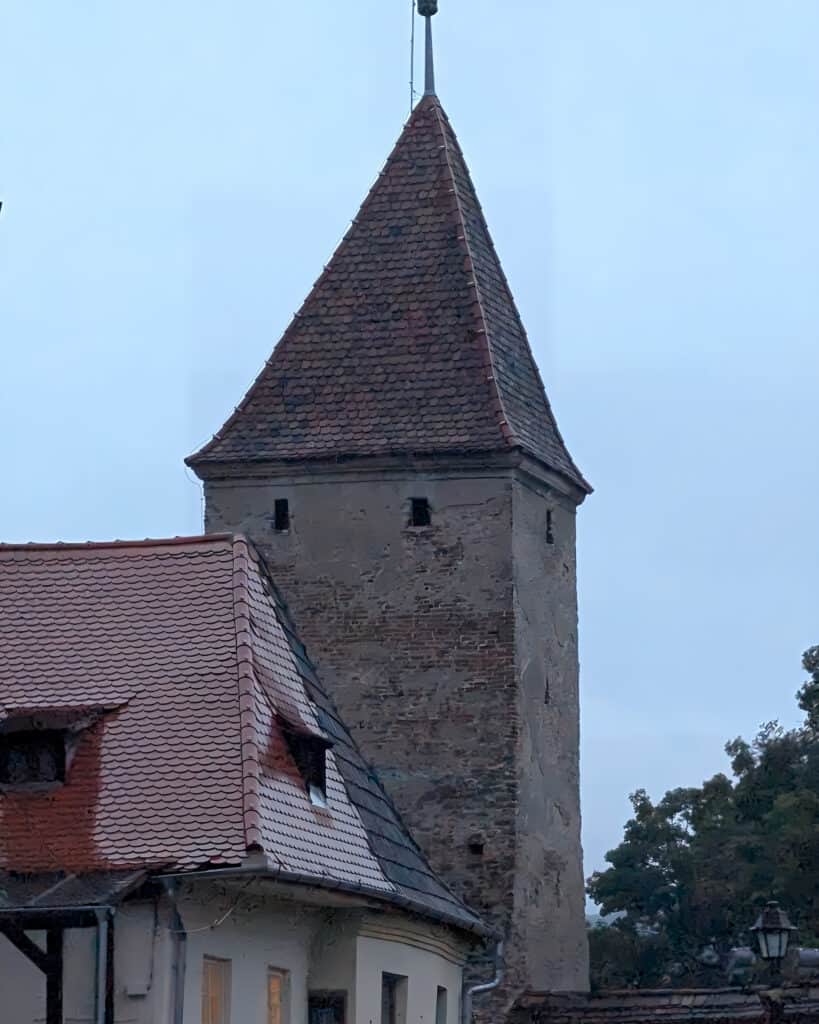
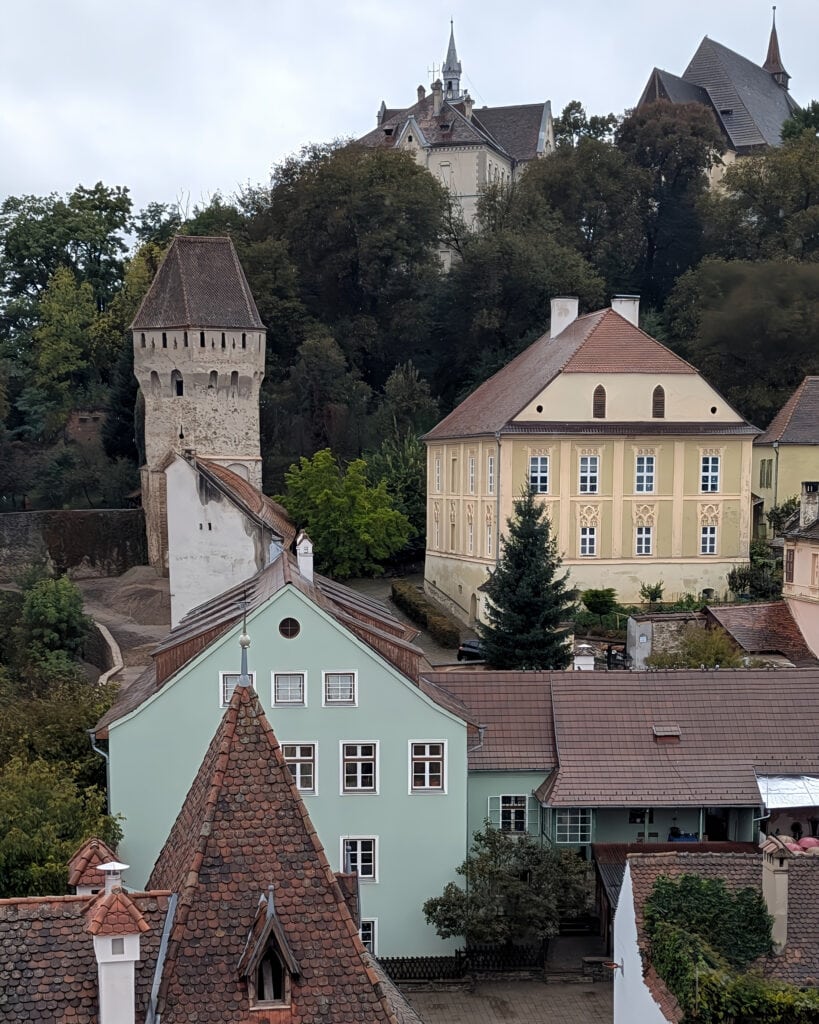
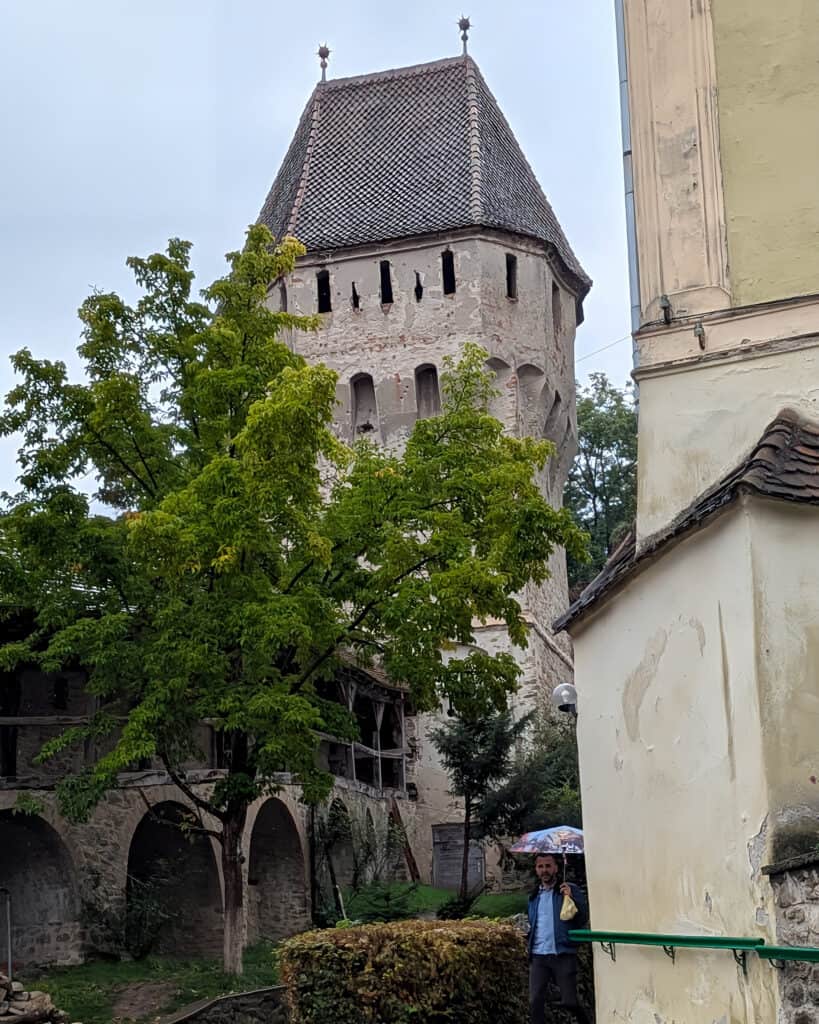
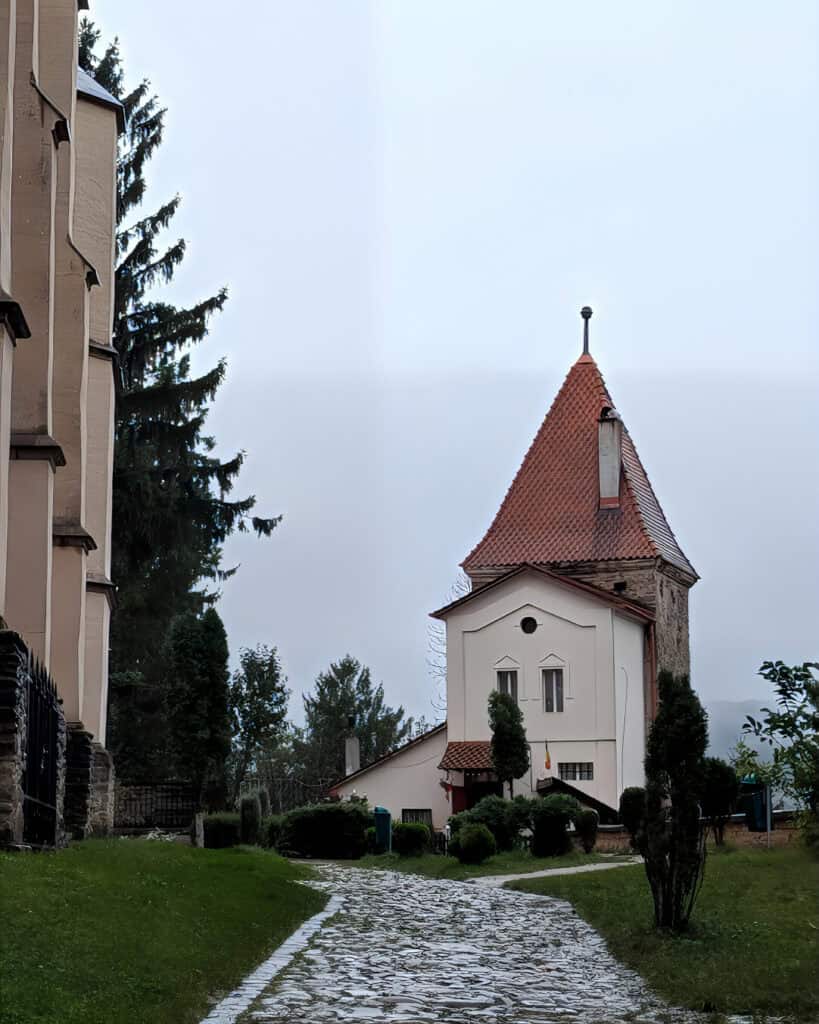
You won’t be able to enter most of them, but finding each one feels like a treasure hunt through the cobbled streets of the Citadel, and you’ll find plenty to see on the way.
3 Explore Piața Cetății (The Citadel’s Square)
At the heart of the Citadel sits Piața Cetății. It’s picture perfect and lined with colourful medieval buildings. This is the social and historic centre. The narrow cobbled streets of the old town radiate outwards from here. It’s a place to stop, and people watch at one of the pavement cafes, or wander into one of the tourist shops. Look out for Casa cu Cerb (the Stag House). It’s a traditional hotel and restaurant with a mural of a stag with real antlers embedded in the walls.
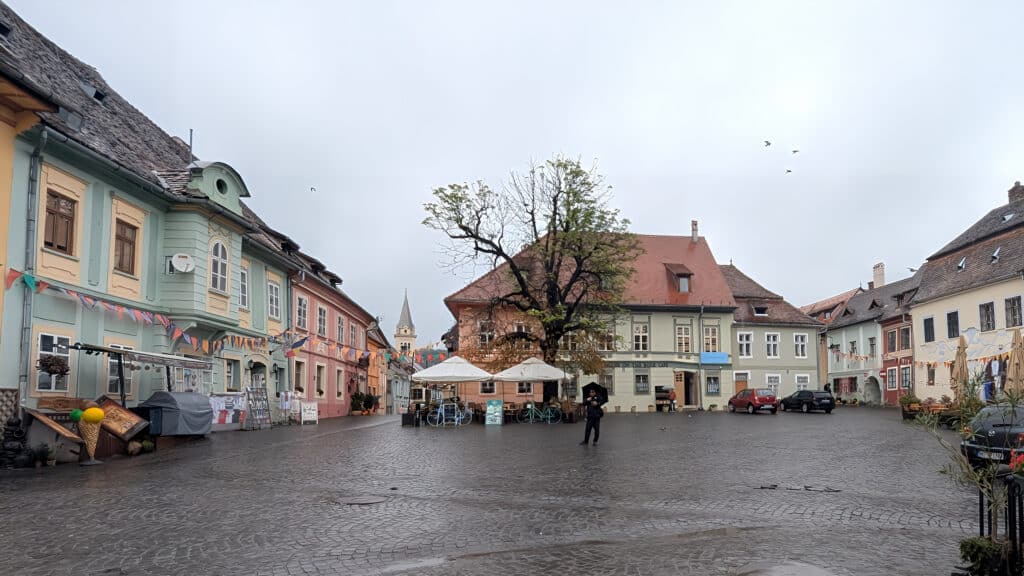
Our next stop, the birthplace of Dracula, is on the square too.
4 Visit Casa Vlad Dracul
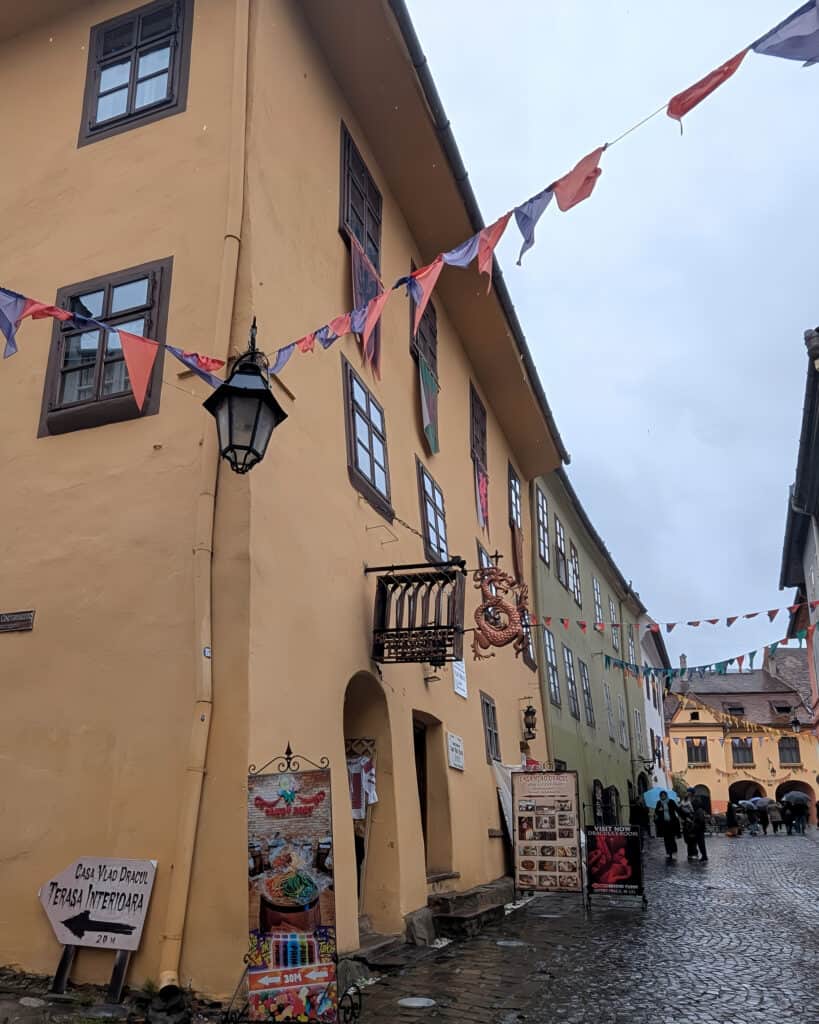
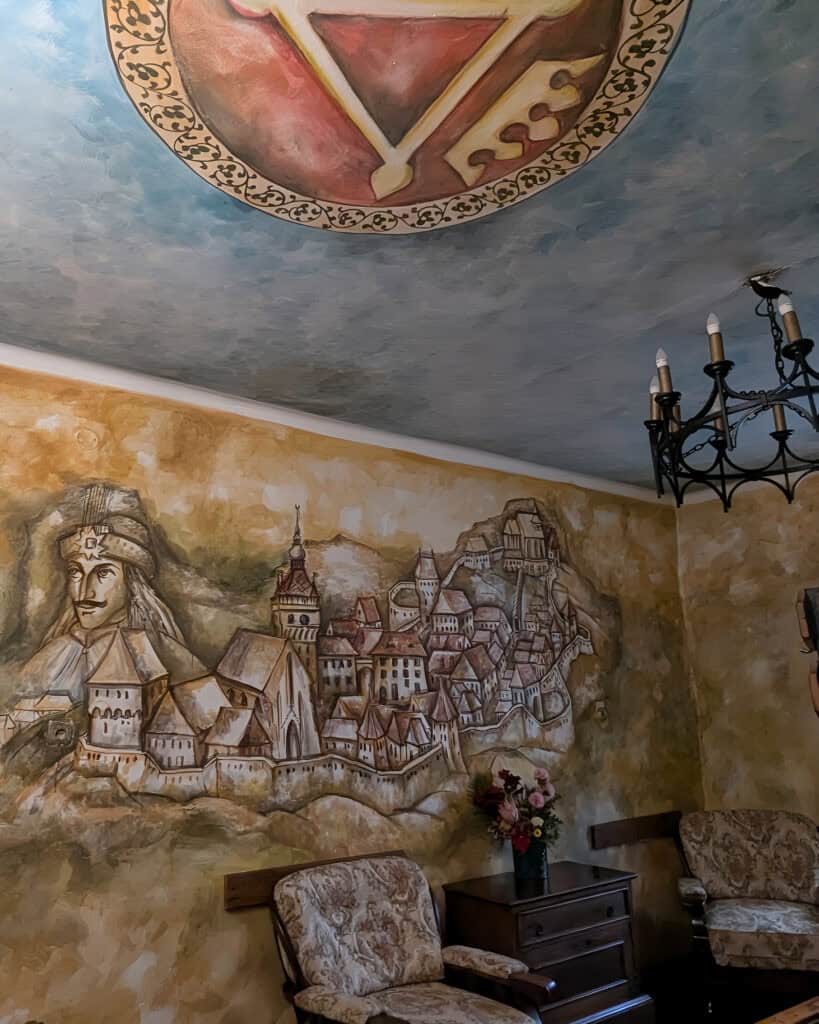
Whether or not Bram Stoker had Sighișoara specifically in mind when he created Dracula, the city has enthusiastically leaned into the connection.
Casa Vlad Dracul (the House of Vlad Dracul) is a handsome yellow building on Piața Cetății, and it’s here that Vlad II, father of the infamous Vlad III, aka Vlad the Impaler, aka the man who inspired Dracula, lived in the early 15th century. Vlad III is believed to have been born here around 1431.
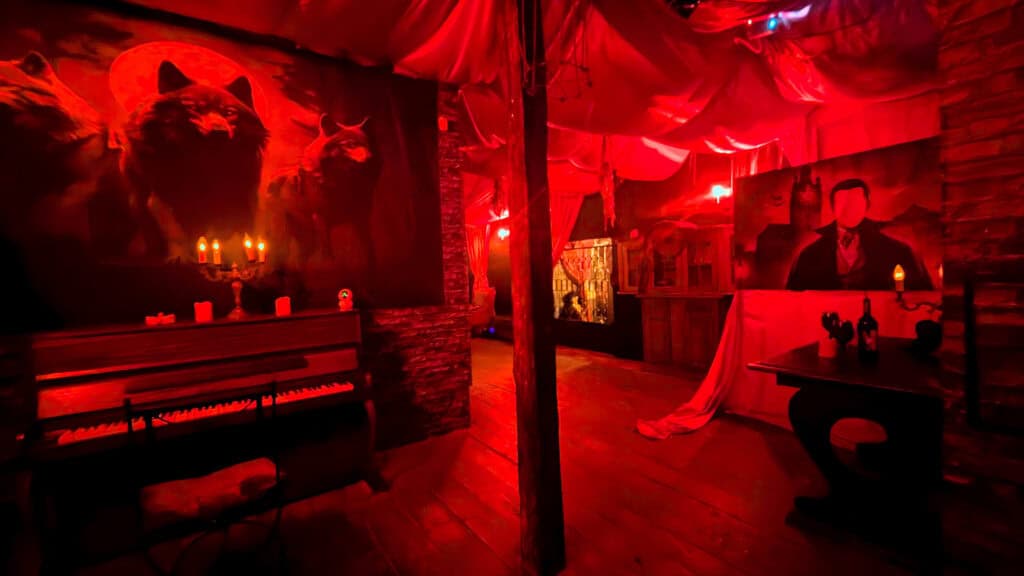
Today, the ground floor operates as a restaurant. I didn’t eat here; there were other, better-reviewed places, but I did go upstairs to the Dracula Room, which was a spooky series of rooms with Dracula scenes in. I went in on my own, and with the door shut behind me, I didn’t linger much longer than taking the photos! Yes, it’s commercialised, and blatantly so, but the building itself is genuinely fascinating, and if you’ve made it all the way to Sighisoara, it’s worth a few extra steps to go inside and make your own mind up about it!
5 Wander the Colourful Streets
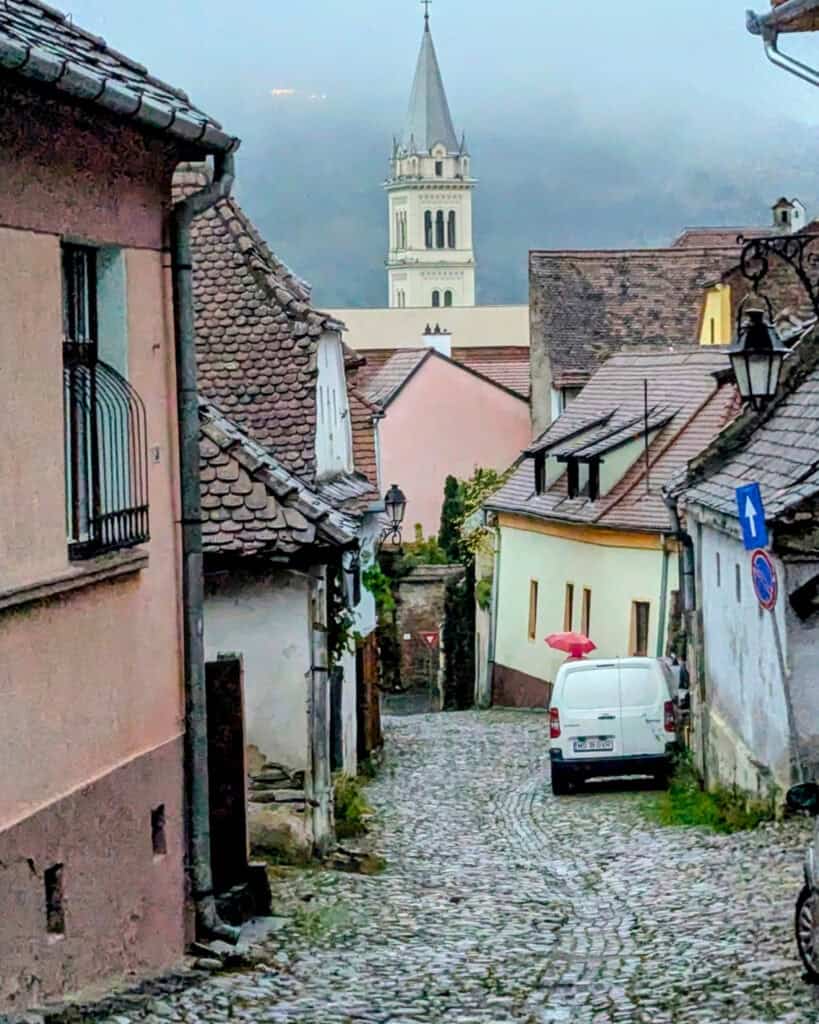
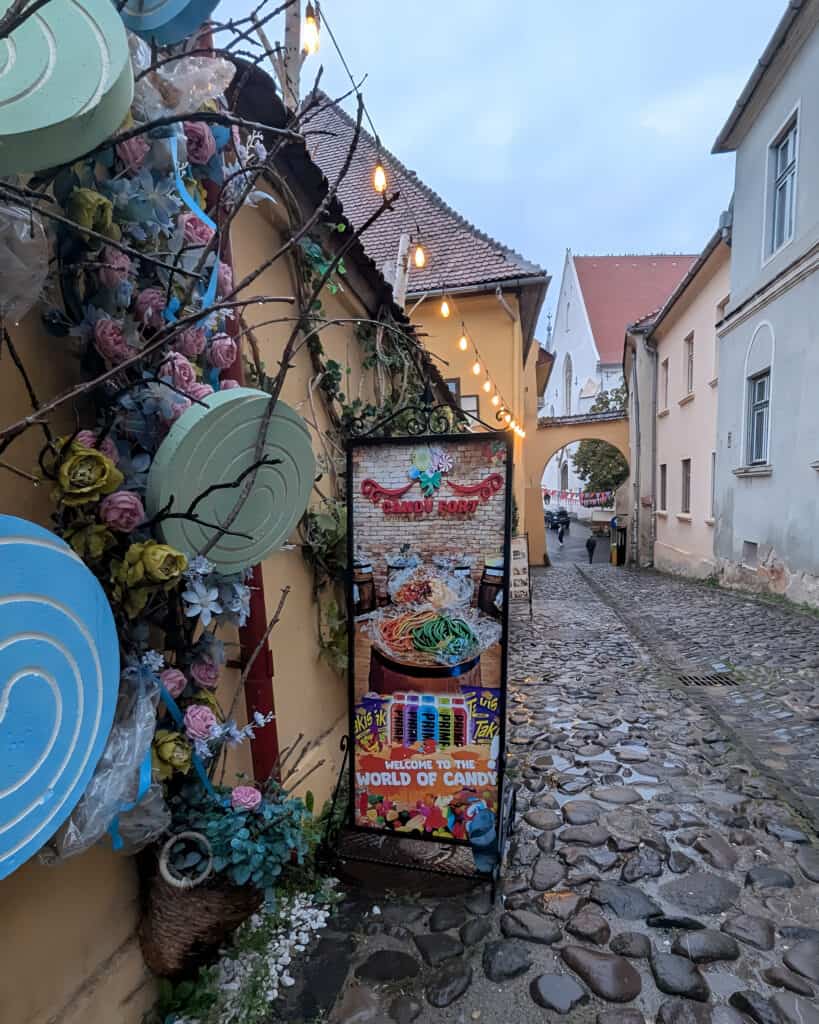
Some of the best moments in Sighișoara don’t happen at any particular attraction. Just take your time to walk each street of the Citadel; there really aren’t many of them. Enjoy peering down narrow alleyways and pausing at doorways that look like they belong to another century.
Two streets are worth seeking out in particular. Strada Tâmplarilor (Carpenter’s Street) is one of the most atmospheric in the Citadel, lined with brightly coloured medieval houses, and Strada Școlii, nearby, leads you towards the Scholar’s Stairs, the entrance to the upper Citadel.
6 Explore the Folk Shops and Antique Shops
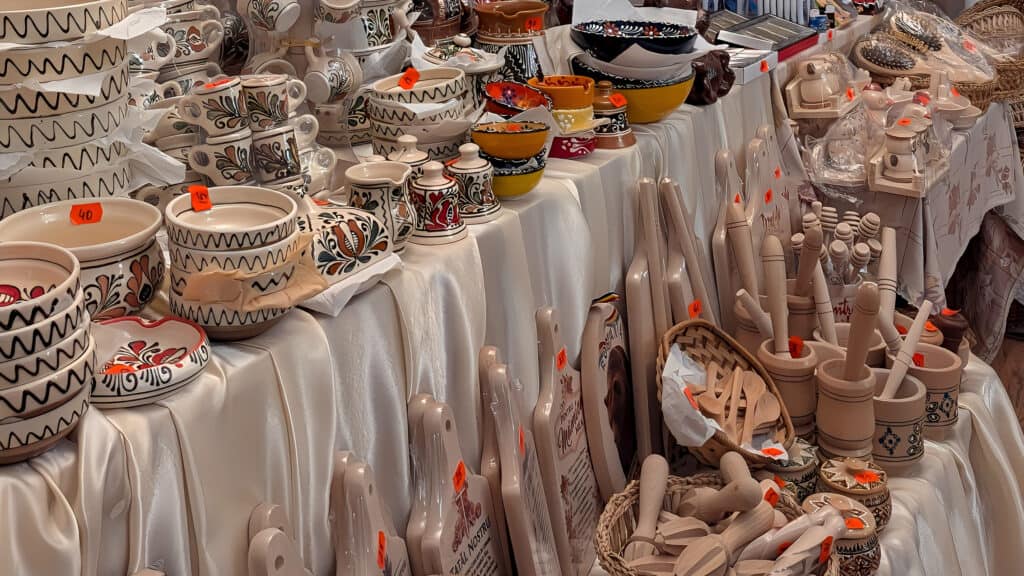
Sighișoara has a good scattering of small independent shops selling traditional Romanian crafts, folk art, and antiques. You’ll find hand-embroidered textiles, painted ceramics, wooden carvings, and jewellery influenced by the region’s Saxon and Transylvanian traditions.
The quality varies, as it does everywhere, but if you poke around patiently, you’ll find things that are genuinely made locally and worth taking home. Here are some of the main shops:
- The Spoonman: On the main Citadel Square with plenty of handcrafted spoons and more
- Casa in Natura Country Store: Welcoming atmosphere and high-quality artisanal items
- Transylvanian Souvenirs: For your fridge magnets and more
- Antiques Shop, Sighisoara: If you’re looking for authentic old items and remnants from Saxon culture
7 Visit the Church of the Dominican Monastery
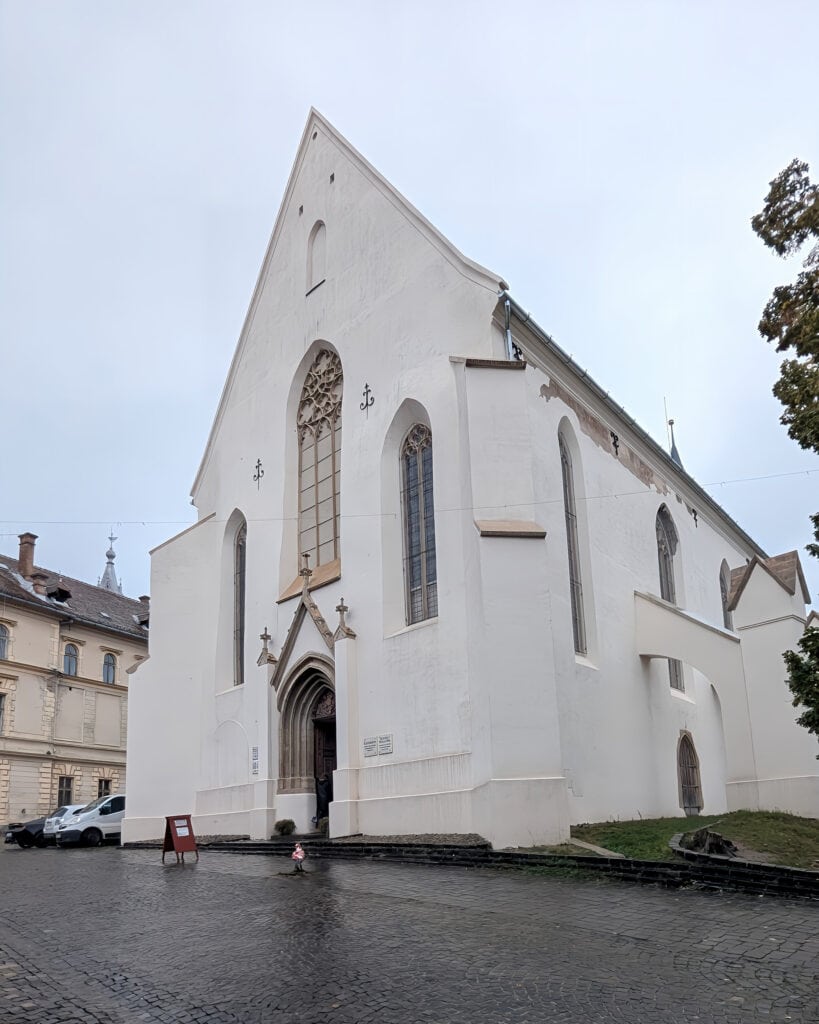
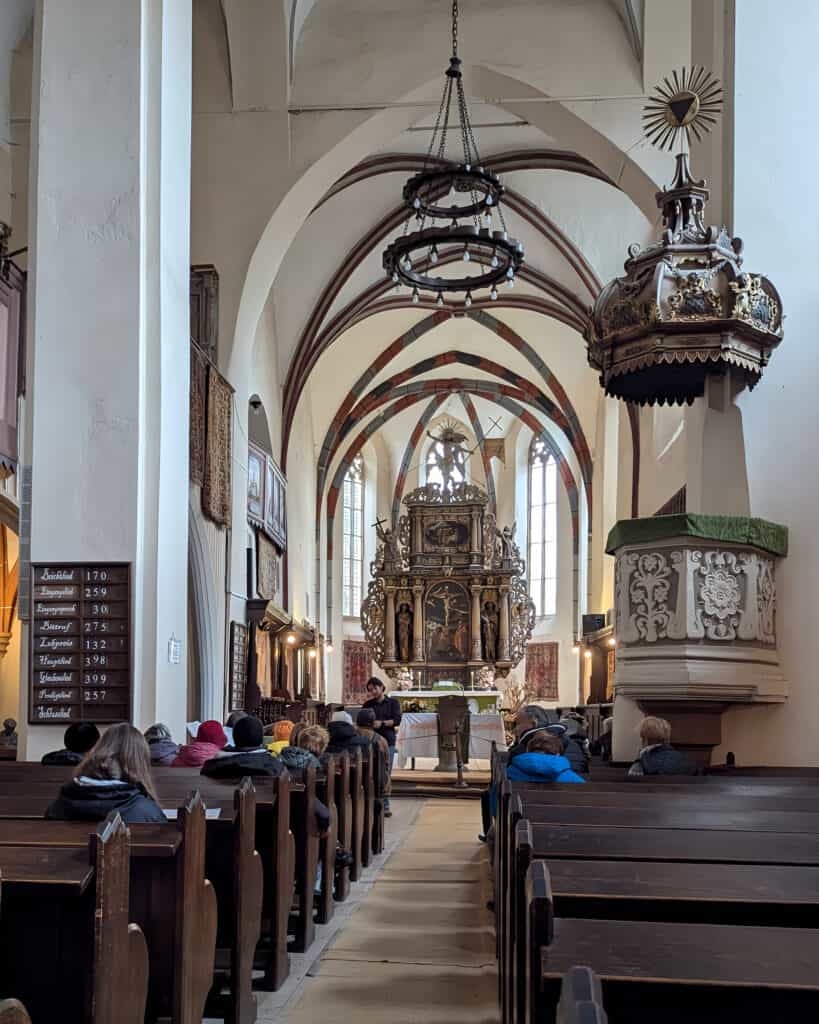
Not to be confused with the Church on the Hill, which sits at the top of Scholar’s Stairs, the Monastery Church is down in the Citadel itself.
When the Saxons converted to Lutheranism in 1556, it became their main church, and it remains the sole surviving structure from the original complex – the rest was demolished in 1888 to make way for the Town Hall.
The late-Gothic interior is worth stepping inside for. Look out for a bronze font dating to 1440, a beautifully carved stone doorframe from 1570 in the Transylvanian Renaissance style, and a collection of 16th and 17th-century Ottoman carpets. There’s also a baroque organ. Classical and baroque concerts are held here regularly – worth checking if something is on during your visit.
If you’ve already visited the Black Church in Brașov, some of this will feel familiar – the Ottoman carpets, concerts and organ recitals, the Lutheran Saxon heritage. But the two couldn’t feel more different in scale and atmosphere.
8 The Town Hall and the Vlad Țepeș Statue
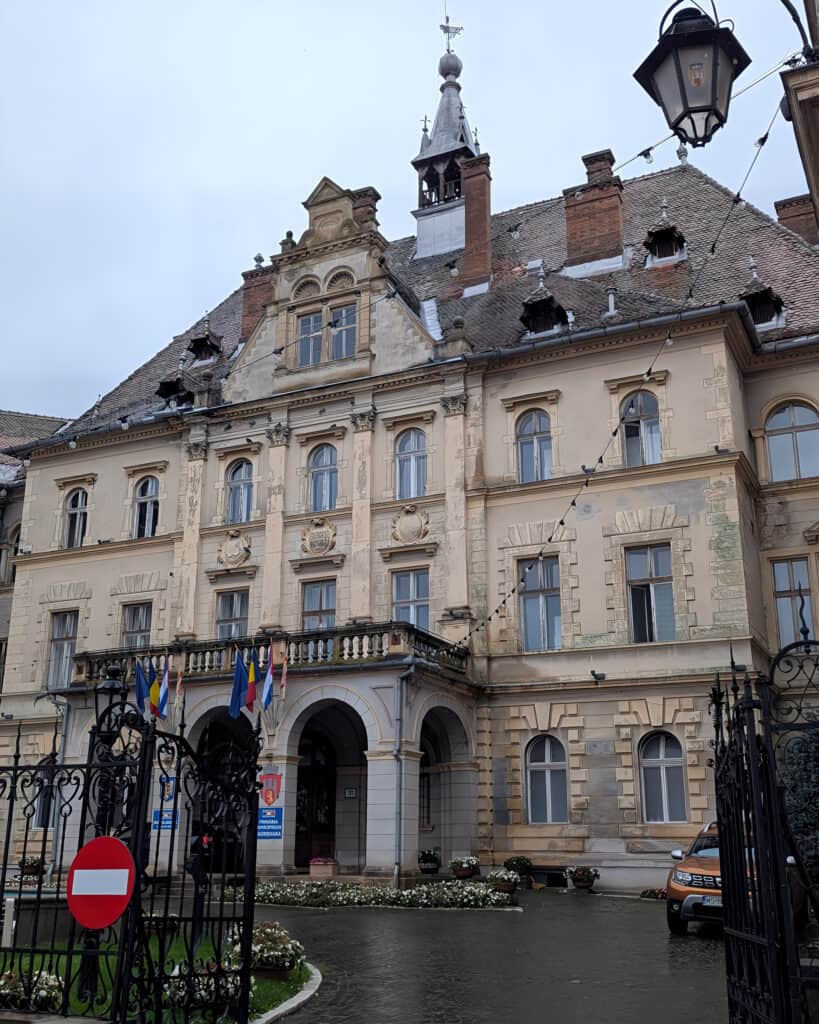
Standing next to the Monastery Church, Sighișoara’s imposing Town Hall is itself a piece of history – built between 1886 and 1888 directly on the site of the Dominican monastery that was demolished to make way for it. The neo-Renaissance building was originally known as the Palace of the Târnava Mare County, and its grand facade feels slightly incongruous among the medieval surroundings. It’s not open to tourists, but as you wander the streets, you’re sure to spot it.
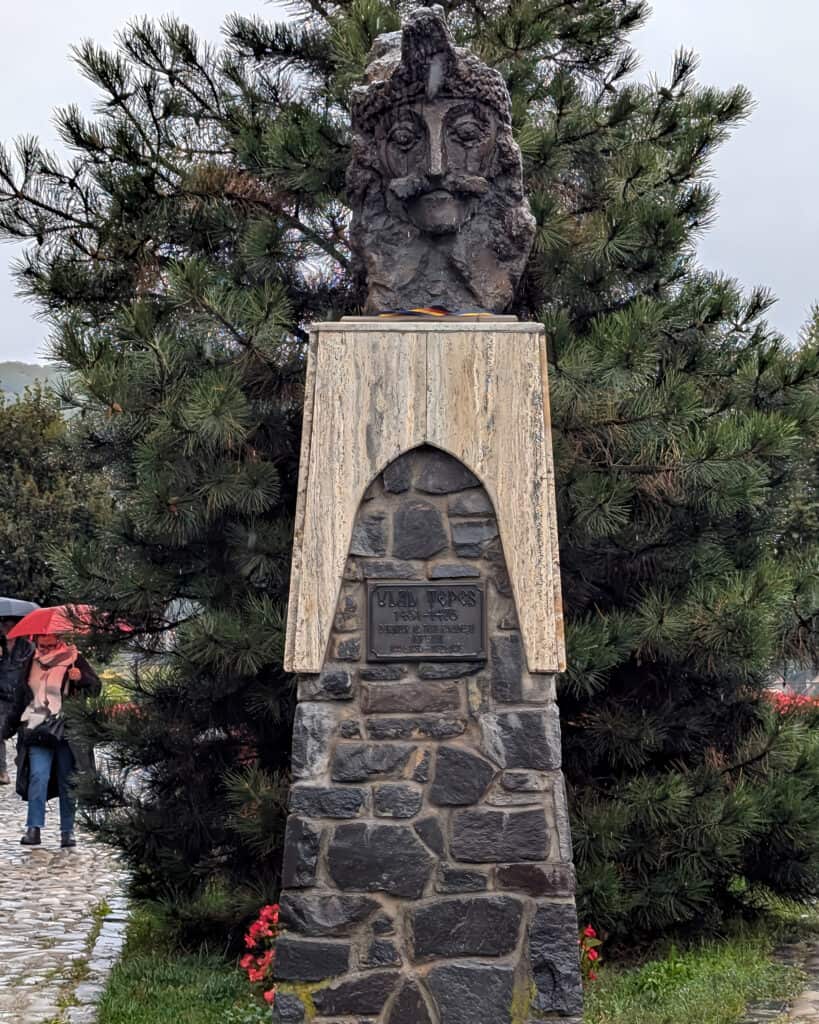
Tucked just behind the Monastery Church is the statue of Vlad Țepeș – the man himself, rendered in bronze. It’s a surprisingly modest monument given the weight of the legend attached to it, but it’s there for the obligatory photo!
9 Visit the Museums
Sighișoara citadel is a piece of history in itself, and you’ll have visited the main city museum already when you walk up the Clock Tower. But there are several other options, if you want more:
- Casa Breslelor (the House of Guilds): I enjoyed this. It’s a series of reconstructions and artefacts depicting the lives of people in the various Saxon Guilds (trades). Hugely thoughtful, a lot of work has gone into this, and I’d recommend it.
- Medieval Weapon Museum: is exactly what it promises: a collection of arms, armour, and military artefacts from the medieval period. It receives mixed reviews, it’s small, and I skipped it, but it’s between Vlad’s house and the Clock Tower so that you won’t miss it.
- Camera de Tortură (the Torture Chamber): Another museum with mixed reviews; it’s not much more than the main room. Again, I skipped it.
Medieval Torture Museum Torture Chamber entrance – through the archway of the Clock Tower
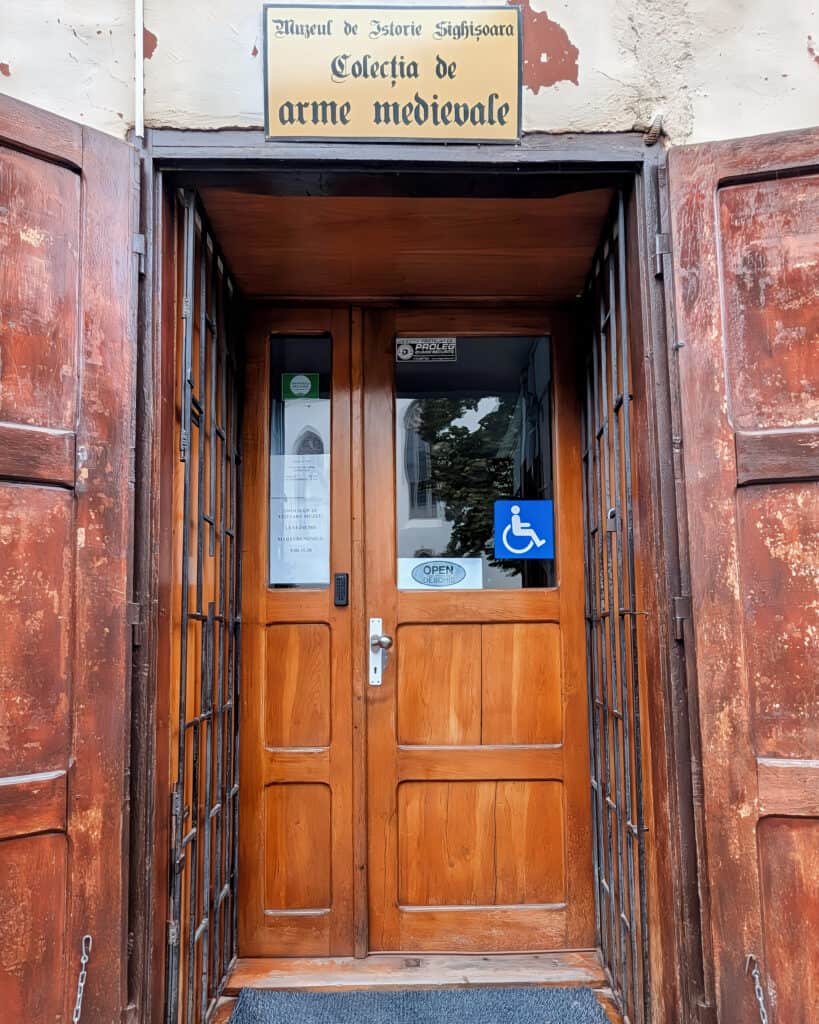
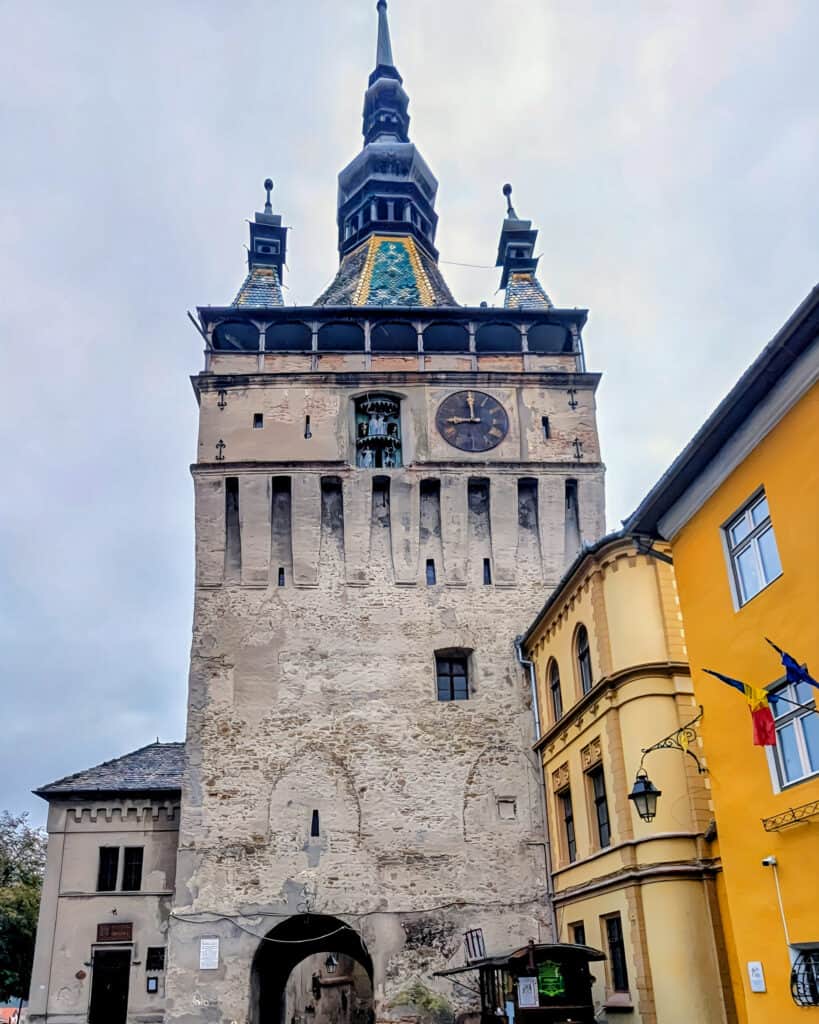
The Torture Museum and the Medieval Weapons Museum are all close to the Clock Tower. Locations and more details are on my Map of Things to Do in Sighisoara.
By this point, you’ll have explored much of the main citadel, and it’s time to climb the Scholar’s Stairs to the top of the hilltop and the area surrounding the Church on the Hill.
10 Climb Scholar’s Stairs
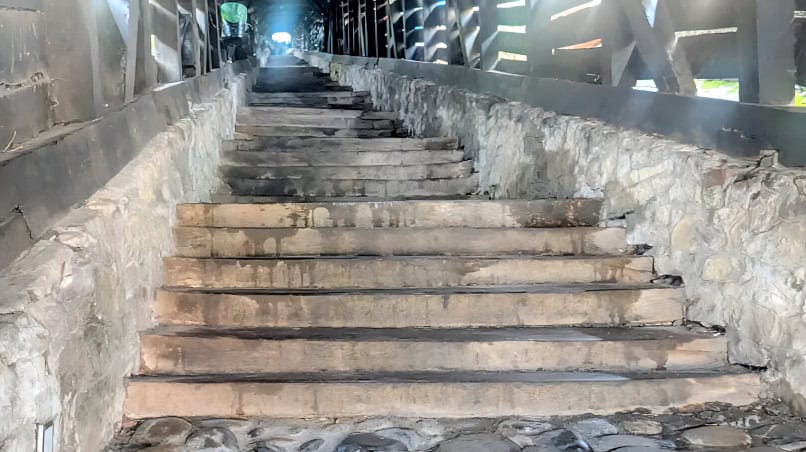
The Scholar’s Stairs – a covered wooden staircase of 175 steps – connects the main citadel to the Church on the Hill and the school, and has done so since the 17th century. It was built so local students could get to the hilltop school safely in winter, protected from snow and ice by the overhead roof.
The staircase still feels remarkable today and is worth the climb. There’s also a path through the Saxon Cemetery, next to the Church, as an alternative route. We tried it in the rain, and it was spectacularly muddy. Use the stairs if it’s at all wet.
Once at the top, the main things to explore are the Church on the Hill and the Saxon Cemetery, but you’ll also find the school and the final Tower (Ropemakers) here too.
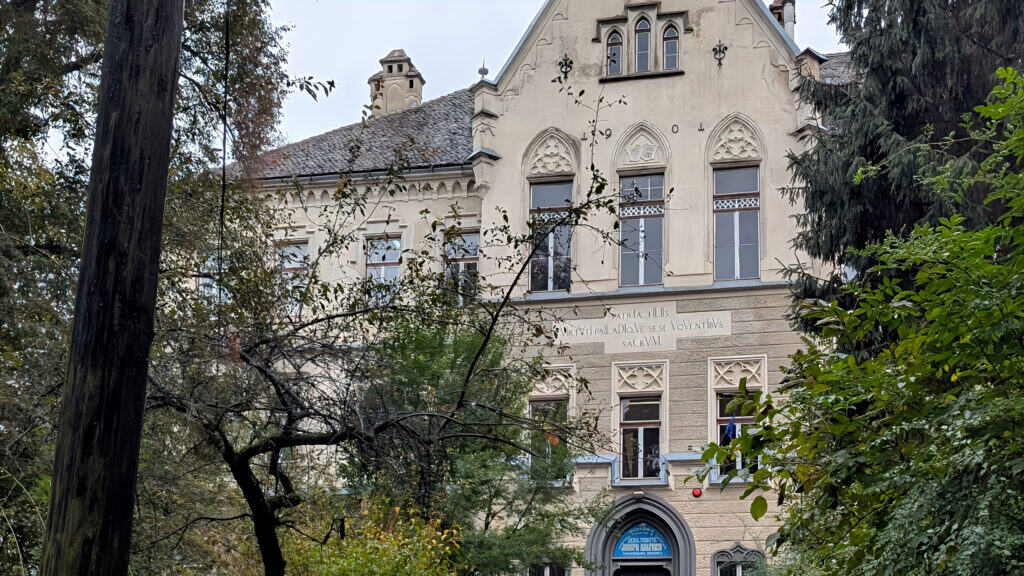
11 See the Church on the Hill
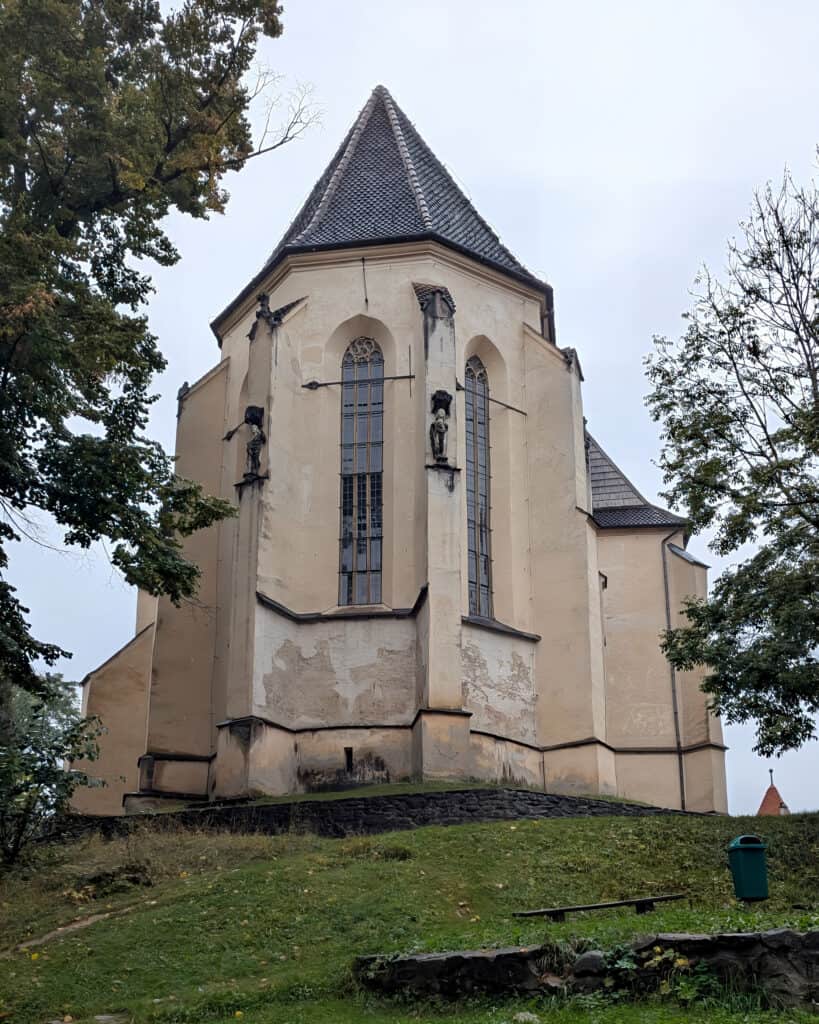
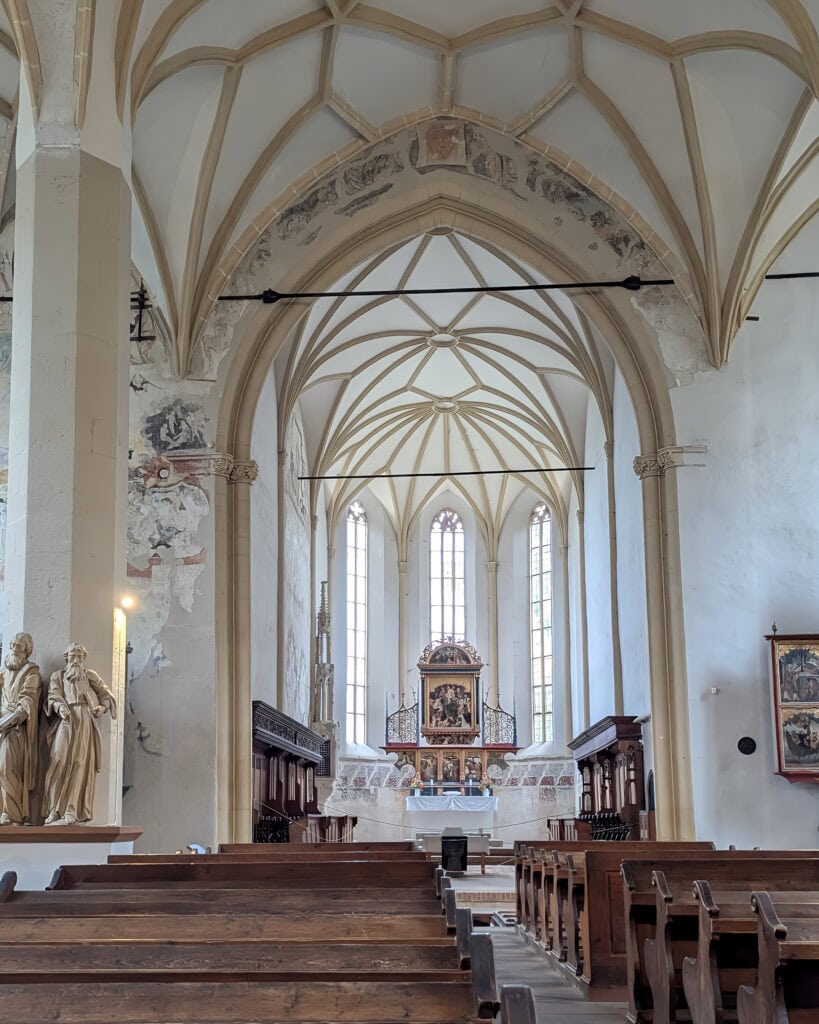
At the top of Scholar’s Stairs stands the Church on the Hill (Biserica din Deal) – a 14th-century Gothic church that’s one of the most important Saxon monuments in all of Romania. It’s a simple interior, but beautiful.
The setting is equally impressive. The Church sits surrounded by old trees at the highest point of the Citadel, and the views out over Sighișoara’s rooftops from up here are some of the best in the town.
12 Explore the Saxon Cemetery
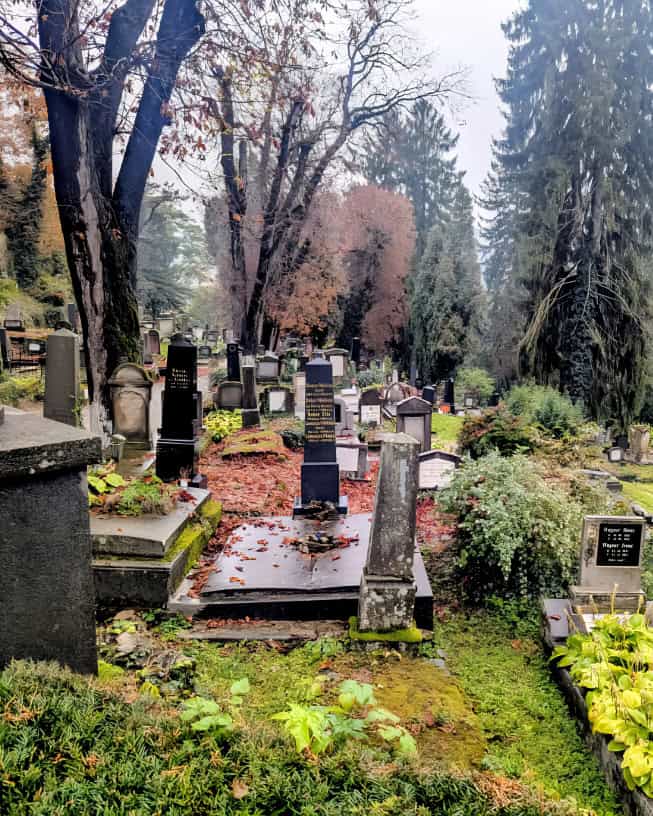
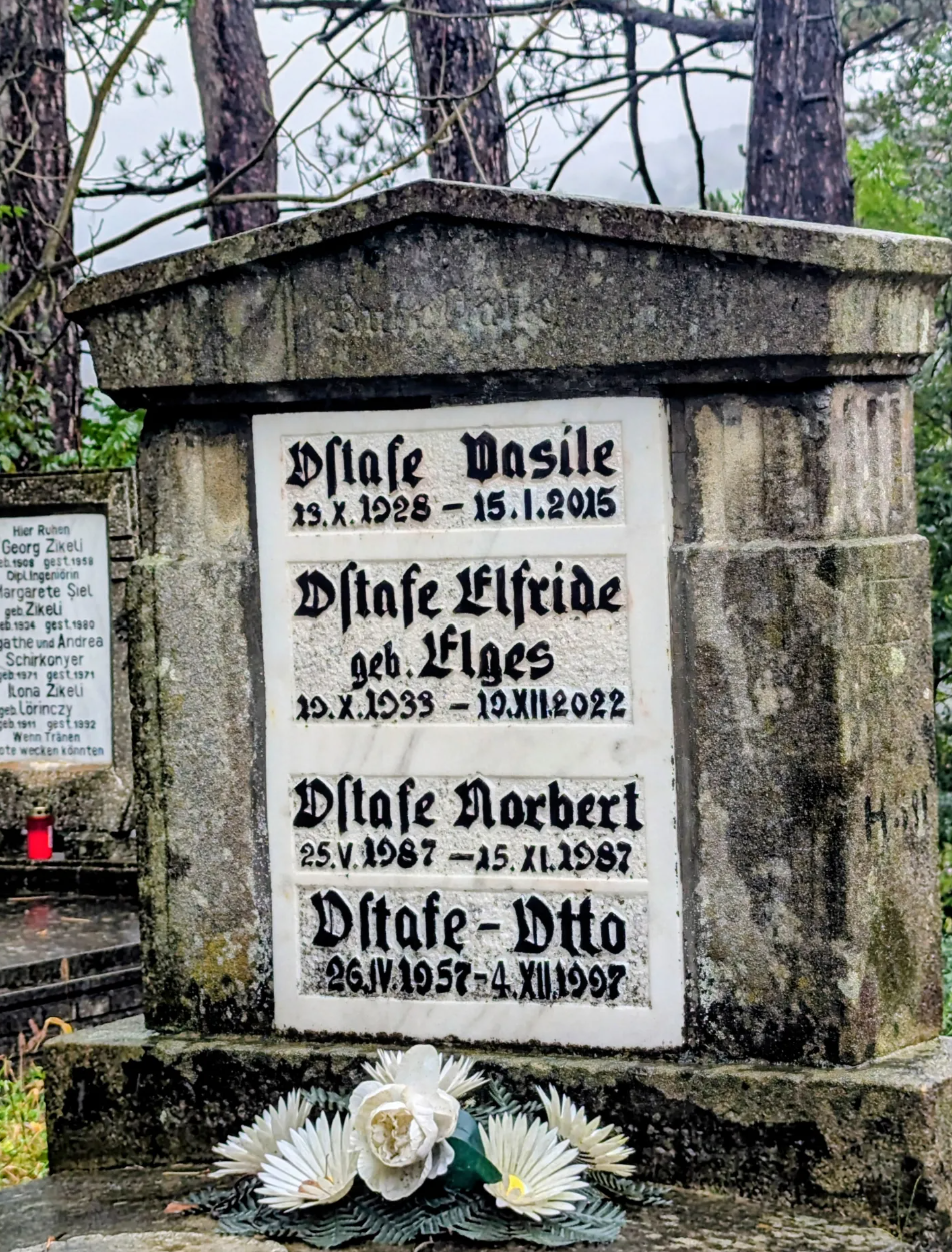
Beside the Church on the Hill lies the Saxon Cemetery – a sprawling, overgrown burial ground that has a melancholy beauty to it. The graves date back centuries, and many of the older tombstones carry German inscriptions, a reminder of the Saxon community that built and shaped Sighișoara over hundreds of years.
The Saxons of Transylvania began to leave in large numbers after World War II, and the community had almost entirely emigrated by the 1990s. The cemetery is, in a way, one of the most tangible records of their presence.
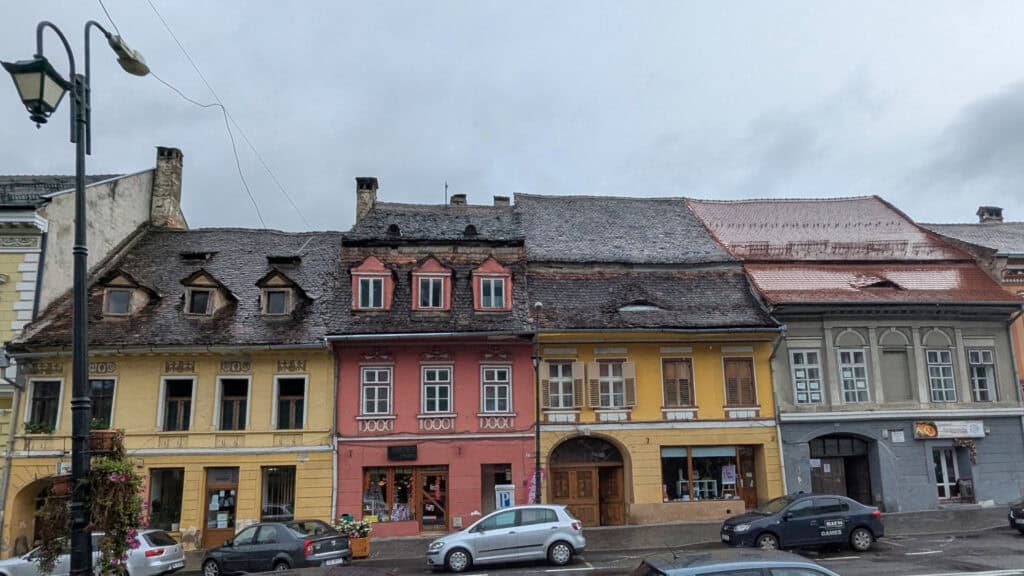
Once you’ve explored the citadel and climbed to the hilltop, allow time for the newer part of Sighișoara – it’s more photogenic than you might expect, and considerably less crowded.
13 Enjoy the cafes in and around Umbrella Street
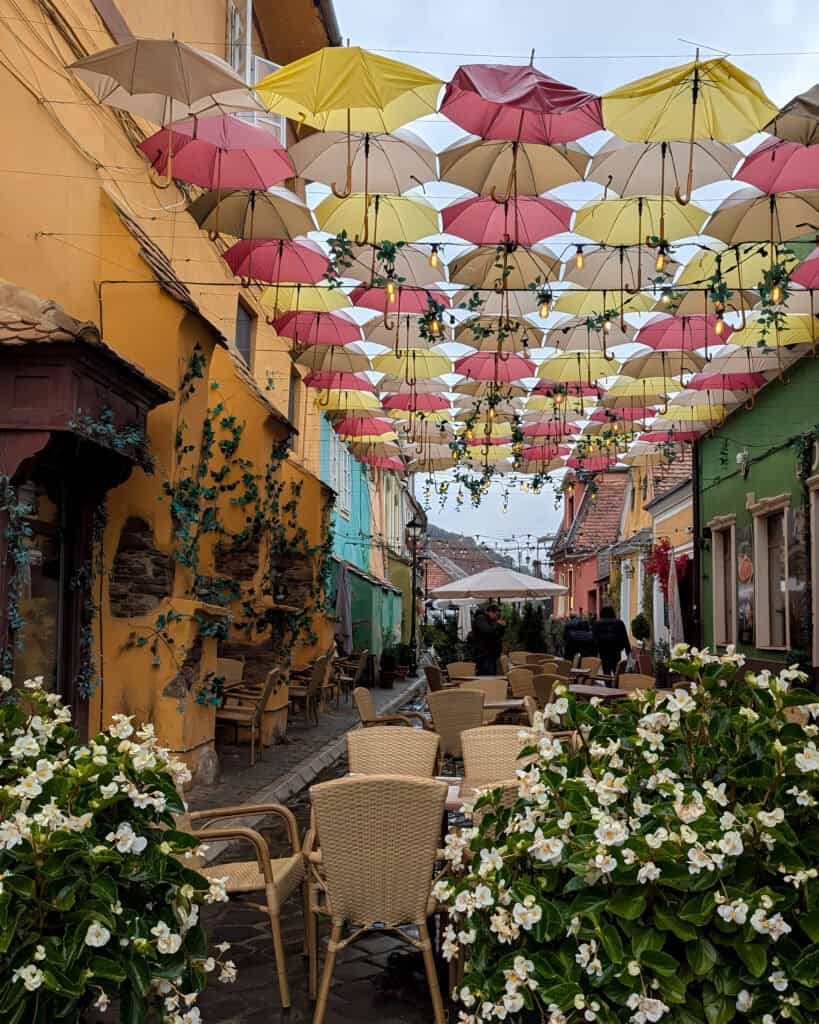
Umbrella Street is Sighișoara’s answer to a global trend, a stretch of colourful umbrellas strung overhead between the buildings, creating a canopy of colour above the cobblestones. It’s unashamedly photogenic, and it works, even if it wasn’t here a few centuries ago.
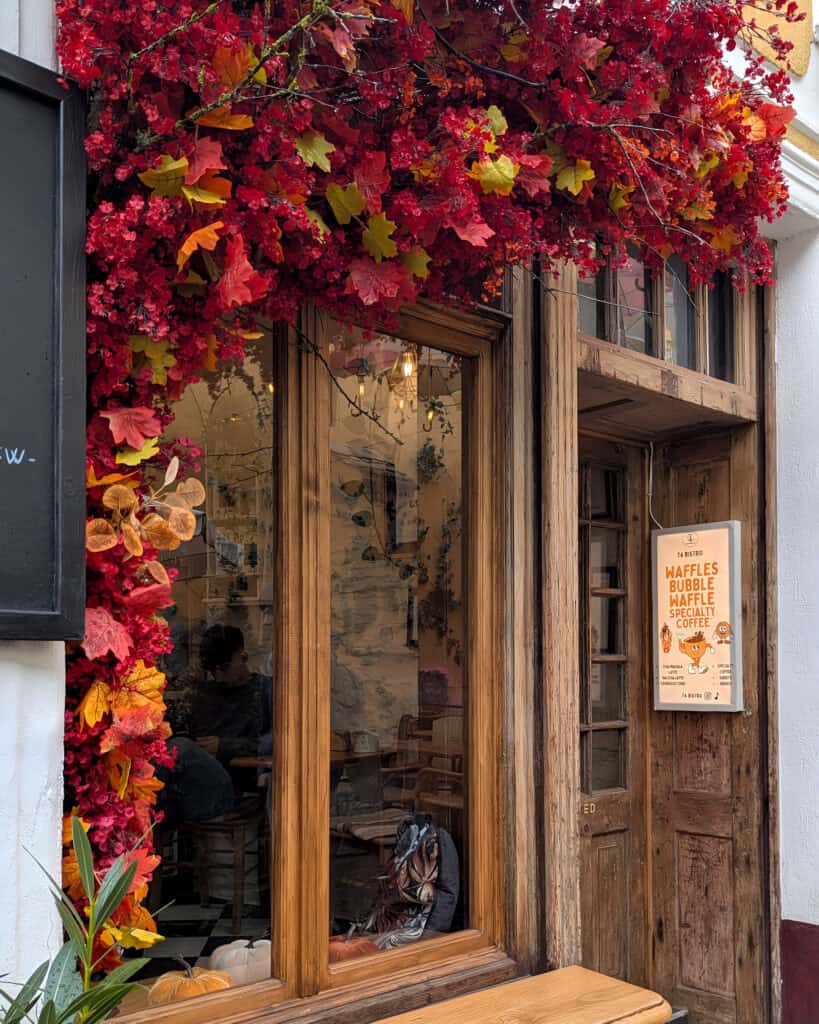
It’s the kind of thing that divides opinion between those who love a good Instagram backdrop and those who prefer their medieval towns undecorated. Wherever you fall, it’s hard to walk past without at least pausing to take a picture. There are several coffee shops, cafes and patisseries in and around Umbrella Street, which we visited and I’ve marked on the map.
14 Step Inside the Holy Trinity Church
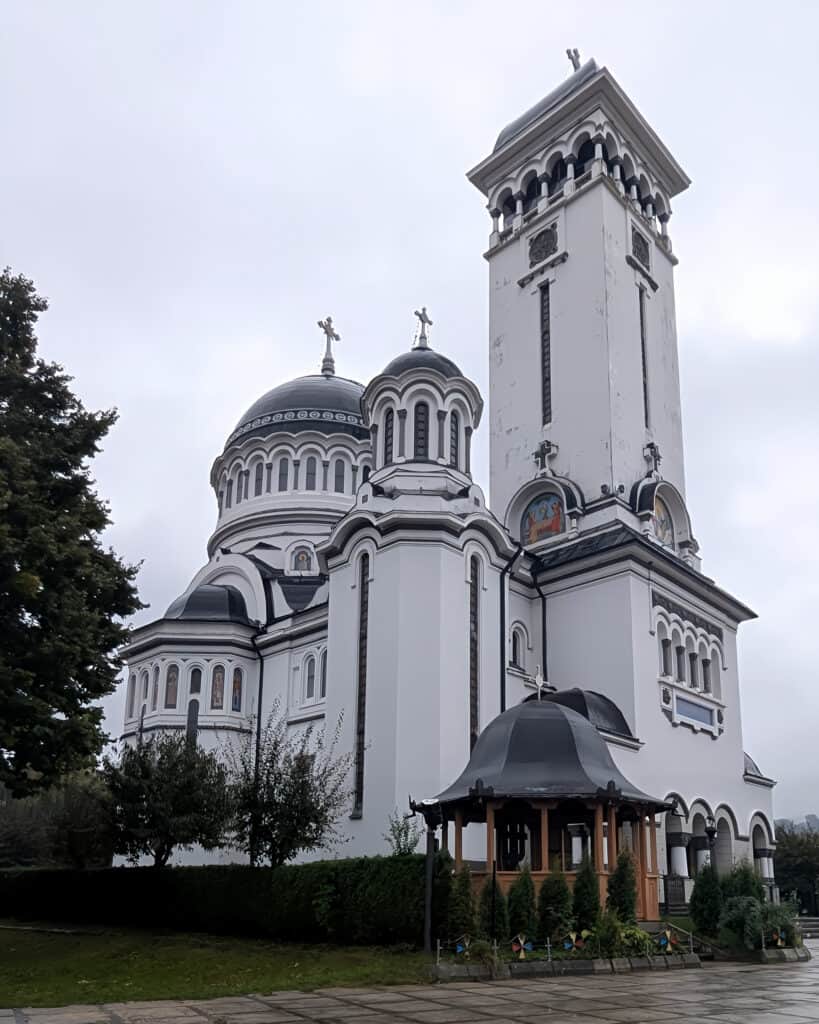
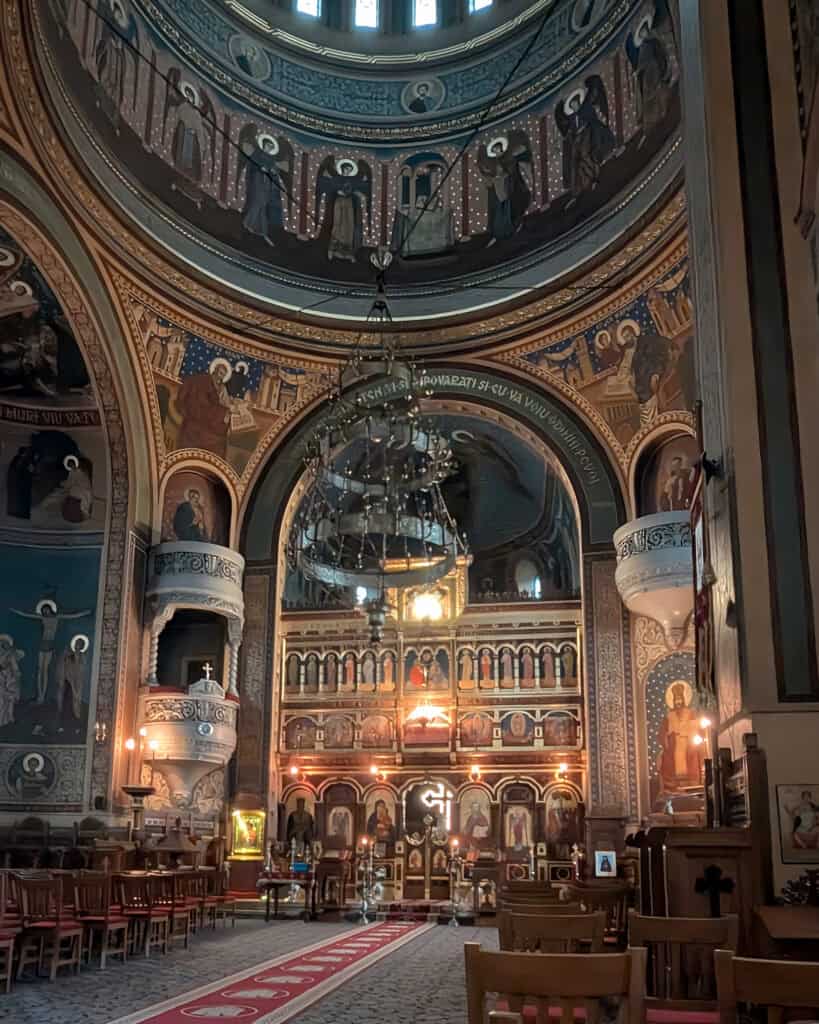
The Holy Trinity Church (also known as the Romanian Orthodox Church of the Holy Trinity) offers a very different perspective on Sighișoara’s religious heritage. This is a Romanian Orthodox church. It’s ornate and turreted on the outside, in a Byzantine style. On the inside, it’s richly decorated with icons and frescoes. Take a look inside. If you catch Flixbus to Sighisoara, you’ll pass it on your way between the bus stop and the entrance to the citadel.
15 Enjoy a Tour or Spooky Activity
Once in Sighisoara, you can take tours and enjoy some activities, including some with a Dracula theme. Here are some popular and well-reviewed options:
- Sighisoara: Candlelight Tour of Dracula’s Home Town
- City Tour Sighisoara Legends & Landmarks A Walk Through Time
- Sighișoara Vlad Dracula Medieval Self-Guided Audio Walking Tour
- Sighisoara Fortress Quest: Exploration Game and Tour
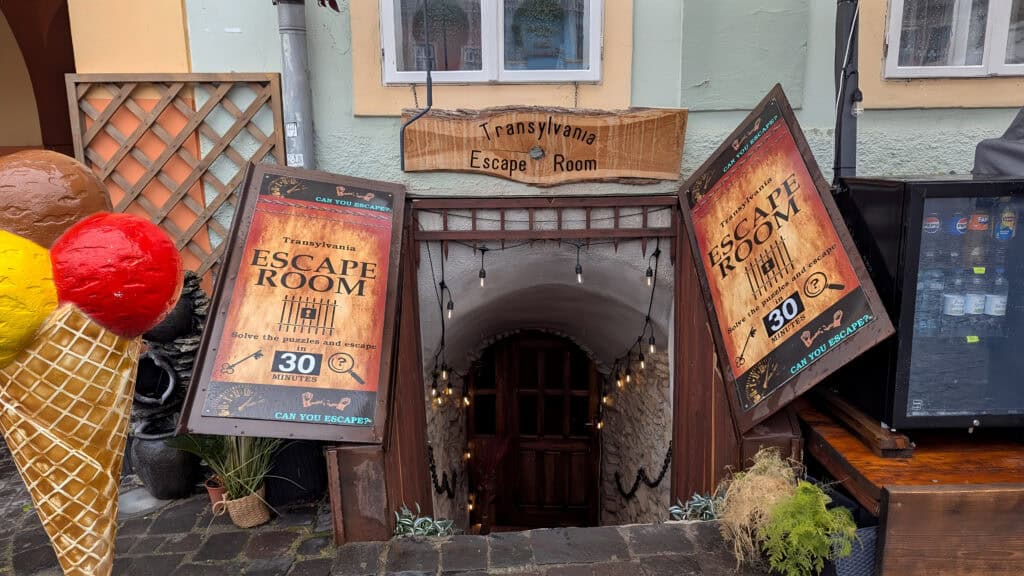
- Sighisoara Escape Room
The most popular way to visit Sighisoara is on a day trip from neighbouring cities, especially Brasov. Here are some options if this suits you better than travelling independently.
We chose to visit Sighisoara by public transport. I’ve included details on how we got to Sighisoara on the bus and where we stayed.
Where to Stay in Sighișoara
I don’t normally make specific accommodation recommendations – everyone has different budgets and priorities, and I’m sceptical of bloggers who list five hotels when they’ve clearly only stayed in one. But for Sighișoara, I’ll make an exception, because where you stay genuinely shapes the experience.
Many visitors, if they stay at all rather than day-trip from Brașov, end up in one of the larger hotels in the new town. Perfectly comfortable, I’m sure – but you’d be missing the point entirely.
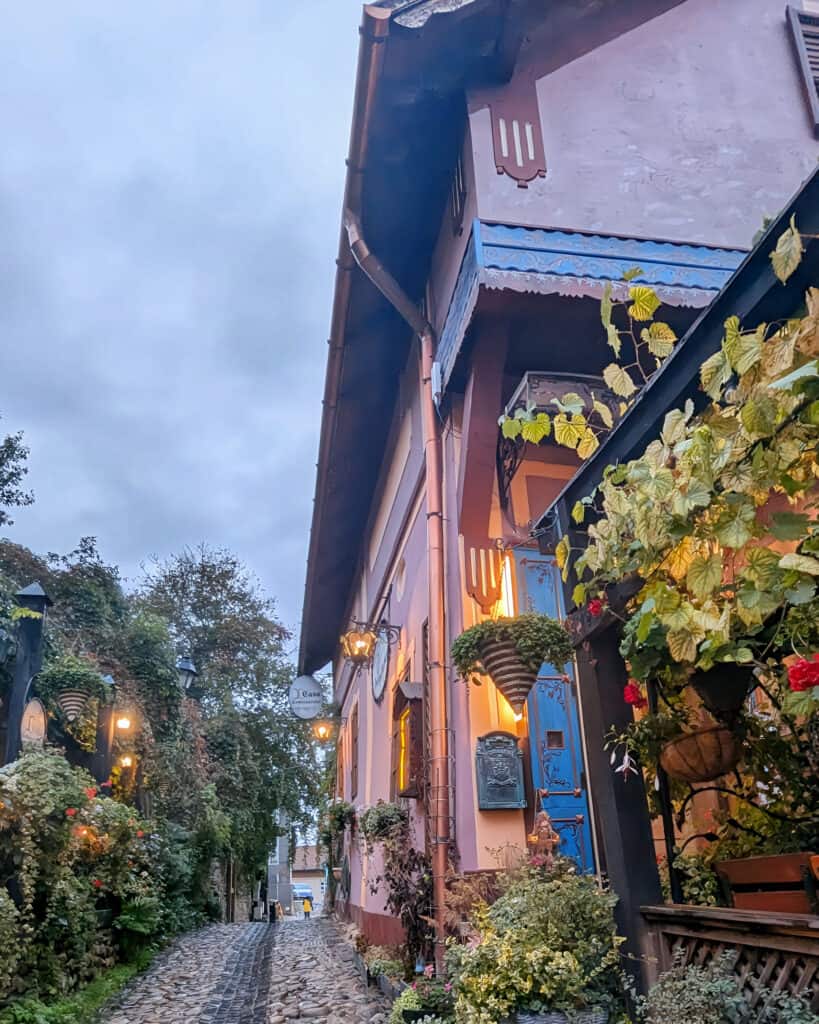
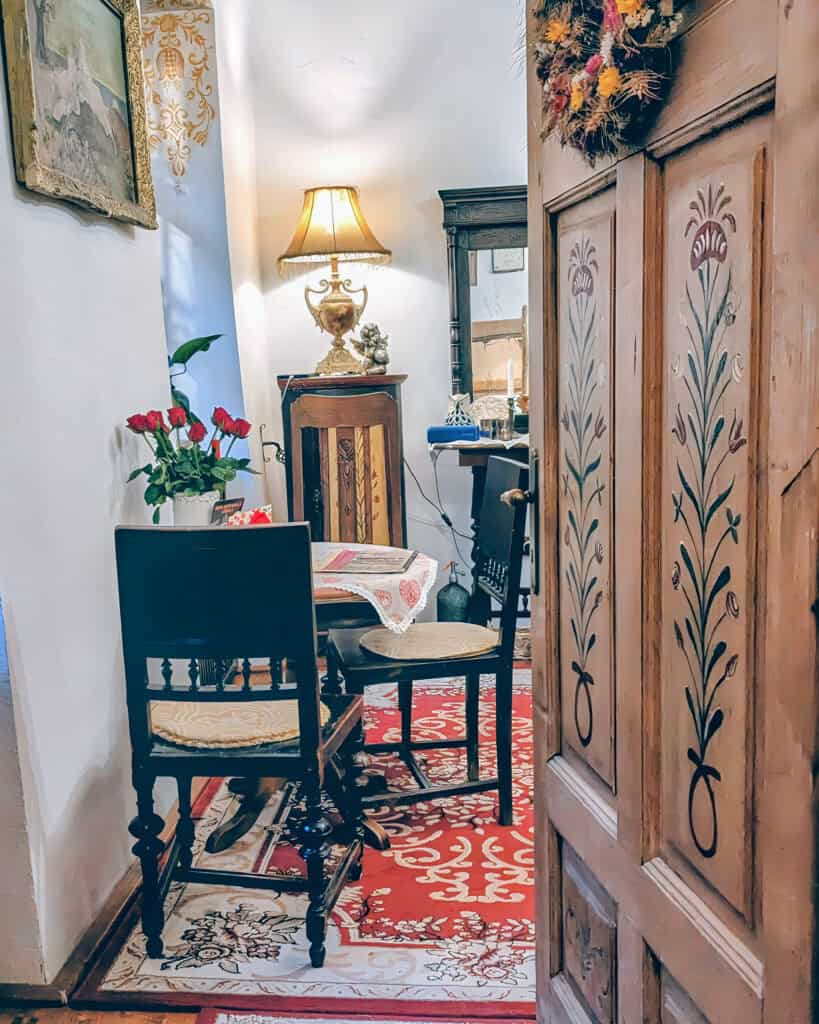
Casa Cositorarului is right in the heart of the citadel, a few steps from Piața Cetății, and it is genuinely unlike anywhere I’ve stayed. Decorated with antiques and medieval-style furniture – not in a theme-park way, but in the way of a building that has accumulated beautiful things over a very long time. One reviewer put it better than I could: “not an accommodation, but a museum.” The view from the room across to the Clock Tower was also special.
Then there’s the breakfast. We didn’t even realise it was included. The owner – warm, proud of her place, and evidently gifted in the kitchen – sets out an extraordinary spread of homemade food: eggs, jams, zacuscă, and local produce. It arrives like a small celebration rather than a hotel breakfast.
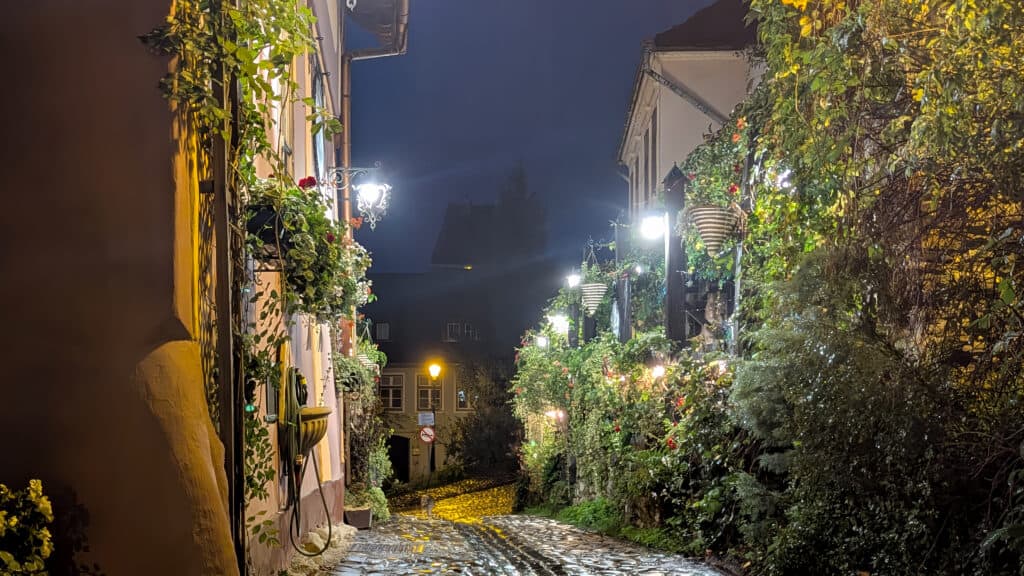
Staying here also means the citadel is yours once the day trippers head home. The cobbled streets after dark, with the towers lit and the crowds gone, are worth the trip alone.
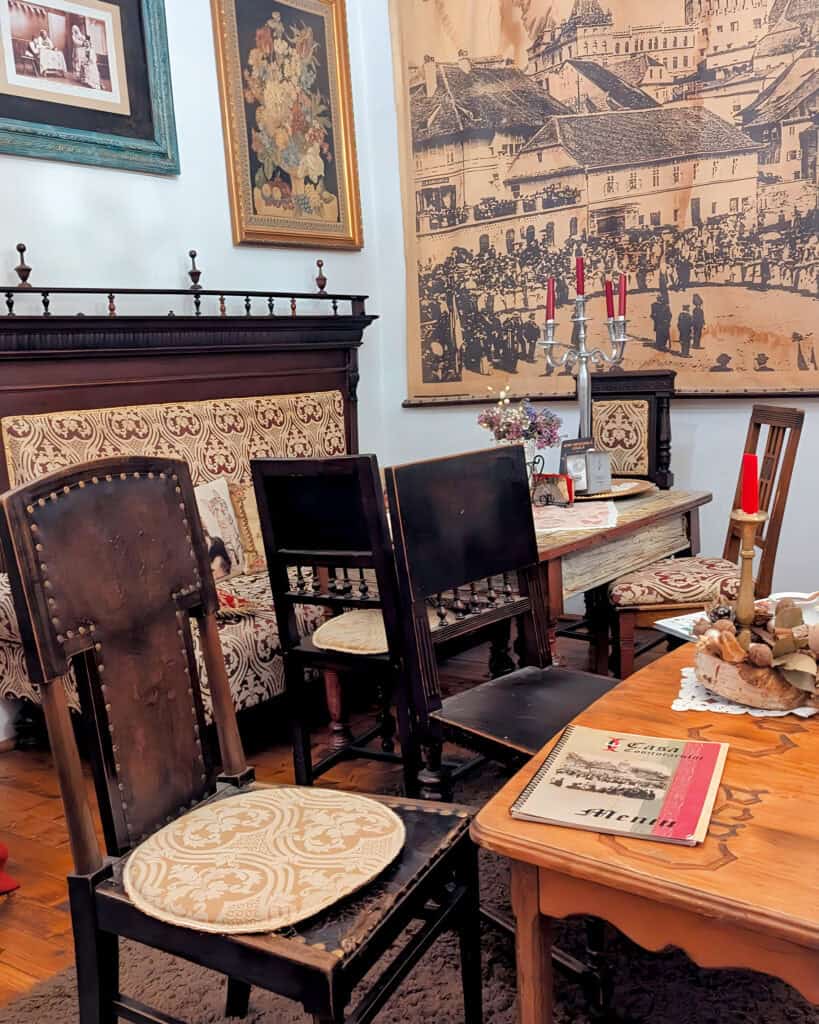
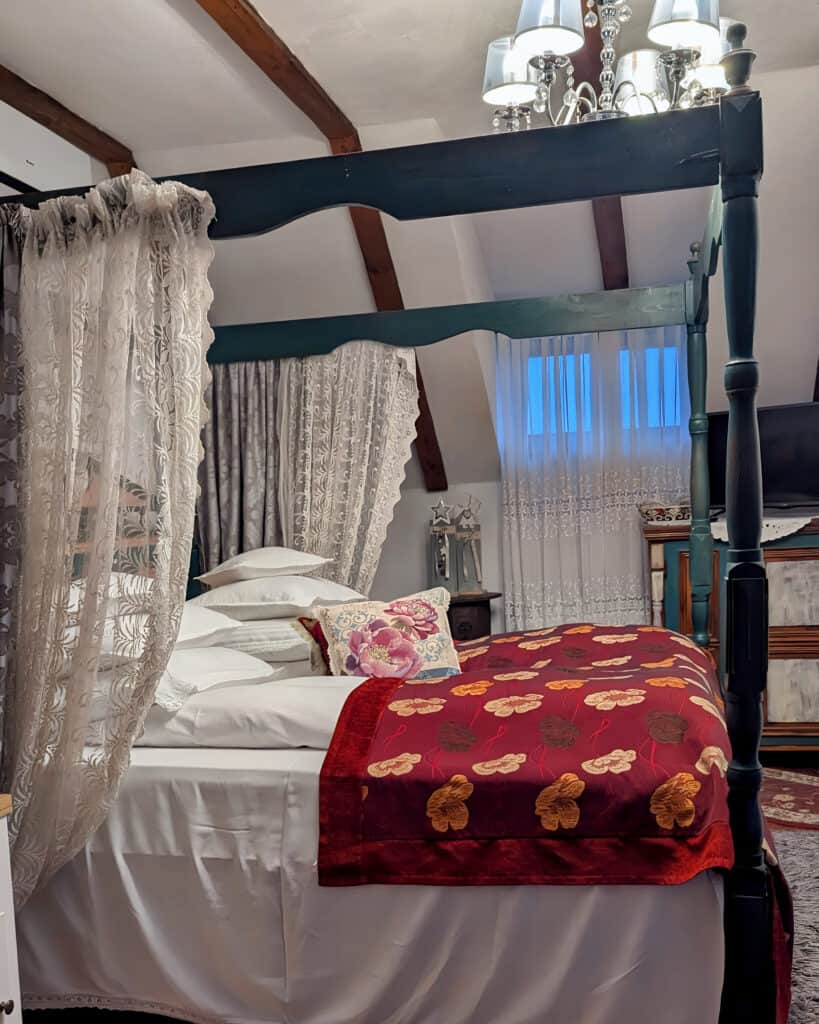
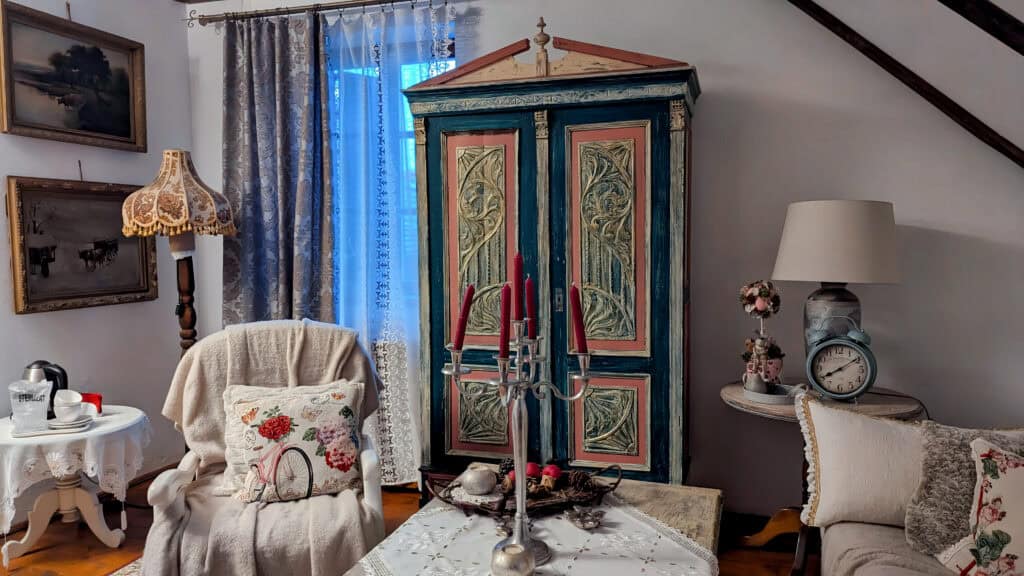
➡️ Book Casa Cositorarului on Booking.com
Getting to Sighisoara
We took the Flixbus from Brasov. The service is just under 2 hours. It’s not frequent and didn’t lend itself to a trip there and back in a day. So we took the opportunity to stay over, and we were so glad we did. I’ve marked the Flixbus bus stop on the map. It’s on the edge of town, just beyond Holy Trinity Church.
Frequently Asked Questions
For general advice on visiting Romania, including when to go, currency and getting around, see my Romania home page.
Here are some answers to some commonly asked questions for Sighișoara.
Is Sighișoara worth visiting?
Yes, without question. It’s known as the prettiest place in Romania. Step back in time to this UNESCO-listed citadel in the heart of Transylvania. It’s the birthplace of Vlad the Impaler and inspiration for Bram Stoker’s Dracula. too.
How long should I spend in Sighișoara?
A day is enough to see the main sights of Sighișoara. That said, for the full experience, I would definitely recommend staying overnight. Check my Where to Stay section for details of a unique, memorable (and budget-friendly) experience.
Is Sighișoara worth visiting independently, or is a tour better?
If your only opportunity to visit Sighișoara is on a tour, take it. Any visit to Sighișoara is worth it. But our independent trip from Brasov on Flixbus was straightforward. Once there, there’s the option to take walking tours, including ones that embrace the Citadel’s spooky side if that appeals to you. Check my tour section for all the options.
Sighisoara is Transylvania in one small, neat package. And if you only visited one place in Transylvania, I think it would be my top pick. But Transylvania has so much more. We visited while staying in Brașov, in the Carpathian Mountains and as part of a wider trip into Transylvania from Bucharest. Special mention too, to the bears at Libearty Bear Sanctuary, which I highly recommend for your trip to this region of Romania.
Have you visited Transylvania, or are you planning a trip? Does Sighisoara appeal? Let me know in the comments.
If you enjoyed this article, why not sign up for my monthly newsletter? Or follow my Facebook Page for more European Travel ideas?
Thanks for Reading!