Things to Do in Sarajevo: 20 Best Attractions and Local Tips
“When you go to Sarajevo, what you experience… is life”. Mike Leigh, English Film Director
Sarajevo had been on my list for a long time. After a few days in Belgrade, we crossed into Bosnia and Herzegovina via Tuzla, ticking off one of my last remaining Balkan countries – and a trip I’d been genuinely looking forward to. It didn’t disappoint.
The mountainous backdrop is dramatic, and so is the history. The assassination that sparked the First World War happened here. Less than a decade after hosting the 1984 Winter Olympics, the city endured a brutal siege during the 1990s conflict. Sarajevo is often called the “Jerusalem of Europe”, and within a few compact streets, you’ll find Ottoman mosques, Orthodox and Catholic cathedrals, and a synagogue. The shift from the old Ottoman quarter in the east to Austro-Hungarian façades in the west happens in a matter of steps.
If you still think Sarajevo is a hidden gem waiting quietly to be discovered, think again. The city is busy – and I found it that way in October, well beyond peak season. Bosnia, and Sarajevo in particular, are having a moment.
We spent four days exploring the city properly, which gave us time to venture beyond the centre and see more than just the headline sights. This guide brings together the key things to see, where to gain perspective (literally and historically), and what to eat while you’re doing it.

This guide may include a few affiliate links. If you choose to buy something through one of them, I may earn a small commission (at no cost to you). Thank you for supporting One Small Bag and helping keep this resource ad-free and independent.
Map of things to do in Sarajevo
Here’s a map I created that includes everything to see and do in this article for you to save and keep for your trip to Sarajevo.
Highlights within Baščaršija
If you’ve seen photos of Sarajevo, chances are they are from the old town, Baščaršija, which feels remarkably different from the Austro-Hungarian streets a few minutes away.
It follows the classic Ottoman layout: a tight cluster of cobbled craft streets radiating from a central square, with mosques, hans (inns), baths and little workshops tucked in between. The 15th-century core is still remarkably intact, given Sarajevo’s recent history.
Baščaršija is the obvious place to begin. I’ve marked the key sights on the map, but you don’t need a rigid plan. It’s a place to wander and take it all in. Pause for coffee. Peer into metal workshops. Buy something you didn’t know you needed. Then do it all again.
1. Start in Sebilj Fountain & “Pigeon Square”
Start in the central square – better known as Pigeon Square- and you’ll see why.
There are pigeons everywhere. And people selling little bags of “bird food”, which may or may not be wildlife-approved seed, some looked suspiciously like popcorn to me! If you decide to feed them, brace yourself. These birds are bold: prepare for an aerial ambush.

If you can see past the birds and the crowds, you’ll spot the elegant wooden Sebilj fountain at the centre. The current structure dates back to the 18th century. The symbolic heart of Baščaršija, it provided drinking water for travellers and locals. Today, it’s mostly a photo stop and a practical reminder of Ottoman hospitality going back centuries.
And do better than me, get there early before the crowds and bird food sellers wake up for the best photos with fewer people in them.
2 Shop in the Craft Streets and Markets
As you leave the square, you’ll find yourself in cobbled streets amidst stalls selling handicrafts and souvenirs, often handmade and of high quality. Look out for the embroidered text styles, wood and metalwork items, amongst the predictable postcard-and-magnet selection.
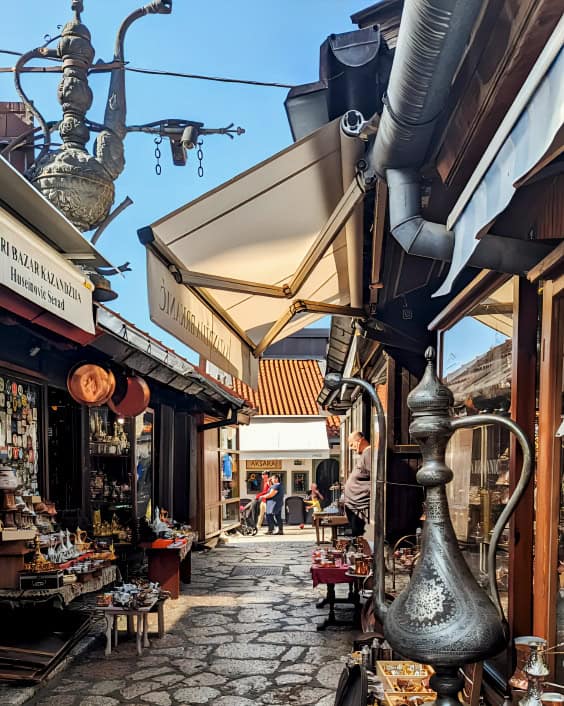

Kazandžiluk (Copper Street): One of Baščaršija’s oldest craft streets and a definite destination. Traditionally, it is home to copper artisans who produce coffee sets, trays, and household items. The street layout reflects the Ottoman guild system, where each trade occupied its own zone. While many workshops now cater to visitors, the street remains one of the clearest visual links to Sarajevo’s pre-industrial economy.
If you head further west, you’ll come to the Gazi Husrev‑beg Mosque. Beyond that, you’ll find more shopping streets, including Bezistan. Originally built to protect valuable goods such as silk and jewellery. Its stone vaulting and enclosed design contrast with the open streets of Baščaršija outside. The clock tower, with its highly unusual lunar clock, is also nearby; step outside the Bezistan to the stalls outside and look up. There’s also more shopping at our next stop, Morića Han, a former caravanserai.
3. Search out Sarajevo’s caravanserais
A visit to at least one former caravanserai (roadside inn) should be near the top of your list for Sarajevo. Morića Han (monks’ inn) is the obvious choice as it is by far the best preserved. Built, in or around the 16th century, to accommodate traders and their horses as they passed through the city, its enclosed courtyard and thick walls offered both security and shelter. Today it functions as a café and cultural space, but it’s easy to picture how Baščaršija operated within the wider Ottoman trade network. It’s a beautiful place to wander.


While Morića Han is the best-known, there are others. I’ve added two more to the map.
Kolobara Han: Sarajevo’s first caravanserei, built in the 15th century. There’s now a restaurant on the site, with the caravanserai’s remains in the gardens, and small shops built into the walls. Beautiful, but check the reviews if you want to eat there, because they weren’t great when we visited!
Tašlihan: Uncovered on the grounds of the Europa Hotel, you’ll find the remains of Tašlihan, another Sarajevo caravanerei in the hotel garden.
4 Visit the Old Town Mosques
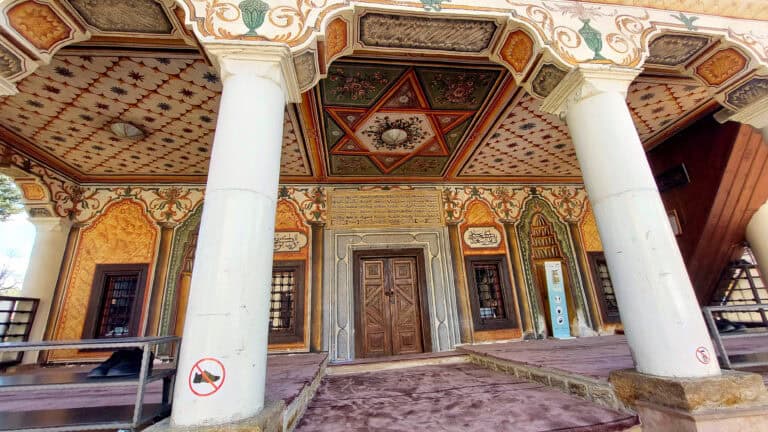
Baščaršija Mosque: Just off the square, you’ll spot Baščaršija Mosque, a striking yellow-toned mosque, built in the early 16th century. It originally served merchants and travellers working in the nearby market streets, just like its namesake Baščaršija. A target in the Bosnian war, the Baščaršija Mosque was heavily shelled and later carefully restored. It’s often open to visitors for a look inside.

Gazi Husrev‑beg Mosque: Sarajevo’s most important Islamic Monument and one of the finest examples of Ottoman architecture in the Balkans. Completed in 1531, it formed the centrepiece of a larger endowment that included schools, baths, a library and markets. The mosque remains an active place of worship, and it’s definitely worth visiting the inside if it’s open to visitors.


5 Spot the Lunar Clock
The Sarajevo Lunar Clock near Gazi Husrev-beg Mosque is unusual in that it measures lunar time rather than solar time. It traditionally marks prayer times according to the Islamic calendar and must be manually adjusted throughout the year. It’s a small but telling example of how religious practice shaped daily life in old Sarajevo.


6 Discover Church of the Holy Archangels
The old Orthodox Church, the Church of the Holy Archangels Michael and Gabriel, dates to the 16th century and is among the oldest Orthodox churches in the Balkans. Its modest exterior contrasts with a richly decorated interior and a small but important museum collection. Located steps from mosques and synagogues, it quietly reinforces Sarajevo’s long-standing multi-religious character.

7 Admire the City Hall

Sarajevo City Hall sits right on the edge of the old town, impossible to miss with its striped pseudo-Moorish façade and riverfront position. Completed in 1896 under Austro-Hungarian rule, it later became the National Library. Shelled in August 1992 during the siege, the building burned for days, and an estimated two million books and manuscripts were lost. What stands today is the result of a painstaking reconstruction completed in 2014. Inside, you’ll find a soaring central atrium beneath a stained-glass dome, grand staircases, exhibition rooms, and restored decorative details that hint at the original splendour, even if much of the library’s collection is gone forever. It’s beautiful, yes, but it’s also sobering.
8 Learn the story of Inat Kuca
Closer to the river, you’ll almost certainly spot the striking Inat Kuća. Literally meaning “House of Spite”, and linked to a well-known Sarajevo legend. When Austro-Hungarian authorities sought to redevelop the riverbank, the owner reportedly agreed to move only if the house were rebuilt brick by brick on the opposite bank. Whether entirely true or not, it’s a good story shorthand for Sarajevo’s stubborn independence of spirit.

9 Latin Bridge: The spot where WW1 started
A few minutes’ walk west from Baščaršija brings you to the modest stone arches of the Latin Bridge. It’s not grand. It’s not especially dramatic. And yet this is where one of the most consequential events of the 20th century unfolded.
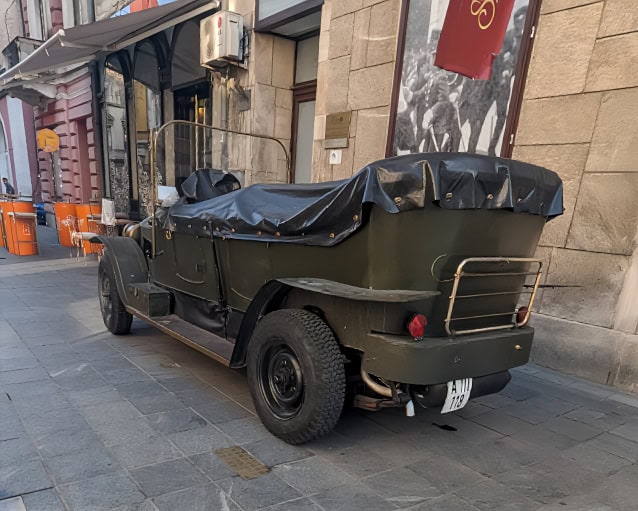
On 28 June 1914, Archduke Franz Ferdinand was assassinated just beside the bridge by Gavrilo Princip – the spark that ignited the First World War. There’s no theatrical staging here, just a simple plaque marking the approximate spot on the pavement. It’s easy to walk past if you’re not looking.
Right next door, you’ll find the Museum of Sarajevo 1878–1918, which focuses on the Austro-Hungarian period and the assassination itself. It’s relatively small, but if you have time, it provides useful context. Even if you’re not a history obsessive, pause here for a moment. Few places in Europe allow you to stand quite so casually on a spot that shifted the direction of world politics.
Beyond Baščaršija: Bistrik & the Austro-Hungarian Quarter
Just west of Baščaršija, Sarajevo changes almost mid-pavement. The Ottoman cobbles give way to wider streets, pastel façades and a distinctly Central European feel. It’s one of the clearest architectural mood swings in Europe — and it happens in a matter of metres.
10 Cross Sarajevo Meeting of Cultures
There’s even a literal line in the street marking where East meets West. Stand with one foot on each side, and you’re symbolically between Ottoman and Austro-Hungarian Sarajevo. It’s slightly theatrical, yes — but it neatly captures what makes this city so compelling. Take a moment here. Look behind you towards the minarets. Then look ahead to the orderly façades and civic buildings. The contrast is immediate.
11 Walk along Ferhadija
Continue west along Ferhadija, the main pedestrian artery, lined with shops, cafés and some of the city’s most recognisable buildings. It feels lighter and more open than Baščaršija, with Austro-Hungarian symmetry replacing Ottoman intimacy. It’s an easy walk, and you’ll pass several key landmarks without needing a map.
12 Visit Sacred Heart Catholic Cathedral
The twin spires of the Sacred Heart Cathedral rise prominently along Ferhadija. Built in 1889, it’s a clear statement of the city’s Catholic presence during the Austro-Hungarian era. The interior is relatively simple compared to some grand European cathedrals. Outside, you’ll often find people meeting “at the cathedral” — it’s one of Sarajevo’s most recognisable reference points. It’s also the place closest to our favourite restaurant in Sarajevo. Klopa, you really must not miss this one.

13 Discover the Orthodox Cathedral
Just off Ferhadija, the domes and striped façade of the Orthodox Cathedral Church of the Nativity of the Theotokos rise above a small park. Built in the 1860s, it’s one of the largest Orthodox churches in the Balkans, which you might not expect given how compact the surrounding streets feel. Step inside for a very different atmosphere from the Catholic cathedral. Dark wood, gilded iconostasis, hanging lamps, and richly painted icons make a striking contrast.
Outside, the park in front of the church is full of everyday life, with fewer tourists than nearby Ferhadija. We found a large outdoor chessboard with a game in full swing. In the same park stands the Monument to the Children of Sarajevo, a moving memorial to the children killed during the siege. The sculpture shows a child encircled by birds within a globe-like frame — delicate in form, devastating in meaning once you read the inscription. Like so much in Sarajevo, it sits in ordinary public space rather than behind barriers, woven into daily life.


14 Go to the Museum of Crimes Against Humanity and Genocide
If you want a deeper understanding of the 1990s war, this small but powerful museum doesn’t soften the edges. Through photographs, personal stories and artefacts, it documents the siege and the broader conflict in Bosnia and Herzegovina. It’s not a light visit. But it provides important context for the city you’re walking through — particularly if you’ve already noticed the Sarajevo Roses set into the pavement.
15 Find the Central Market
Markale is Sarajevo’s main covered market – lively, colourful and integral to daily life. You’ll see stalls piled with fruit and vegetables, local cheeses and the usual mix of shoppers doing their rounds. It’s also a place of memory. Two shelling attacks during the siege took place here, and a plaque marks the victims. Like much of Sarajevo, it’s an ordinary place carrying extraordinary history.

16 Take a moment at the Eternal Flame.
At the western end of this stretch stands the Eternal Flame, lit in 1946 to commemorate Sarajevo’s liberation during the Second World War.
This part of Sarajevo feels more formal, more European in the Central European sense — but it’s only a short walk from the call to prayer in Baščaršija. That proximity is what makes the city so distinctive. You don’t need to travel across town to experience the shift. You need to keep walking.
17 Catch a view of the city from above
We caught a wonderful view of Sarajevo as we arrived on the bus from Tuzla, close to the Serbian border. If you don’t arrive by road, there are plenty more options for a wonderful view over Sarajevo.
View from the Yellow Fort
If you’re already in Baščaršija, the simplest option is to walk up to the Yellow Fortress (Žuta Tabija). It’s not a long climb, but it is steep in places. At the top, you’re rewarded with one of the classic postcard views: red rooftops in the foreground, minarets and church towers rising from the valley, and hills layered behind. It’s especially popular with both locals and visitors at sunset.
We skipped this, getting diverted at Sarajevo brewery on the way and opted for my next option, the cable-car instead, but I’ve marked the yellow fort on the map, in case you do better than we did!
Take the Trebević Cable Car & discover the Olympic Legacy
If you want a quick sense of Sarajevo’s geography, take the cable car up Mount Trebević. The ride itself only takes a few minutes, but the shift in perspective is dramatic. One moment you’re among trams and cafés; the next you’re gliding above red rooftops with the valley opening out beneath you.

From the top, the views stretch across the entire city, making it easier to understand just how encircled Sarajevo is by hills, something that becomes more sobering when you remember the siege. Today, though, Trebević feels peaceful, with walking trails and fresh mountain air just minutes from the centre.
A short walk from the cable car station lies one of Sarajevo’s most striking reminders of the 1984 Winter Olympics, the abandoned bobsleigh track. Now covered in graffiti and slowly being reclaimed by forest, You can walk along the curves where athletes once raced, which feels slightly surreal given what the city endured just a decade later.

It’s an easy half-day addition to a Sarajevo itinerary, and I’ll cover the cable car ride and Olympic site in more detail in a separate post.
Avaz Twist Tower
If you’d rather skip the hills altogether, head to the Avaz Twist Tower in the modern business district. It’s Sarajevo’s tallest building, and the 36th floor viewing platform offers a 360-degree panorama without the climb. There’s a bar and cafe at the top too. It’s about 30 mins walk from the old town or bus 41 will get you there directly. I’ve marked it on the map.

Architecturally, it’s very different from anything in the old town, all glass and contemporary curves, but that’s part of the point. From the top, you can see the full sweep of the valley, the older Ottoman core, the Austro-Hungarian quarter and the newer developments stretching west.
Beyond the Centre
Once you’ve explored the old town and walked west along Ferhadija, it’s worth venturing a little further afield. Sarajevo is compact, but some of its most interesting spots sit just beyond the immediate centre.
18 Explore Ilidža and Vrelo Bosne
At the western edge of the city, Ilidža feels noticeably greener and calmer. From here, Velika Aleja – a long, tree-lined avenue – leads towards Vrelo Bosne, the spring of the River Bosna.
It’s a gentle, flat walk (or carriage ride if you’re feeling traditional), ending at a series of clear pools and wooden bridges where the river begins. After the intensity of Sarajevo’s history and compact streets, this area feels almost restorative.
I’ll cover the full trip to Vrelo Bosne in a separate post, but if you have half a day to spare, it’s an easy and worthwhile escape from the centre on the tram.

One of the Cafes in Vrelo Bosne 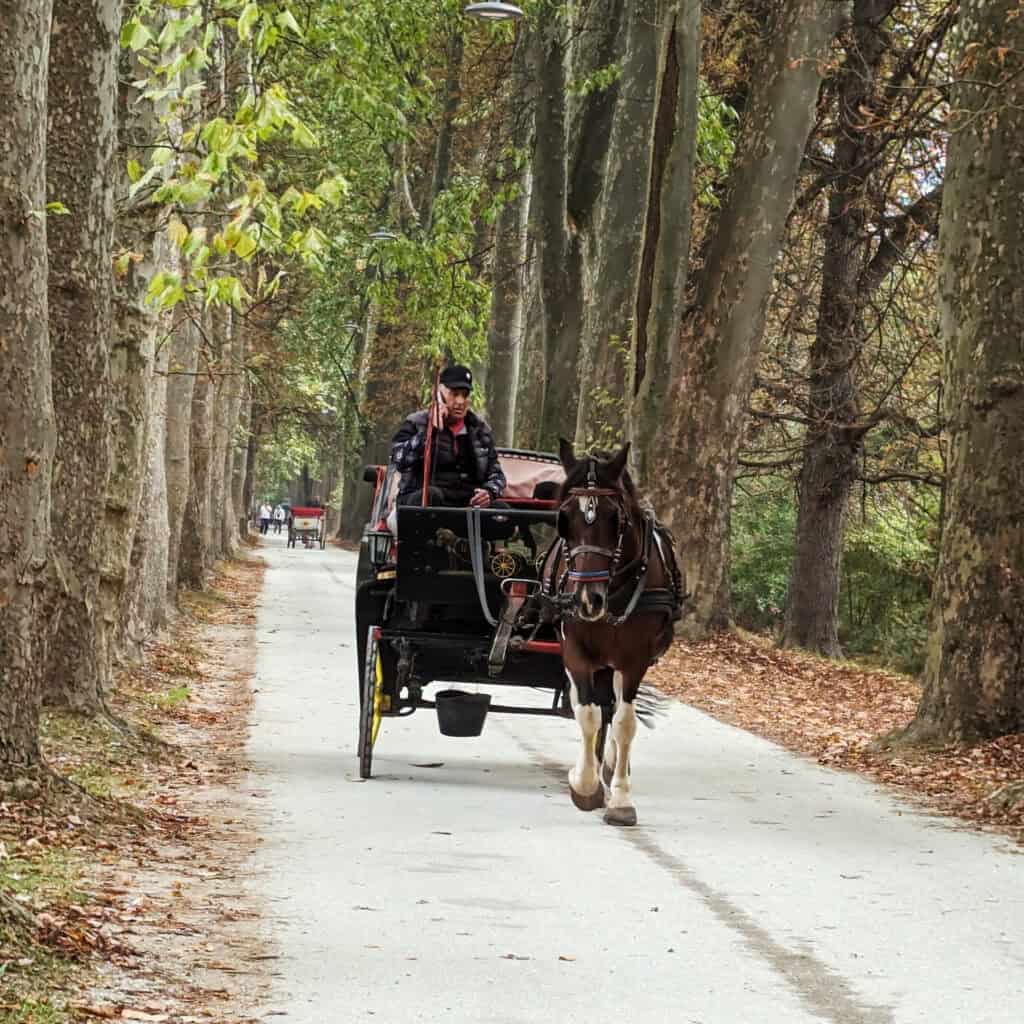
Horse-Drawn Cart in Vrelo Bosne
19 Learn About the Siege: Sarajevo Tunnel of Hope
For a deeper understanding of the 1992–1996 siege, visit the Tunnel of Hope near the airport. During the war, this narrow underground passage connected the besieged city with territory beyond the blockade, allowing supplies — and people — to move in and out.
Today, part of the tunnel has been preserved as a museum. It’s not a glossy attraction, but it’s powerful. Walking through the confined space makes the scale of Sarajevo’s ordeal feel immediate rather than abstract.
It’s a little outside the centre, so you’ll need to plan transport or join a tour, which is something we didn’t have time for, unfortunately. It’s a popular trip.
20 Visit the Academy of Fine Arts
Back closer to the centre, the Academy of Fine Arts sits on the south bank of the Miljacka, housed in a striking former Evangelical church. Its copper dome and ornate façade make it one of the most photogenic buildings along the river. We didn’t go inside, but I took a photo as we passed it, as the building was so striking and slightly incongruous with everything else close by.

21 Take a Day Trip beyond Sarajevo
If you’re short on time and not planning to travel further around Bosnia and Herzegovina independently, I’d strongly recommend taking a full-day tour from Sarajevo. It’s a long day, expect an early start and a fair amount of driving, but it’s an efficient way to see some of the country’s most striking landscapes and historic towns in one go.
The route typically heads south through the mountains, following the Neretva River, and covers these highlights:
Konjic: A small riverside town known for its Ottoman stone bridge spanning emerald-green water. It’s a quick stop, but a scenic one – and your first real sense of how dramatically the landscape shifts once you leave Sarajevo’s valley.
Blagaj: This was my favourite stop. Home to the 16th-century Dervish monastery built dramatically beneath a towering cliff, beside the source of the Buna River. It’s one of the most photogenic spots in the country. We had enough time here to take a tour inside, have a drink, and take photos outside.
Počitelj: A hillside village of stone houses, narrow steps and fortress ruins, overlooking the Neretva valley. It feels almost Mediterranean, particularly in warm weather. The climb to the top is steep but short, and the views make it worthwhile.
Kravica Waterfall: A wide curtain of waterfalls set within a natural amphitheatre. I went for a swim. It’s a beautiful place to relax and take in the scenery.
Mostar: The day ended in Mostar, famous for the reconstructed Stari Most (Old Bridge). The old town is lively and colourful, and while it can feel more touristy than Sarajevo, the bridge itself is undeniably impressive, particularly when the light catches the river below. I wish we had more time here. Our tour guide was generous with his time, and we stayed as long as we could.

The Stone Bridge at Konjic 
Old Bridge at Mostar 
Dervish Monastery, Blagaj Tekke 
Kravica Waterfall:
It’s ambitious to cover all of this in a single day, and you won’t see everything in depth. But if you want a broad introduction to southern Bosnia and Herzegovina – mountains, Ottoman heritage, waterfalls and one of the country’s most recognisable landmarks, it’s a strong option, and I would highly recommend it.
➡️ Day Tour to Konjic, Blagaj, Počitelj, Kravica Waterfall and Mostar from Sarajevo
I’ll share more details about the route, timings and what you could reasonably see by public transport if you didn’t want to do a tour in a separate post. But as a snapshot of the country beyond Sarajevo, it’s hard to beat.
Our food and drink Experience in Sarajevo
Bosnian food is hearty, generous and refreshingly unfussy. If you like grilled meat, fresh bread and simple salads, you’ll be very happy here. If you’re a vegetarian, you won’t be without options, but it will be a little hit and miss. The cuisine reflects Ottoman influence with Central European touches, featuring less spice than you might expect and a greater emphasis on charcoal grills and slow-cooked dishes.
The first thing to try is ćevapi (or ćevapčići): small grilled minced-meat sausages served with soft somun bread, chopped onions, and often a spoonful of kajmak, a rich, creamy dairy spread somewhere between clotted cream and soft cheese. It’s simple and addictive.
Look out for:
- Burek (and other filled pastries like sirnica with cheese or zeljanica with spinach)
- Pljeskavica (a Balkan-style burger, usually enormous)
- Begova čorba (Bey’s soup — a thick chicken and vegetable soup)
- Mixed grill platters
- Strong Bosnian coffee, served the traditional way in a džezva
Salads tend to be crisp and lightly dressed — cabbage, tomato, cucumber — designed to balance the meat rather than compete with it.
Portions are generous, prices are reasonable, and meals are rarely rushed. Bosnia isn’t about fine dining theatrics; it’s about solid food, good company and leaving the table satisfied.
Let’s start with the best, and if you’re not a meat eater, look away.
Our favourite meal at Klopa

This was a shared platter at Klopa, a restaurant near the Catholic Cathedral, serving traditional Bosnian food with a modern twist. I can’t remember exactly what this was, other than we went in, saw the dish being served on other tables, and asked for the same. A beautifully cooked and presented meat platter with generous salad and bread. Definitely a highlight. If you eat out only at one place in Sarajevo, I highly recommend Klopa. We managed to get a table without booking, but I wouldn’t rely on it. I’ve marked it on the map.
Bosnian Coffee (and Something Sweet)
Coffee in Bosnia is slow, strong and taken seriously. Don’t expect a takeaway cup and a brisk walk. Traditional Bosnian coffee is served in a small metal pot called a džezva, with the thick, unfiltered coffee poured into tiny cups and often accompanied by a sugar cube and a glass of water. It’s similar to Turkish coffee, but locals will gently remind you it’s Bosnian.

Bosnian Coffee in our hotel 
The coffee is rich and intense, with grounds settling at the bottom of the cup. It is best enjoyed slowly and often served with something sweet: flaky baklava, syrup-soaked and unapologetically rich, or small cubes of lokum (similar to Turkish delight). The combination of strong coffee and very sweet pastry works perfectly, especially in one of the small cafés around Baščaršija, where time seems to stretch slightly.
Beer in Sarajevo
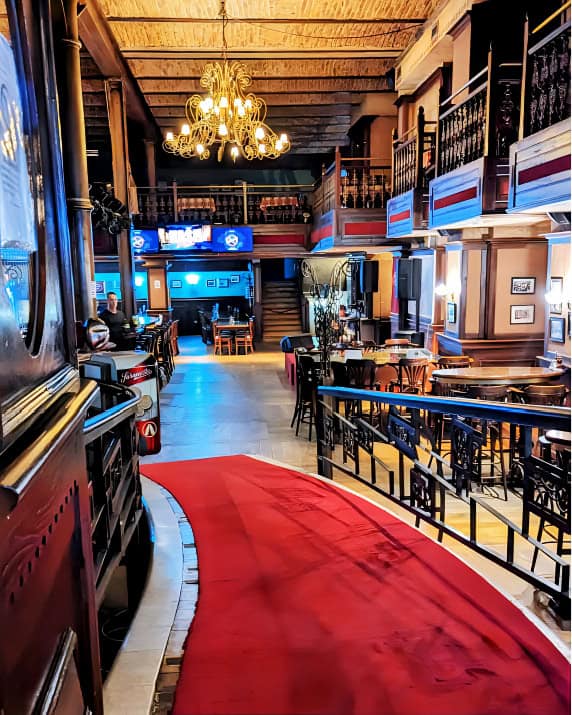
If you didn’t know, I’m a beer drinker, so I like to try the beers wherever I go. There’s a brewery in Sarajevo, which is beautiful inside. Our beers were (mostly) good, maybe not exceptional, but it’s a beautiful setting to spend the evening. Food is served, but it was more expensive than the other food we ate in Sarajevo.


Where to stay in Sarajevo
I would heartily recommend staying right in the centre of Baščaršija. We stayed at the hotel Divan, which looked out directly onto the cobbled streets and cafes of the old town. I would highly recommend it.

Our Hotel, Hotel Divan, in the Background 
The Cobbled streets of the old town close to the hotel
So that brings me to the end of this article on things to do in Sarajevo. I hope if you’ve got this far, you’ve found it useful. If you’d like to see more posts from One Small Bag, I do have a monthly newsletter. I’d love it if you join me. I promise I won’t spam you! I have more posts coming soon from Bosnia and Herzegovina.
Thank you for reading!