Top Things to do in Belgrade: Beyond the Nightlife
Serbia was one of the last European countries we hadn’t explored, so that made it reason enough to plan a visit. We were aware of Belgrade’s reputation for lively nightlife along the Sava River, and we found that vibrant spirit continued in Skadarlija, the Bohemian quarter, and in bars across the city.
Kalemegdan Fortress and the Church of Saint Sava dominate Belgrade’s skyline, while the ultra-modern waterfront development is becoming ever harder to ignore, and all three are worth seeing.
But there’s far more to it than nightlife and big statements: the city offers a solid mix of cultural and recreational attractions, making it a fascinating place to explore day or night. So without wasting more time, here’s our trip report covering things to do in Belgrade from our visit to one of Europe’s least-visited capital cities.
This guide may include a few affiliate links. If you choose to buy something through one of them, I may earn a small commission (at no cost to you). Thank you for supporting One Small Bag and helping keep this resource ad-free and independent.
Rather than rattling through a long tick-list of things to do in Belgrade, it makes more sense to explore Belgrade by neighbourhood. So I’ve grouped the main things we did, and a few we missed, across the three central municipalities: Stari Grad (the historic core), Vračar (home to St Sava), and Savski Venac (the waterfront and key transport hubs). I’ve also included a map covering everything mentioned, so you can save it and use it to plan your own visit.
Map of Things to do In Central Belgrade
Things to do in Stari Grad
Stari Grad is Belgrade’s historic old town, centred around Kalemegdan Fortress and the confluence of the Sava and Danube rivers. It’s compact, walkable, and home to many of the city’s key sights, museums, cafés, and older streets.
1 Kalemegdan Fortress
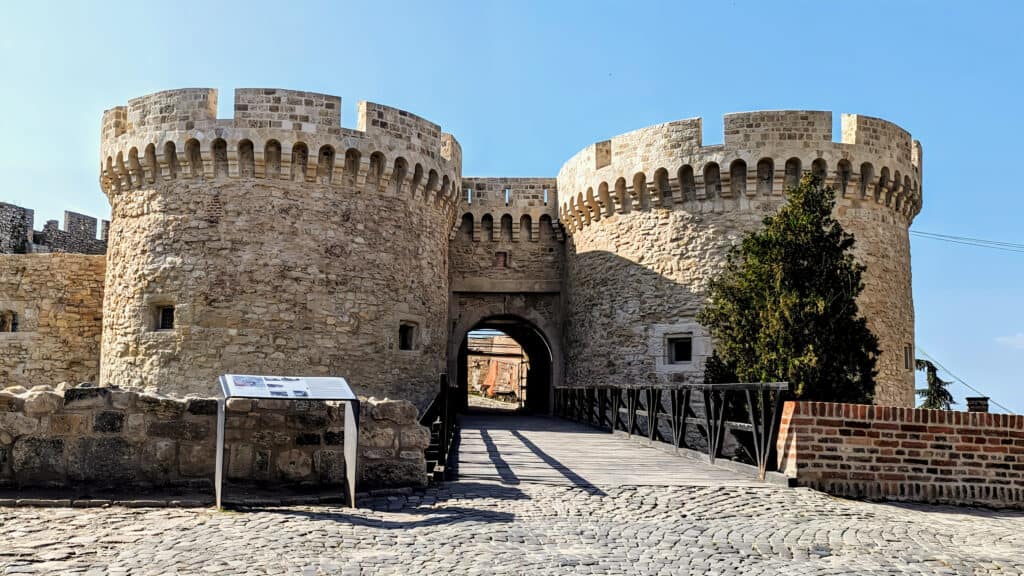
So let’s start with one of the biggest draws in Belgrade: the magnificent Belgrade Fortress or, to give it its correct title, Kalemegdan Fortress. There’s been a fortress in this spot, perched high above the Danube and Sava for nearly two thousand years. And the view from the ramparts fully justifies its position and the hype.
Upper Fortress
The fortress is free to enter, and the first thing to do when you arrive is to head to the top for the best views of the city. The Sava and the Danube meet beneath the fortress walls, and looking across the water, you’ll spot the modern municipality of Novi Beograd and the historic district of Zemun too.
The Victor Monument (Pobednik) stands here at Belgrade Fortress. Serbia unveiled the statue in 1928 to commemorate victories in the Balkan Wars and the First World War, originally planning to install it in Terazije Square. Objections to its nudity instead led it to the fortress, where it now rises on a 14-metre-high Doric column, its modesty safely elevated above the confluence of Belgrade’s rivers.
Scattered around this upper section are several historic structures, including the Roman Well, the Great Gunpowder Warehouse, and the Military Bunker. The guided Belgrade Fortress underground tour will take you through the tunnels, bunkers, and hidden chambers beneath the walls. There’s also a clock tower here – and unlike its counterpart at the fortress in Novi Sad, this one has its hands on the right way round.

Victor Monument (Pobednik) close up at Kalemegdan Fortress Clock Tower on the walls of Kalemegdan fortress


The Lower Fortress and Ružica Church
From the Upper Fortress, paths and steps lead down into the Lower Fortress. For me, the most memorable stop here was Ružica Church. It doesn’t look especially striking from the outside, but inside it’s unexpectedly rich, with frescoes and gold decoration typical of Orthodox churches.

Inside the Ruzica church within the Belgrade fortress Chandelier made of ammunition at Ružica Church, Kalemegdan fortress,


There is one very unconventional feature. Swords, bayonets, rifle parts, and shell casings adorn the chandeliers. Ružica was badly damaged during the First World War and rebuilt in the early 1920s using materials on hand, including spare and discarded weaponry. It’s not the first time we’ve seen a war theme in a Balkan church either; it brought to mind the fortress church in Veliko Tarnovo, where the paintings depict battle scenes!
There are plenty of cannons and other weaponry on display on both the upper and lower levels of the fortress, and a Military Museum too, which you need to pay to enter.

2 Kalemegdan Park
Wrapping around the fortress walls, Kalemegdan Park faces the rivers and provides a generous green buffer between the city and the water. It’s a popular spot with both locals and visitors to relax and enjoy one of Belgrade’s most atmospheric open spaces.

3 Knez Mihailova Street
From the fortress, walk along Knez Mihailova Street, Belgrade’s main pedestrian thoroughfare and one of its liveliest stretches. It’s a bustling, attractive street lined with shops, cafés, street performers, and elegant 19th-century buildings. You’ll want to spend a little time here, soaking up the atmosphere and enjoying the constant comings and goings.

4 Republic Square
Knez Mihailova leads directly to Republic Square, which sits right at the heart of the city. It’s a popular rendezvous point. And if you’re feeling a bit disoriented, it’s somewhere everyone can point you towards.
There’s a real mix of styles and activity in the square. The National Museum of Serbia, with its neoclassical façade, and the prominent equestrian statue of Prince Mihailo are the most eye-catching features (both pictured). Much of the surrounding architecture is less grand, but it’s still a good place to people-watch and get your bearings. Republic Square is also a cultural hub, home to the National Theatre and the Boško Buha Theatre. There’s also an abundance of offices, shops, cafés, and the city’s cultural centre.

5 Skadarlija
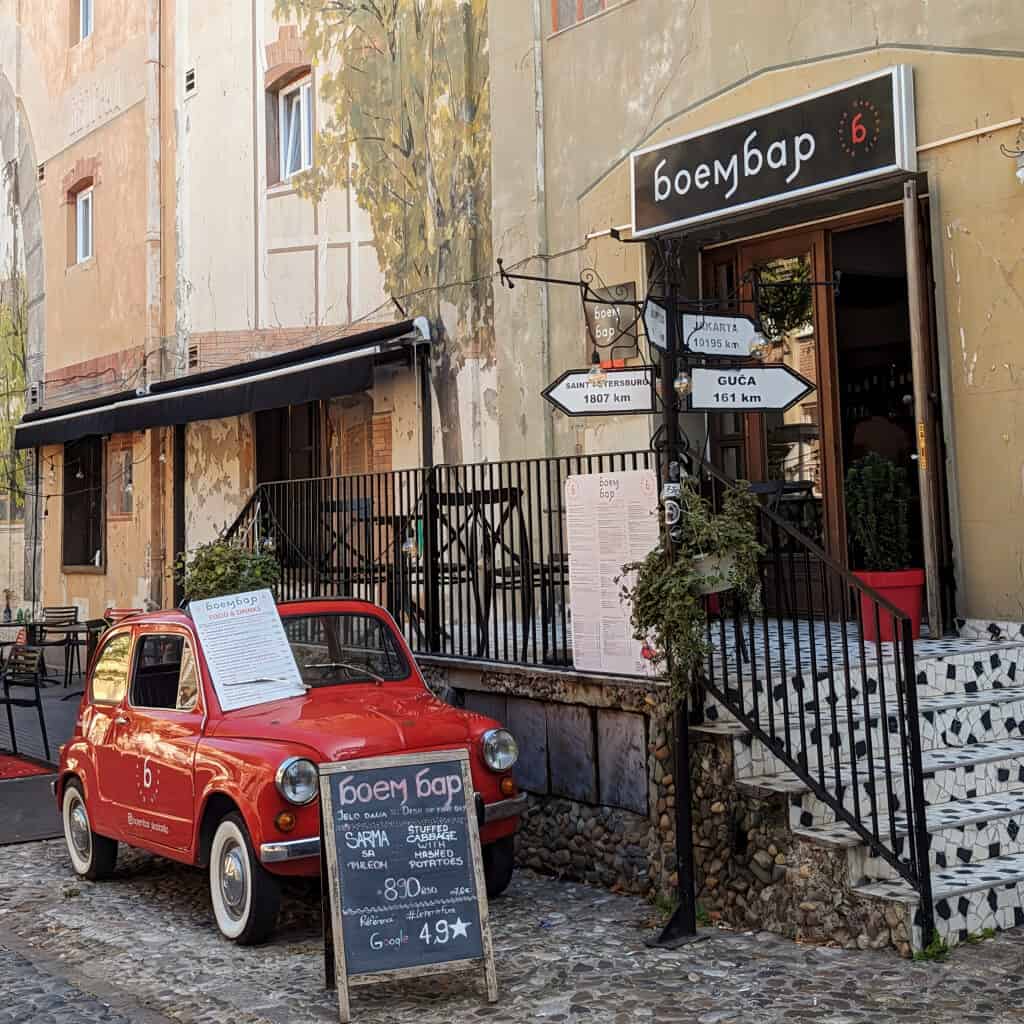
Just a few minutes’ walk from Republic Square, you can wander into Skadarlija, one of the most recognizable parts of Belgrade’s old town. Traditionally frequented by artists and intellectuals, it’s known as the city’s Bohemian Quarter or the Serbian Montmartre. These days, it’s undeniably one of the more touristy areas of the city, but it still feels lively rather than contrived, and it’s popular with locals too.
Skadarlija is all cobbled streets, low-rise buildings, cafés, restaurants, and bars, with plenty of visual distractions along the way: street art, quirky sculptures, flowerpots, and even a replica of Sarajevo’s Sebilj Fountain. It’s an easy place to spend time, especially if food, wine, and live music feature high on your Belgrade wish list.
Skadarlija in Belgrade Brasseerie in Skadarlija street, the bohemian heart of Belgrade.

There’s no shortage of places to eat and drink here. These are the ones we tried and would happily recommend:
- Zavičaj Skadarlija for a traditional Serbian feast and a genuinely warm welcome
- DOGMA Craft Beer Station for local craft beer and excellent people-watching on the main drag
- Bluz i Pivo, tucked away in a colourful corner and doubling as a live music venue
We stayed at Belgrade Inn on Francuska Street, with Skadarlija right on the doorstep. A very convenient base for exploring the city, with a comfortable room and quality breakfast included.

While this covers some of the main things to do in Stari Grad, exploring without a fixed agenda is the main appeal in cities like Belgrade. There’s such a contrast of styles and things to see.
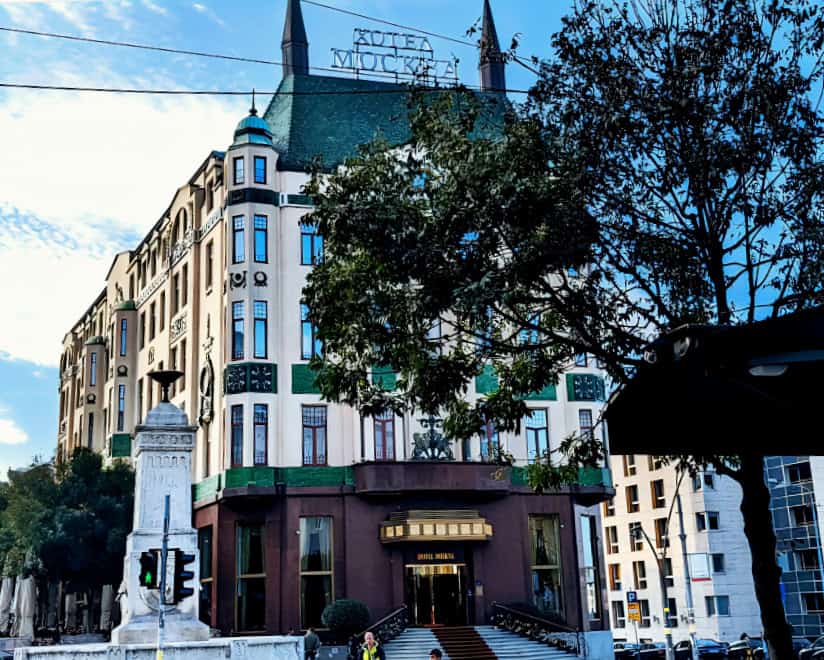
Terazije is one such example. It’s one of Belgrade’s older central squares between Stari Grad and the river. Its main landmark is the historic Hotel Moskva, a striking turreted early-20th-century building.
Things to do in Vračar
Vračar is a leafy, historic municipality in central Belgrade, stretching south from Slavija Square towards the Temple of Saint Sava. It’s known for its parks, cafés, traditional kafanas, the popular Kalenić Market, and a scattering of more upmarket boutiques.
If you leave Stari Grad and head south along Kralja Milana, you’ll naturally find yourself in Vračar and its most dominant landmark, the Church of Saint Sava.
6 Church of Saint Sava
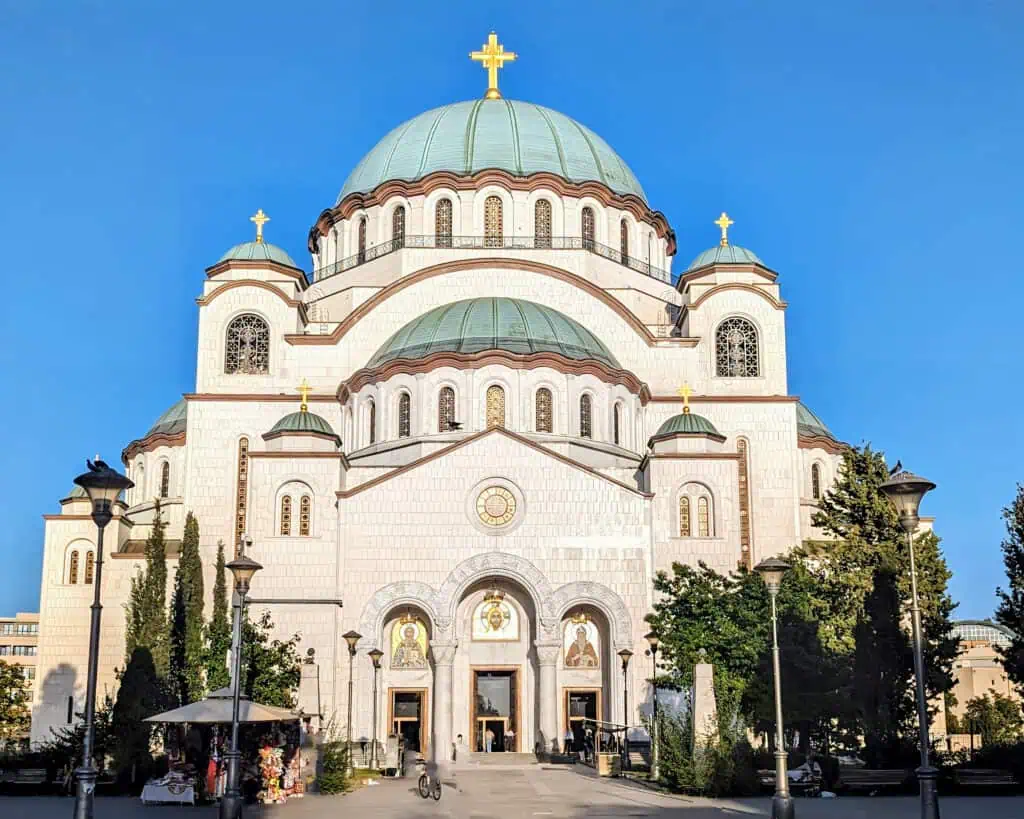
The Temple of Saint Sava is the largest Orthodox church in Serbia and among the largest in the world. It’s named after Saint Sava, the founder of the Serbian Orthodox Church, and stands on the Vračar plateau beside the National Library of Serbia. Tradition holds that the Ottomans burned Saint Sava’s relics on this hill in 1595, which is why the site carries such symbolic importance. It also explains why the Church of Saint Sava stands here, rather than in the centre of Belgrade.
The church’s pale stone exterior and vast central dome dominate the skyline, and its elevated position only adds to the sense of scale and grandeur. It’s a landmark you can spot from many points around the city. Construction began in 1935 but was repeatedly interrupted by war and political upheaval; while the exterior is complete, interior decoration is still ongoing.
Visitors can step inside to see an interior covered in large-scale and gold-toned mosaics, a familiar feature of Orthodox churches. Even if churches aren’t usually your thing, the craftsmanship and sheer scale make it well worth a visit.


7 Sveti Sava Park and Karađorđe’s Park
Open parkland surrounds the Church of Saint Sava, offering wide paths, benches, and open views across the city. A large statue of Saint Sava stands nearby, and the green space then stretches south towards Karađorđe’s Park, marking the edge of the Savski Venac municipality.
After spending time around the temple and park, this part of Vračar proved to be a good place to stop for food and drink. We stopped to eat at Za Druga, on Makenzijeva Street. It sits roughly halfway between the Temple of Saint Sava and the Nikola Tesla Museum. It serves Serbian-inspired food with a more modern, lighter touch, alongside a wide range of fresh juices. It was a welcome change from some of the heavier dishes we’d been eating elsewhere.
A few minutes’ walk from there, we found Chillton, a small craft beer bar that happens to hold Belgrade’s highest rating in the European beer guide (yes, we do check these things). It’s well off the usual tourist radar, but we were made very welcome. It’s busier in the evenings.

8 Nikola Tesla Museum
The Nikola Tesla Museum is one of Belgrade’s most distinctive small museums, located on Krunska Street in a former villa. It focuses on the life and work of Nikola Tesla, with original documents, models, and personal belongings on display. Visits include short guided tours, including demonstrations of Tesla’s inventions. It’s compact, well-managed, and if you only have time for one museum in Belgrade, this would be a strong choice.
If you have more time in Vračar, there are a few nearby places we didn’t manage to fit in, including Kalenić Market, the largest food market in the city; Gradić Pejton, known for small independent shops; and Cvetni Trg (Flower Square), a popular spot for cafés, with the Beograđanka, an iconic 1960s high-rise, looming above it.
Things to Do in Savski Venac
Savski Venac feels very different from both Stari Grad and Vračar. It’s an area for transport links and activities along the Sava River. The name Savski Venac literally translates as “the wreath on the Sava”.
9 Belgrade Main Railway Station
One of its most recognizable landmarks is the former Belgrade Main Railway Station (Glavna železnička stanica), now closed to rail traffic, but it’s a beauty of a building. Much more so than Beograd Centar (Prokop), around a 30-minute walk further south. That’s the station currently used for trains to Novi Sad and beyond, and best described as ‘unfinished.
In front of the main railway station stands a statue of Stefan Nemanja, a powerful medieval ruler and founder of the Serbian state, installed here as part of wider changes to the area.
The Belgrade Bus Station, located here, was our starting point for our onward journey into Bosnia and Herzegovina.

10 Belgrade Waterfront
The biggest change, however, is along the river. Belgrade Waterfront is a large-scale redevelopment project stretching along the Sava, backed by significant investment from the UAE. It has reshaped the skyline with modern apartment blocks and what is now the largest shopping centre in south-eastern Europe. The striking Kula Belgrade tower is the tallest building in the country.
Critics point to the project’s scale, lack of transparency, and stark contrast with older Belgrade. But there is no denying it has become a defining feature of the city.

11 Belgrade’s Floating Nightlife
Belgrade has a reputation as a party city, and if you are visiting in the summer months and want to party, you’ll almost certainly find yourself on a splav or splavlovi (if you visit more than one). While not averse to a party, I might have been the oldest there by some margin, so I skipped this core part of Belgrade’s highlights. Here are some of the top Splavlovi in Belgrade if you’re interested. It’s worth doing some research first, as booking a table in advance is often required, especially at weekends and busy times.
12 River Cruises
Belgrade offers the perfect opportunity to take a river cruise and see the city from a different perspective. There are cruises during the day and at night. Sadly, we ran out of time, so we’ll try this next time.
Other Areas to Explore
13 Street art and Savamala
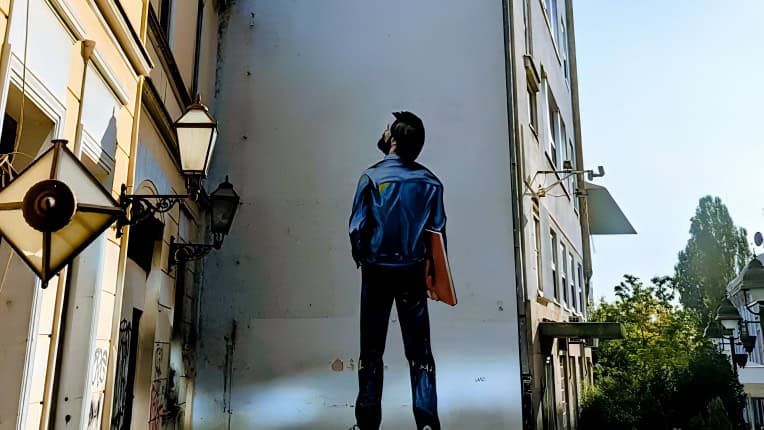
Belgrade might not be known as a street-art city in the way Berlin or Tirana are. However, there’s still an abundance of murals and large-scale public art, particularly around Savamala, an area near the river that has undergone repeated cycles of neglect and reinvention. Rather than curated trails, artworks tend to appear on the ends of buildings and in side streets, and it’s definitely something to look out for.
14 Novi Beograd
Across the Sava lies Novi Beograd, a vast, planned district defined by wide boulevards and large-scale modernist architecture. It looks dramatic from the fortress, particularly landmarks such as the Genex Tower. It’s very different from central Belgrade and works better as a destination in its own right rather than a casual add-on, if you have time to explore beyond the centre.

15 Zemun
To the north-west, Zemun is more like a separate riverside town than part of the capital, with an Austro-Hungarian influence. One for our list next time, too.
So that brings us to the end of the things we found to do in Belgrade, along with a few we missed. If you have a day to spare from Belgrade, I highly recommend taking the train to Novi Sad, Serbia’s second city, as we did. There’s a good choice of organized tours from the city, too and a good option, as there’s limited public transport to reach some of the more remote places.
Have you been to Serbia? Do let me know in the comments.
After we visited Belgrade, we took the bus to Bosnia and Herzegovina, and that’s where I’ll be writing about next. If you’d like to subscribe to my monthly newsletter, I’d love to have you join me.