Visiting Libearty Bear Sanctuary in Romania: Is It Worth It?
Deep in the Carpathian Mountains above the village of Zarnesti lies Libearty Bear Sanctuary, the largest brown bear sanctuary in the world. Over 100 bears live in 69 hectares of forest, surrounded by trees to climb and deep pools to bathe and swim in. Wild bears live in the same forest beyond the Sanctuary, but Libearty is a safe place for bears rescued from cruelty and captivity. Bears come to Libearty to heal and to receive the care they need. Many have never known the freedom of the forest. They spend the rest of their days in an environment as close to their natural habitat as possible, and about as far from a concrete zoo enclosure as you can imagine.
Libearty Bear Sanctuary is about 30km from Brasov. For me, it was an absolute highlight of our Transylvanian adventure. A unique opportunity, I would thoroughly recommend it.
In this article, I’ll explain how to visit and what to expect when you get there. I’m a Sceptic when it comes to wildlife encounters and not a fan of zoos either, so I’ll share my thoughts on whether Libearty Bear Sanctuary is an ethical wildlife experience.
This guide may include a few affiliate links. If you choose to buy something through one of them, I may earn a small commission (at no cost to you). Thank you for supporting One Small Bag and helping keep this resource ad-free and independent.
Is Liberty Bear Sanctuary ethical?
So how did I know this was an ethical way to keep and visit bears? People for the Ethical Treatment of Animals (PETA) has a great article that covers whether an animal ‘Sanctuary’ is ethical. It’s well worth a read. These are the questions they recommend asking, and I’ve added my honest answers based on my visit.
How are animals housed?
The bears live in their natural habitat, with trees to climb, a forest area to explore and deep pools to bathe and groom in. It’s a fenced-off section of the forest and home to wild bears. Even bears actively receiving treatment are kept in a natural environment. And one which is clean and spacious too.
What environmental enrichment is offered?
There are nutritional challenges to encourage foraging and seasonal adjustments to build up fat stores for the winter. There’s space to dig and artificial dens. There’s plenty of opportunity for bears to withdraw into a private space or socialise with others.
How big is the facility?
These are huge enclosures in a 69-hectare space. The fences were as much about keeping wild bears out as about keeping Sanctuary bears in.
Are visitors allowed to touch or hold animals?
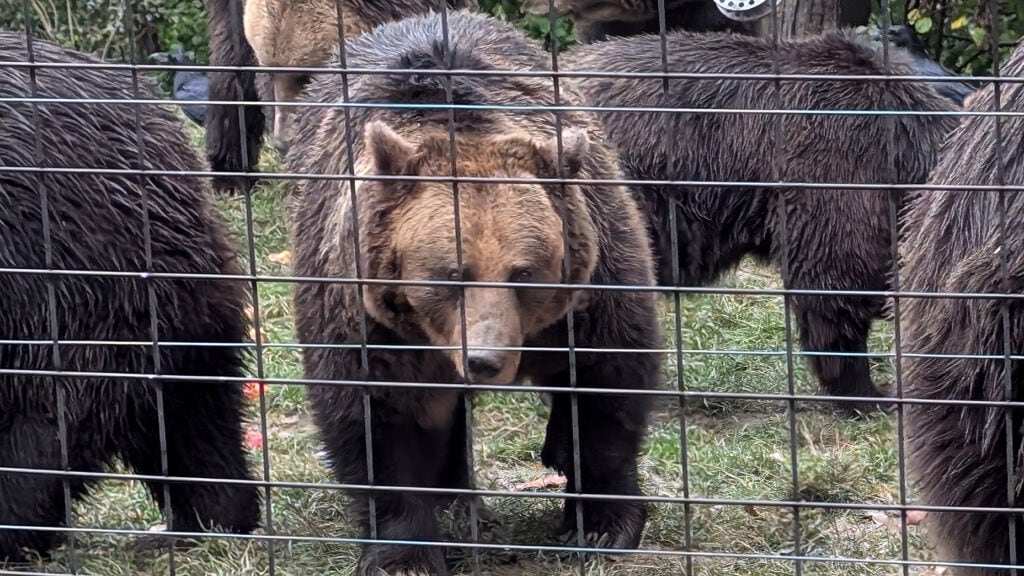
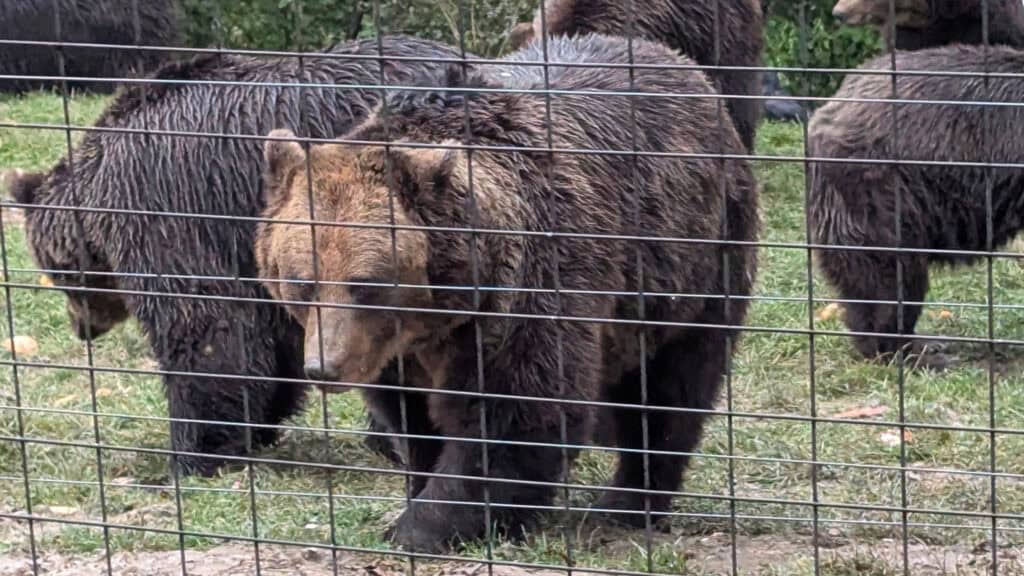
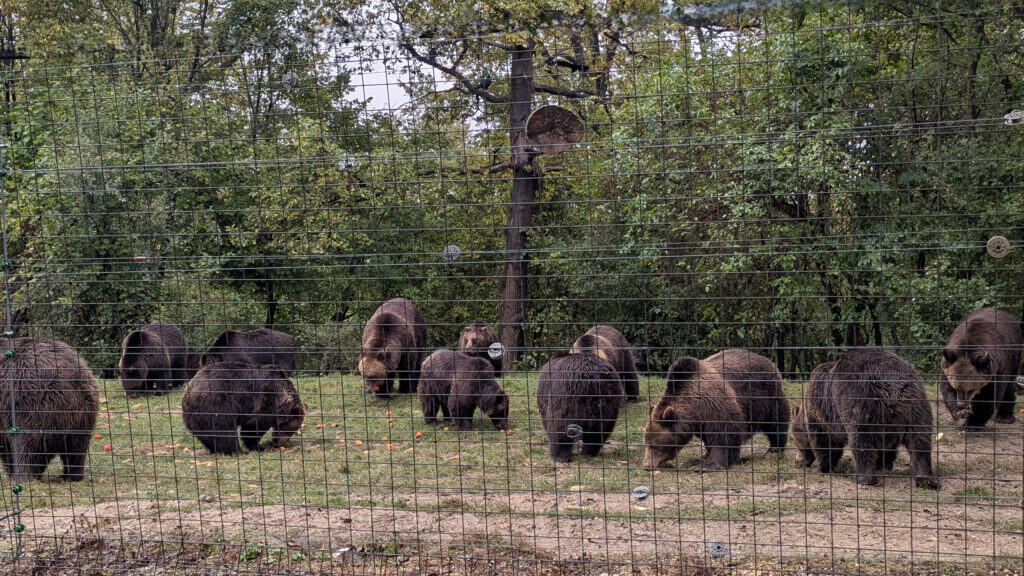
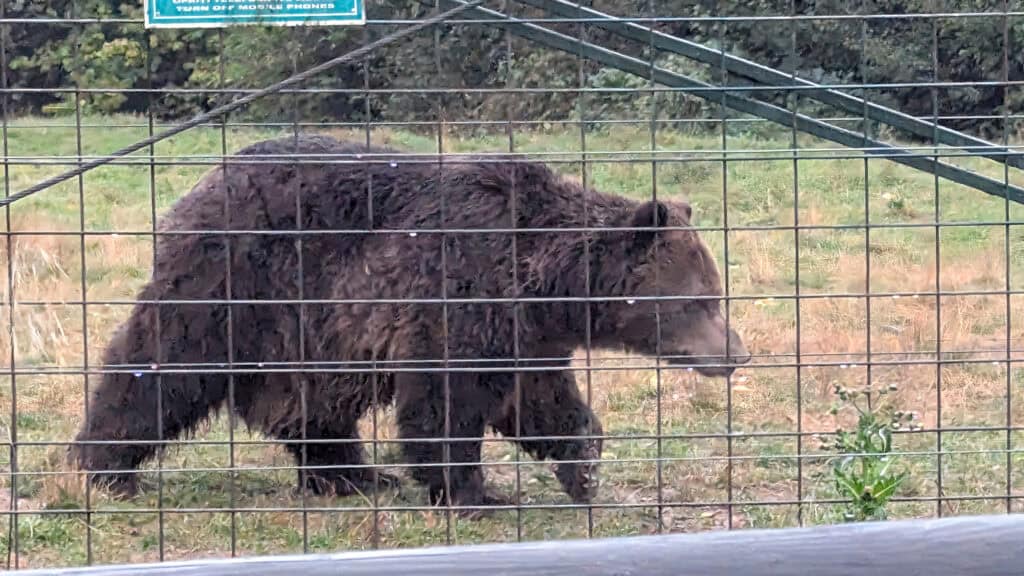
No, absolutely not. In fact, even getting close to the fence and using flash photography near the bears was actively discouraged. And that’s why my photos include fences: I respected the guide’s request not to approach it. Children under 5 are not permitted to visit at all.
While we felt welcome at the Sanctuary, I sensed the Sanctuary saw visitors as a necessary income stream to support the bears. Definitely a ‘bear first’ rather than ‘visitor first’ attraction, and I applaud it.
How are animals acquired?
Bears are rescued from captivity and cruel conditions. Recently, the Sanctuary has taken several bears, including cubs who had become ‘urbanised’. They were regularly wandering into a village outside Brasov. A problematic situation, the Sanctuary was clearly wrestling with.
Does the facility breed animals?
No. Bears arriving at the Sanctuary are sterilised, and wild bears from the forest are kept out. No cubs are born at the Sanctuary.
Do they have a reputation for animal welfare?
Yes Libearty has been recognised by National Geographic Traveller as one of the world’s most ethical wildlife attractions. It is rated a top-tier Sanctuary, praised for allowing rescued bears to live in a natural forest habitat with minimal human interaction.
Our Visit: What Actually Happens on the Tour
Here’s our account of our time at Libearty Bear Sanctuary
Do check the Ticket, and Tour practicalities, and the section on Getting to the Bear Sanctuary, where I’ve covered what you need to know to book your trip.
Arriving at the Park
Arriving in the car park on a wet Autumn day meant a muddy walk to the entrance of Libearty Bear Sanctuary. There’s a small shop that also serves as a ticket reception area, plus a welcome sign with a reassuring message telling us this experience was not a zoo.
We had arrived early. In fact, so early, the tour before us had only just started. We asked if we could join the earlier tour, but it wasn’t possible. There’s a strict limit of 50 people per tour for the bears’ welfare. All the tours that day were fully booked. So we spent a rather damp 40 minutes or so outside waiting for our slot. There’s no cafe or inside waiting area.
When our time came, we joined the guide who would be taking us around the Sanctuary. With 50 people on our tour, 50 milling around from the last tour, and some people arriving without tickets and leaving disappointed, I wouldn’t describe this as a slick experience. We visited on a wet day in October, when you might have thought the Sanctuary would be quiet. So take that as a warning: don’t turn up without pre-booked tickets.
Walking Around the Bear Sanctuary
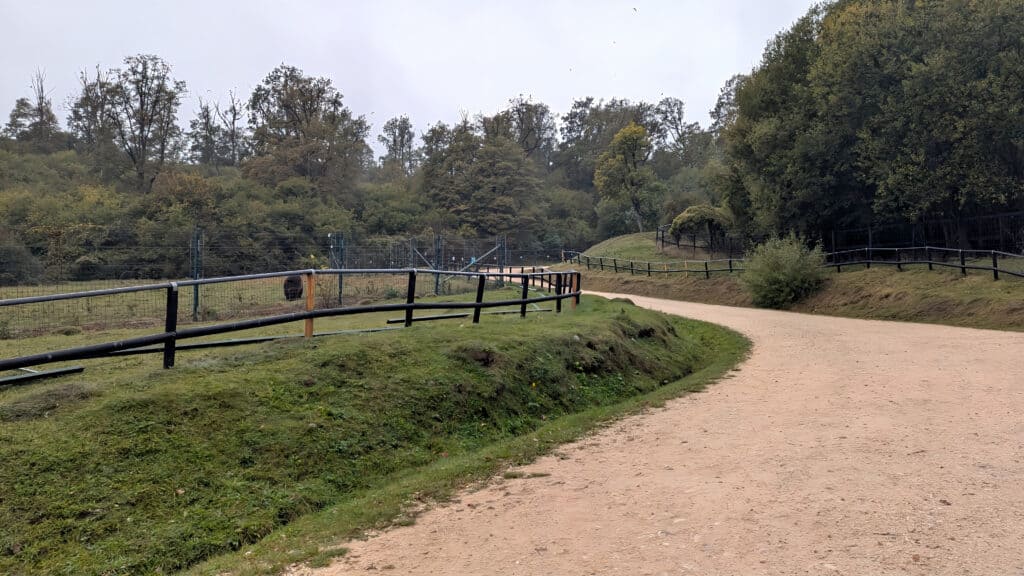
The walk takes about an hour, and it’s as much about telling stories about bears’ lives in Romania as it is about watching the bears.
We were offered plenty of opportunities to ask questions as we walked through the Sanctuary. And as someone coming from a country where cows are the apex predator in the ‘deaths by wildlife’ stakes, I had plenty of questions! And, of course, I asked them.
So, here we go. This is everything we learned about Romanian bears, plus why they were living at Libearty and what their lives were like at the Sanctuary.
Learning about Wild Bears in Romania
Romanian bears are related to American grizzly bears (both Ursus arctos), but Romanian bears are slightly smaller. Better salmon fishing in the Rockies, maybe?
Romania is home to the largest population of brown bears in Europe outside Russia. With illegal logging eating into the bears’ natural habitat and human settlements expanding into the Carpathians, the bears have increasingly wandered into villages and towns in search of food, bringing them into closer contact with humans. Bear visits are a particular problem in and around Brașov, where the city is working on bear-proof rubbish disposal. Locally, these animals are sometimes nicknamed “trash-bin bears” – a phrase that says a lot about how normalised their urban appearances have become.
Hearing Stories of Captive Bears in Romania
Looking back in time, many bears in Romania had a pretty miserable time of it. Some were kept in tiny cages outside hotels and restaurants as tourist novelties. Others were forced to perform in circuses or used as dancing bears on street corners. Bears were often blinded, some had their claws removed, and many were chained to make them less dangerous.
Change came in stages. The Romanian government passed laws allowing the confiscation of captive bears. When Romania joined the EU in 2007, strict new zoo regulations meant many Romanian zoos couldn’t comply, leaving over thirty bears suddenly in need of a home. Libearty took them. Wild animals were banned from circuses in 2017, with owners facing criminal charges for non-compliance. Yet again, Libearty stepped in and rescued the bears.
The bears at Libearty today reflect that whole history. Restaurant cage bears, zoo bears, circus bears, and a few that arrived not because of past suffering but because they’d become regular visitors on the outskirts of Brașov. The Sanctuary took them too. Bears are still arriving from outside the EU, including captive bears from Armenia.
The Libearty Bear Sanctuary website tells the story of each bear.
Caring for Bears when they first arrive
We learned about the care bears receive when they arrive at the Sanctuary. The bear receives medical care, including wound treatment and dental repairs. The Sanctuary also sterilises the bears.
For the first few months, they may stay in a smaller enclosure to help them adjust to their new freedoms. After that, they can enter the main enclosure. They are not generally released back into the wild, as bears coming from captivity seldom have the skills to live fully in the wild.
Viewing the Bears on the Tour
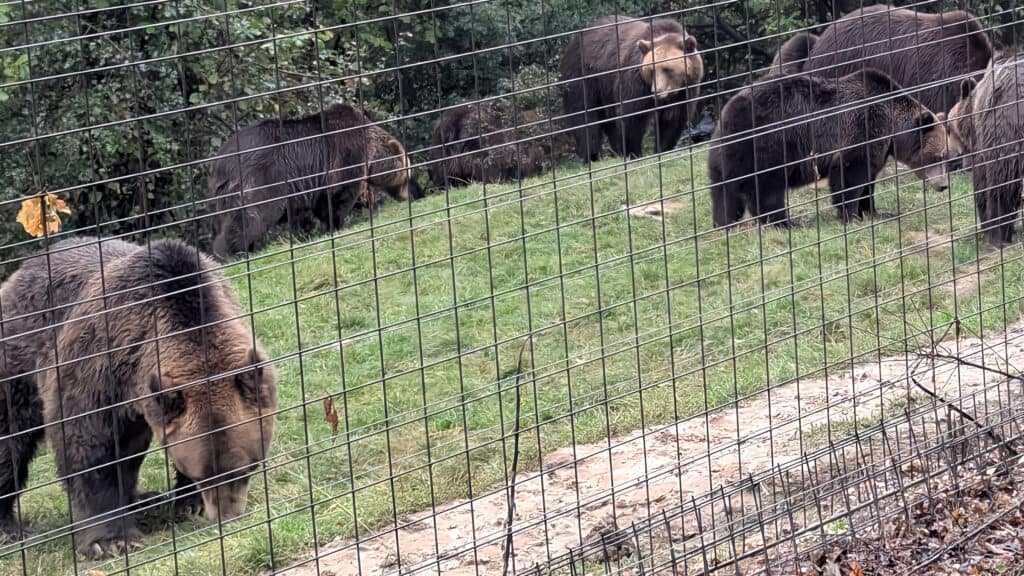
There was plenty of time to stop and see bears as we walked through the forest. Some were well hidden, others were close to the fence and visible. The bears have the freedom to approach or stay away as they choose. On a good day, you’ll have bears just a few metres from you. The guides know the bears individually and can point out who’s who. Don’t use flash photography – it genuinely bothers them.
Our trip was in autumn, so I asked if we would see fewer bears or sleepy bears getting ready to hibernate. The truth is, many of the bears never learned natural bear behaviours, and while some hibernate in the winter, many do not. But they are given extra food in the autumn, so those that do can build up their fat stores. It means visitors can see the bears year-round.
Feeding the Bears
The Sanctuary time tours so they coincide with bear feeding times. We watched a lorry load of apples and fruit being hurled over the fence with a spade. Each bear requires around 10 kg of food per day, so with 100 bears, that’s around 2 tonnes per day. The dog is from the dog Sanctuary next door to Libearty.
If you see photos of lots of bears all close together, they are most likely congregating for food. They have plenty of room to spread out if they want to.
Maya’s Story – The Birth of Libearty
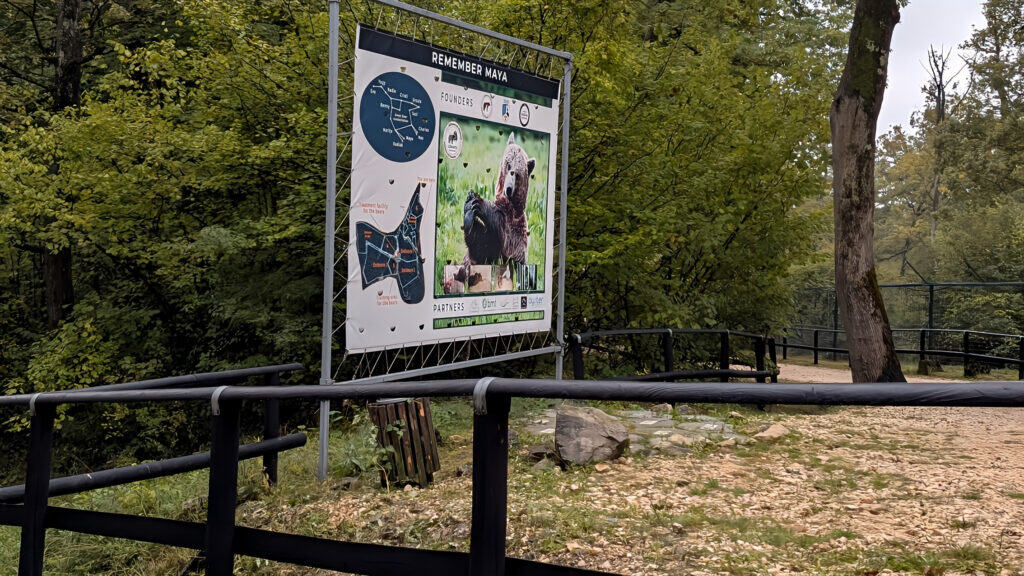
An important part of the Bear Sanctuary visit is to retell Maya’s story. The heartbreaking life and death of Maya the bear led to the birth of Libearty Bear Sanctuary in 1998.
Cristina Lapis, Libearty’s founder, discovered Maya living in a filthy cage in the yard of a hotel near Bran Castle, malnourished, forgotten, barely able to lift her head. For four years, Cristina and her husband drove sixty kilometres every day to feed her and sit with her. Maya recovered enough to recognise the sound of their car and stand up to greet them.
But captivity eventually broke her. In 2001, Maya began to self-mutilate, chewing her own paw almost to the bone. Despite surgery and round-the-clock care, she died in Cristina’s arms on 11 March 2002.
Cristina had promised Maya she would one day run free in the woods. She was too late to keep that promise for Maya. But she built the Sanctuary instead, so that no other bear would go through the same thing.
It’s quite a story. Have tissues ready.
Contradictory Advice on Surviving a Bear Attack and How to Avoid Them
Towards the end of our tour, our guide took a few minutes to cover bear safety, which felt mildly unsettling, given that we’d just spent an hour standing next to some very large ones.
His words started reassuringly and passed without comment. Bears are naturally shy and will generally avoid humans. Just try not to surprise them and don’t carry your lunch around in thin packaging. Hike in groups, make noise, and carry a bear bell or whistle to announce your arrival; this will give the bears warning and time to move on. Lastly, stay on marked paths and keep dogs on a lead.
And his advice on surviving a bear attack?
Don’t run, back away slowly, make yourself look big, speak calmly. Do NOT play dead.
At which point, several Americans on our tour piped up. They had a rule, or a three bear rhyme:
Three Bear Rule: If it’s brown, lie down. If it’s black, fight back; if it’s white, good night.
‘This is the standard advice for North America, where you could, in theory, meet all 3, but not simultaneously. It’s clear and memorable, that’s assuming you’re not colourblind! ‘Playing dead’ is suggested because grizzlies often attack defensively and will back off once they feel the threat has passed.
But our guide was not giving ground here. His point? Encounters with European brown bears can be non-defensive. Lying motionless on the ground won’t end well. Has anyone tried it, and are they still around to tell the tale? Nobody knew. I think I’m siding with the Libearty Bear guy!
So the lesson I learned from this is not to go looking for bears of any colour in the forest if you don’t want to end up as the main event at their picnic.
Libearty Bear Sanctuary: Practical Information
Here are some practical details to help you plan your visit.
Booking Tickets for Libearty Bear Sanctuary
We bought tickets in advance for 90 RON (around €17 per person) at the Libearty Bear Sanctuaries website.
And here are some commonly asked questions to help with your booking.
Getting to Libearty Bear Sanctuary
I know Google Maps seldom lies, but looks can be a little deceptive here, and I’m glad I didn’t attempt this under my own steam on public transport and foot.
There are (fairly) regular buses from Brasov to Zarnesti, but things get trickier from there. The Bear Sanctuary is about 3km up in the forest from the main road, before you get to Zarnesti. But I wouldn’t want to walk up this road, it’s narrow, there are no pavements, and it soon turned into a steep, rough track through the bear-filled forest. We visited on a dark, rainy day, which would have made the walk even more unappealing.
We took an Uber, direct from our accommodation in Brasov. This was 135 RON (€26) each way – money well spent. Apparently, not all Uber drivers want to wreck their cars on this journey, so I’d book the trip in advance to make sure you find one.
Taking an Organised Tour
If you don’t want to make your own way to the Sanctuary or purchase tickets directly, there are options.
There’s a 6-hour+ trip that includes Bran Castle and Rasnov Fortress (just the grounds; the interior is currently closed for renovation). If you want to visit all 3, this is the obvious choice.
➡️Brasov: Bear Sanctuary, Dracula Castle, and Râşnov Fortress (doesn’t include entry tickets)
Alternatively, if you want to visit the bears with the arrangements made for you, this is your best bet.
➡️ Brașov: Bear Sanctuary Visit with Tickets and Transfer (includes tickets to the Bear Sanctuary)
When to visit
Morning is always better – bears are most active early in the day. All tours run in the morning for exactly this reason. Weekdays (Tuesday to Friday) are quieter and slightly cheaper than weekends. Summer is the busiest period; spring and autumn are the sweet spot if you want smaller crowds and comfortable temperatures for walking.
Guided tours are the only way to visit the Sanctuary, and they are available in English. The visiting schedule varies by season. Places are limited.
We purchased tickets for the classic tour in advance from Libearty Bear Sanctuary for 90 RON (around €17 per person) for a timed slot. Private, VIP, and super VIP tours are also available for more personal trips, extended tours, and larger group visits.
Supporting the Libearty Bear Sanctuary
Yes, you can sponsor a bear (virtually). Their pictures and stories are all on the website. It’s also possible to make donations. The Sanctuary doesn’t receive state funding and is entirely self-funded, so fundraising is an ongoing challenge.
The bear Sanctuary also accepts volunteers through Oyster Worldwide. They handle the vetting and ensure safety rules are followed. The Sanctuary takes around 70 volunteers a year.
Other Ways to See Bears Near Brașov
Libearty isn’t the only way to get close to bears in Transylvania. If you want to see them in the wild rather than in a sanctuary setting, there are a couple of options worth knowing about, though both come with their own caveats.
Bear Hides
The most accessible alternative is an evening session at one of the bear hides in the forests around Brașov. The walk to the hide is easy, taking around five to ten minutes along a gentle forest path. You watch through a window from what is essentially an elevated treehouse. Sessions typically run from late afternoon until dark, when bears are most active, and success rates are high.
Food is placed near the hide to attract the bears – and yes, if you’re arriving with an ethical checklist, that will raise an eyebrow. The more responsible operators are upfront about it: the quantities are not large or frequent enough to alter bears’ natural behaviour or make them dependent, and Romania’s national forestry authority manages the practice as part of their bear management system. The aim is to keep bears foraging in their natural habitat rather than moving towards towns.
Carpathian Adventures is one of the main operators, should you wish to book a trip to a hide to see the bears.
Bear Tracking
A step up in commitment, bear tracking involves heading out into the Carpathians with a wildlife guide or forest ranger to look for signs of bear activity – prints, scratches on trees, foraging sites – with the possibility of a sighting along the way. Heading out with a guide is essential, as they can safely take you into the dense Carpathian forests and increase your chances of seeing bears. Sightings are not guaranteed,
Honest Comparison
For most visitors to Brașov – particularly those combining bear watching with Bran Castle, an organised tour including Libearty Bear Sanctuary remains a top choice and with good reason.
If, like me, you want to visit the bear Sanctuary, booking tickets directly with Libearty is a good option, and you can book Uber or Bolt to take you there if you don’t have a car.
Tracking is better as the centrepiece of a dedicated wildlife trip.
Overall, for me, Libearty won on points: the individual stories of the bears, the ethical clarity of the sanctuary model, and not having to sit still for two hours waiting…I’d rather keep moving.
Overall, I loved this trip, and I’m glad to have the opportunity to share it here. If you have any questions or are planning a trip, do let me know in the comments or send an email.
If you’re visiting Transylvania, I also have a guide to Brasov. and more guides to Sinaia and Peles Castle, plus Sighisoara coming soon. I do have a monthly newsletter that I’d love you to join. There will be more details from Transylvania once these are published.