Visiting Old Orhei (Orheiul Vechi): Moldova’s Cave Monastery & Dramatic Landscapes

Orheiul Vechi (Old Orhei) is Moldova’s most famous heritage site. It is a dramatic complex of cliffs, caves, monasteries, and ancient ruins, just an hour from Chișinău, the capital of Moldova. We’d booked what we thought was a straightforward tour, only to find ourselves with an adventurous guide who abandoned the brief, detoured off-road, and generally made the day twice as unpredictable and twice as much fun!
Whether you’re going with a guide or attempting a DIY trip, here’s everything you need to know about visiting Moldova’s top heritage site.
This guide may include a few affiliate links. If you choose to buy something through one of them, I may earn a small commission (at no cost to you). Thank you for supporting One Small Bag.
Is Old Orhei Worth Visiting
On Europe’s eastern frontier, between Ukraine and Romania, lies Moldova, a country most tourists overlook. Old Orhei (Orheiul Vechi)is Moldova’s most important archaeological site. It’s a complex, spread across dramatic limestone cliffs and down into the Răut River valley below. The site layers more than 2,000 years of history, including Geto-Dacian fortresses, medieval Moldavian towns, a Mongol settlement of the Golden Horde, and cliff-carved cave monasteries, at least one of which is still in use today.
Designated a Cultural-Natural Reserve, Old Orhei protects not just ruins and religious sites but also the surrounding villages of Trebujeni and Butuceni, where traditional houses, an ethnographic museum, and local guesthouses help preserve rural Moldovan life as part of the visitor experience. It’s widely considered one of Moldova’s top attractions, and it’s on the UNESCO tentative list. But it hasn’t yet received full World Heritage status.
For me, the absolute highlight was going to the top of the ridge and down into the cave monastery. It was truly one of those ‘pinch yourself, is this real?’ moments. If you’re visiting Moldova, I would absolutely recommend putting a trip to Old Orhei on your itinerary.
So, here’s how the day went.
Our Journey to Old Orhei
Vasili arrived bright and early for our hotel pickup. Our guide for the day was tasked with taking us around Orheiul Vechi (Old Orhei) in the morning, delivering us to Cricova in the afternoon for wine tasting, and then returning us to our hotel. We were the only participants for our group trip, so we ended up with a much more personal tour than we’d bargained for.
The journey to Orheiul Vechi would normally take a little over an hour, possibly a little longer in the morning traffic. Still, Vasili wasn’t hanging around, and we arrived earlier than expected. He provided plenty of commentary on Chisinau, villages, and landmarks along the way, plus some personal anecdotes.
As we approached the village of Trebujeni, we caught our first view of St Mary’s perched on a limestone cliff above the Răut River, with the Codru Hills rising behind. Maybe not quite mountains, but dramatic enough to frame the valley like an amphitheatre.
So first, a little orientation before we go through what we saw.
Map of Old Orhei Cultural-Natural Reserve
I’ve created a map and added the main points of interest in the Old Orhei Cultural-Natural Reserve. Information online is a little piecemeal and not all up to date, so the map here is for you to use, save, and share. I hope it’s useful.
Things to do in Old Orhei (Orheiul Vechi)
So now, on to some of the things you can see and do once you reach Old Orhei.
Defensive Wall & Museum
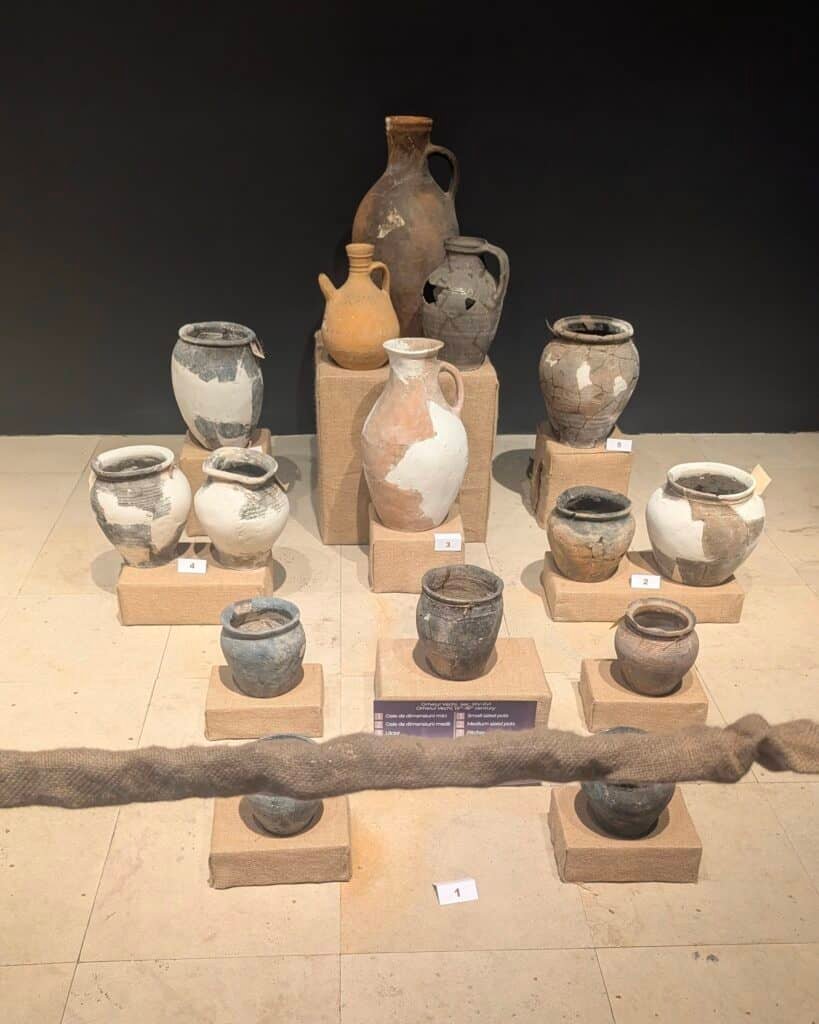
Our first stop was at the newly reconstructed Medieval Archaeology Museum near the visitor entrance. It opened in March 2025, and there’s still not much online about it.

There’s a reconstructed medieval defensive wall, complete with a ditch, an earthen rampart, a wooden palisade, and a guard walkway. There’s even a slick, brand-new underground museum tucked inside with coins and artefacts from Stephen the Great’s time. The only snag? That ‘authentic’ wooden walkway has no railings, and the logs which form the base can be difficult to stand on without wobbling, or at least for me! I very nearly launched myself off the edge.
Perhaps that’s why our guide adjusted our itinerary and took us cross-country in the car, rather than let us hike to the more ‘difficult to reach’ spots on the reserve?


Now on to the part I had most been looking forward to:
Visit the Old Orhei Cave Monastery
After my wobble on the wall, Vasili wasn’t taking any chances and asked at the visitor office if he could drive up to the entrance of the church leading to the cave monastery, rather than let me hike up. While I was embarrassed about making an idiot of myself and receiving ‘old lady privilege’, I wasn’t complaining! Although honestly, the hike wouldn’t have been too long or too strenuous (about 20 minutes). So this part is doable, even if you’re not a mountain goat. Just bring sensible shoes and water, and take your time.
Whichever way you get to the top, here’s the view you will be rewarded with, looking down on the Răut River and the valley below. It’s truly spectacular.

A short walk further along the ridge brings you to a modest bell tower. It’s the clifftop cave entrance to the Old Orhei cave monastery, which is carved directly into the edge of the limestone cliff, but you may need to find a monk to gain access.

Step inside and you’re in a warren of narrow passages, monks’ cells, and a small candlelit chapel. The cave walls are blackened by centuries of smoke. And the cave may date back to the 13th century. In common with most orthodox churches and monasteries in Moldova, modest dress is a custom it is polite to follow. Men should remove their hats, women should cover their shoulders and heads, and avoid shorts or skirts above the knees.


Here we can see the stairs leading down from the bell tower entrance into the cave monastery, as well as the door opening onto the cliff ledge, complete with a resident monk.
Why Do Monks Live in Caves?
Spiritual seclusion: The Răut Valley’s cliffs offered solitude to hermits seeking a life of prayer, away from worldly distractions yet not too far from villages for supplies.
- 15th–17th centuries: Moldova faced Tatar raids and Ottoman incursions, so cliff monasteries doubled as safe retreats during unstable times.
- Soviet times: The cave monastery was closed in 1944, but some monks continued their religious life quietly, despite suppression.
- Modern revival: Since Moldova’s independence, monks have returned, and the cave monastery is once again active.
Several monks live here, making it a living site of worship rather than just a historical monument. I felt I was intruding a little. If you go, be respectful and don’t outstay your welcome.
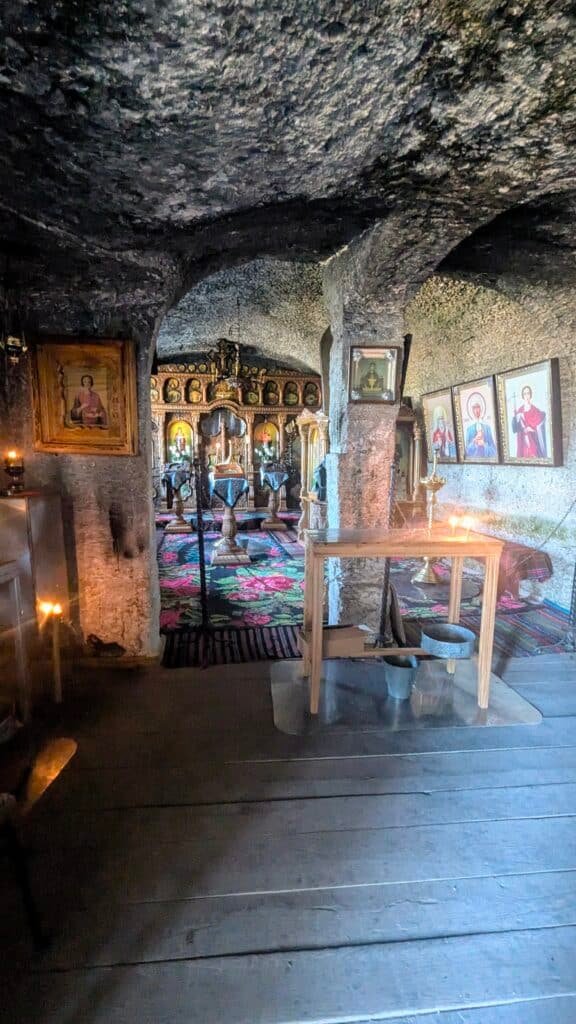

Much of the monastery’s interior is elaborate and highly decorated, with one exception: the monks’ sleeping quarters (shown). They sleep on the pure bedrock, in tiny stone nooks, each opening up into a central corridor,
This is the view you see when you go out the back door. You’re straight out onto a narrow ledge – a health and safety free zone.

Standing on the ridge at Old Orhei, I was reminded of other cliffside sanctuaries I’ve visited, including the suspended monasteries of Meteora in Greece, the vast cave city of Vardzia in Georgia, and the ancient underground cities of Derinkuyu and Kaymaklı in Cappadocia, Turkey. Old Orhei may be smaller in scale, but it shares that same marriage of faith, human ingenuity and raw geology. All are jaw-dropping and some of the most remarkable sites I’ve seen across Europe: an unforgettable moment and a highlight of the trip. Don’t miss Old Orhei and the cave monastery on your trip to Moldova.
Planning a trip to Moldova? Questions about apps, eSIMs, and more? I have a free toolkit for you.

FREE Travel Tech Toolkit
The exact apps, eSIMs, and tools I use to travel smarter – covering transport, translation, money, connectivity, and more. Tested over years of actual travel.
Old Orhei’s St Mary’s Church
St. Mary’s church (sometimes called St. Catherine’s) is the landmark most people notice first at Old Orhei. A bright white Orthodox church perched dramatically on the ridge above the village of Butuceni. It’s generally open during the day, but it may not keep regular hours. If the door is shut, you’ll need to find someone with a key to let you in.

Built in the early 20th century, on the site of an older wooden chapel, it was closed during Soviet times and even used as a museum storehouse. It’s striking inside. Brightly painted with colourful icons in traditional Orthodox style. It was restored after Moldova’s independence from Russia, and regular services are held here once again.

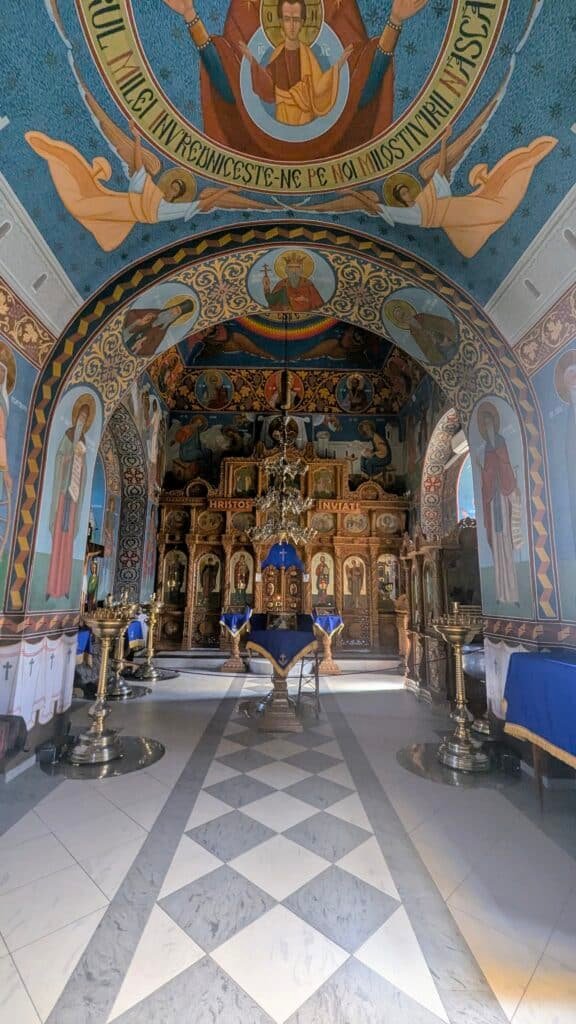
Even if you don’t get the chance to step inside, the setting itself, including the gardens, makes the church worth the climb. Once you’ve seen everything on the ridge, it’s time to come down and visit the village of Butuceni.
Ethnographic Museum at Butuceni
The reserve isn’t just ruins and a church; the living villages of Butuceni & Trebujeni are part of the experience, with their rustic guesthouses, traditional food, and village life carrying on much as it has for centuries.


As we walked back through Butuceni, towards our lunch stop, we stopped off at the Ethnographic Museum. A restored 19th-century peasant house filled with traditional textiles, dowry chests, ovens, and local crafts. It offered a glimpse of rural Moldovan life, and the welcome we received was delightful. After this, it was time for lunch.
Lunch at Butuceni Eco Resort
The Butuceni Eco Resort is a popular place for visitors and locals to eat. It was quiet when we visited, but apparently it gets very busy on weekends.

Traditional Moldovan fare is served from locally sourced produce, with much of it bottled and preserved on site. It’s very traditional and homely both inside and out. Lunch in Butuceni felt like being welcomed into someone’s home kitchen.

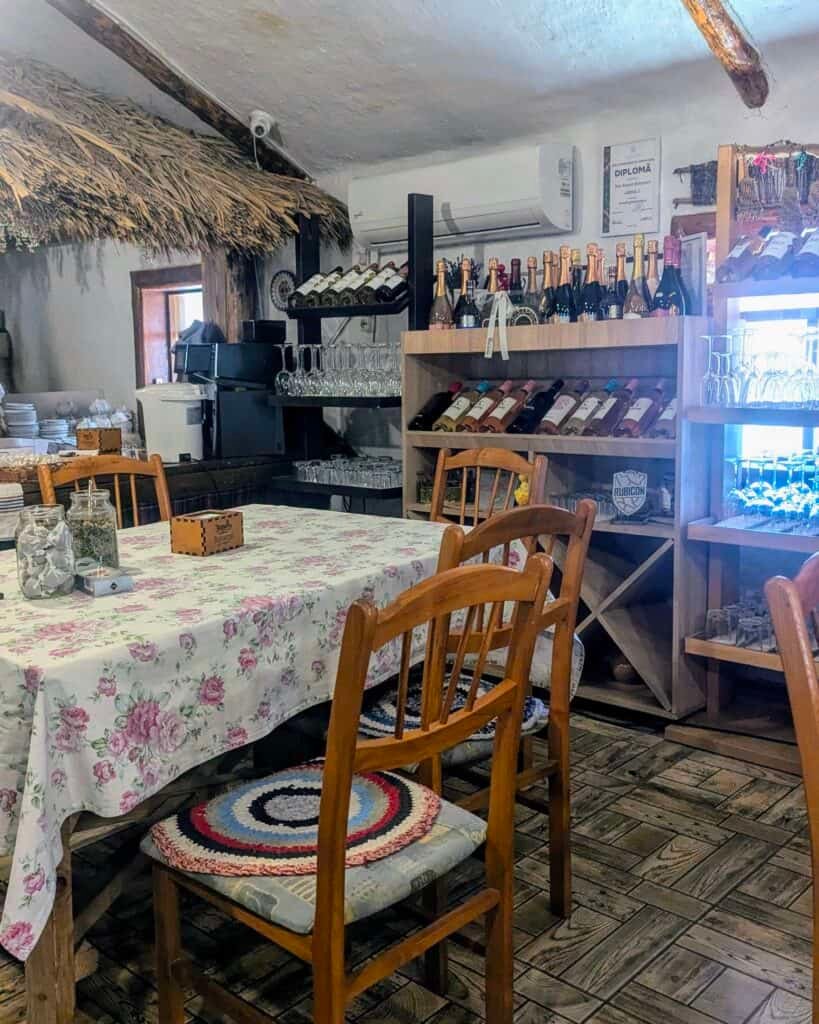
We took advice on what to eat and received traditional Moldovan fare. A steaming bowl of zeamă appeared for me. This is Moldova’s beloved chicken noodle soup, rich and tangy with plenty of herbs and vegetables. Martin chose mămăligă cu brânză, smântână și tocană de porc. That’s soft, golden polenta served with tangy white cheese, sour cream, and slow-cooked pork. Hearty food that went down well with glasses of chilled compote. This popular drink is a simple homemade fruit drink, sweetened by whatever fruit is in season (in our case, berries). Rustic, fresh, unpretentious and delicious.


After lunch, we visited some of the other archaeological sites in Old Orhei.
Tartar Baths
You’ll find the remains of a fortress, churches, and further evidence of medieval Moldavian settlements spread across the reserve, if you have time to look for them and some help finding them.
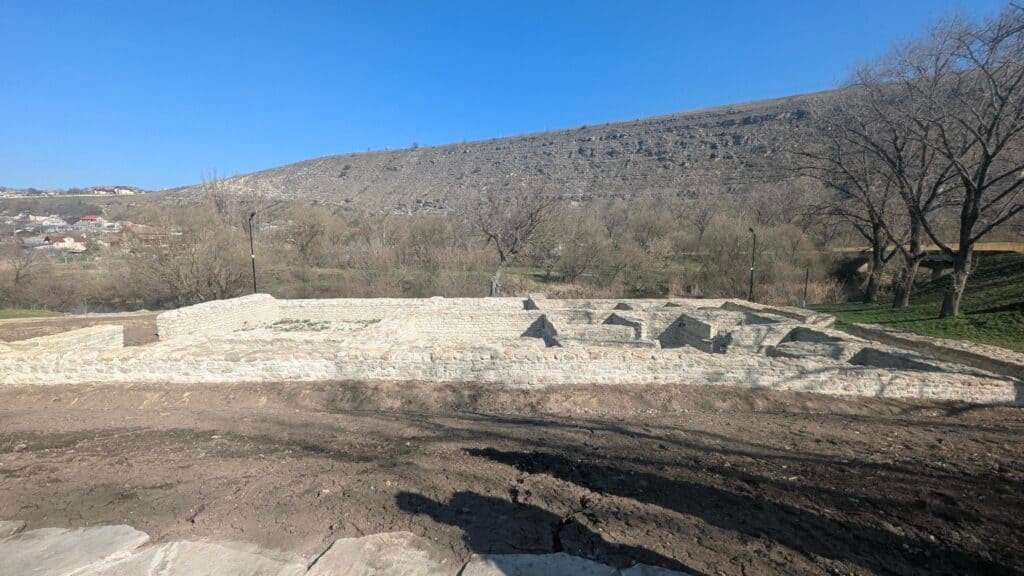
Here’s a picture of a 14th-century stone bathhouse built during the Golden Horde time (Shehr al-Jedid). Way ahead of their time, the medieval settlement shows evidence of advanced heating systems and offers a glimpse into daily life.
Other things to see include cave dwellings
The limestone cliffs hide numerous smaller cave dwellings and hermitages, some dating back to the 10th–12th centuries. These scattered cliffside openings mark where monks once lived in isolation. You can hike up the cliffside to reach them and go inside. Some are collapsed, some are a little more complete. After I nearly toppled off the ramparts earlier, Vasili didn’t suggest this. Instead, he took us off-road for a ride. The jury’s out as to which involved more peril!
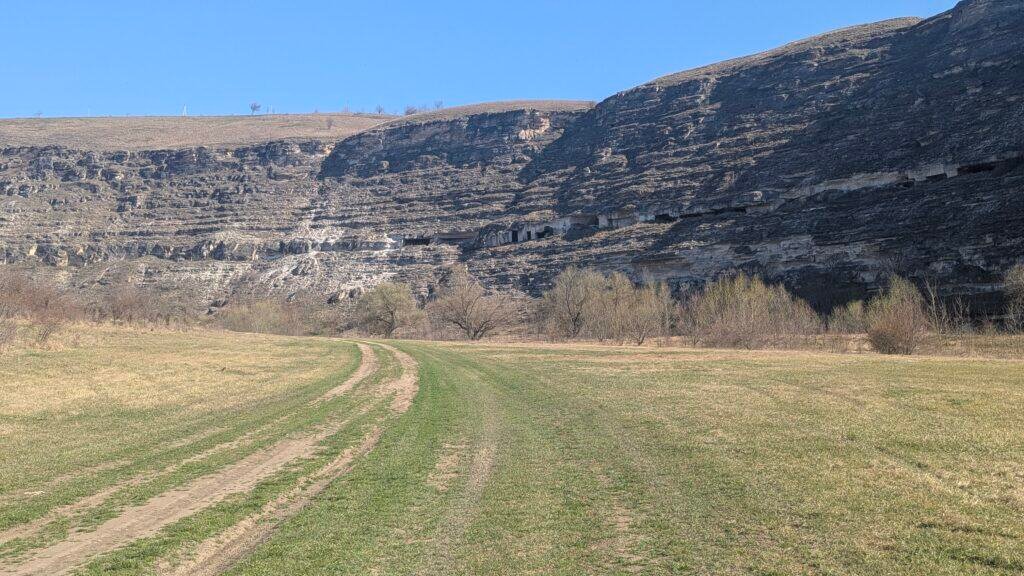
Vasili told us he came here with his friends to fish, relax and picnic. There’s an annual music event, the DescOperă Festival, held here too. The river basin forms an amphitheatre and a spectacular backdrop for the event.
Enjoying the River Basin Off-Road
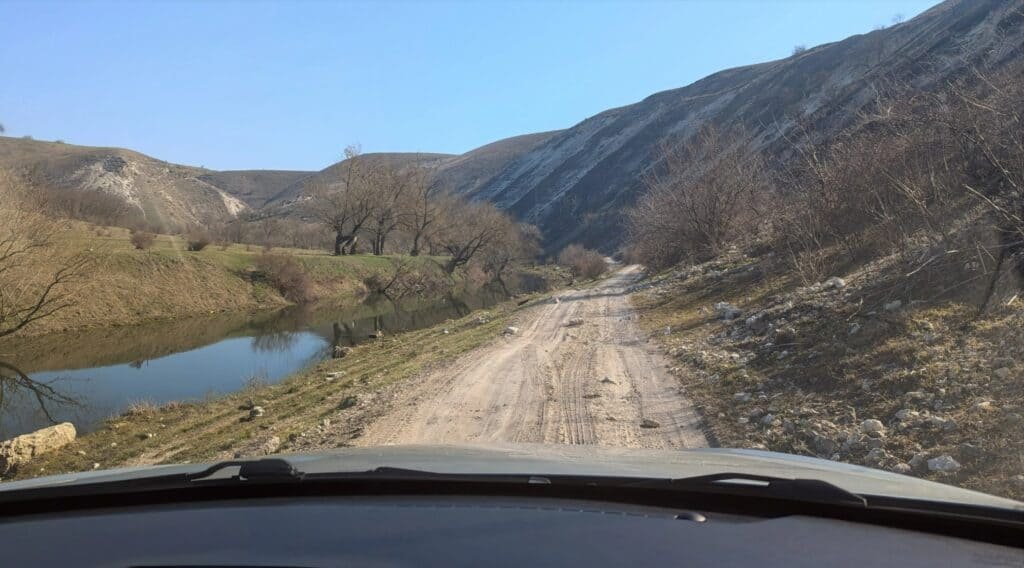
Here you can see where our off-road adventure took us! We drove around the river basin. It was genuinely stunning, but not recommended for driving!
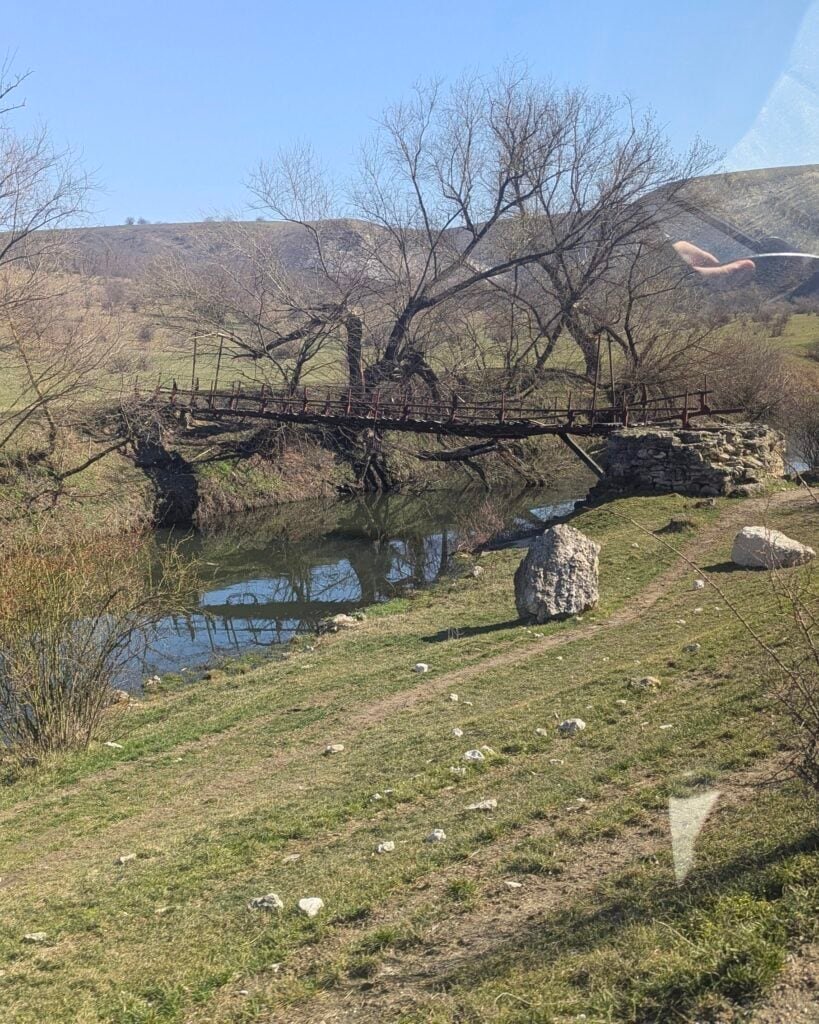
We gave both these bridges a pass! Martin here, marking the end of the road!

Events at Old Orhei: DescOperă Festival
Every summer, Old Orhei becomes the stage for DescOperă, Moldova’s open-air classical music festival. Set in the natural amphitheatre at Butuceni, it brings together more than 150 artists for three evenings of world-class opera and orchestral performances beneath the limestone cliffs. It certainly sounds like a unique experience.
When: Mid–late June (2025 edition: 20–22 June)
Where: Butuceni amphitheatre, Old Orhei Reserve
Tickets: Around 500 MDL (≈ €25) — booking recommended
Programme: Past editions have featured Verdi’s Aida, Puccini’s La Bohème, Carmina Burana, and “Passione Latina” evenings.
Can you visit Old Orhei independently?
Short Answer: Yes, you can, but it’s a very qualified yes. This option isn’t for everyone. I’m usually all for a DIY trip, where it’s practical or possible, but having done the trip with a guide, I’m glad I did. Let’s look at the practicalities:
Visiting Old Orhei Independently by Bus
First thing, don’t catch a bus to Orhei. It’s not the same place, and it’s about 40 minutes from Old Orhei by taxi. There are minibuses (marshrutka) to Trebujeni and Butuceni (the two villages in the Old Orhei complex) from the central bus station in Chișinău.
These are the times (as of October 2025) from autogara.md, the bus company’s website. You can book online too. Expect it to take about 2 hours. The times differ from those on the Old Orhei Website, so they may not be reliable.
- Chisinau to Trebujeni: 8:35, 12.45 13.45 17:15
- Chisinau to Butuceni: 8:05, 10:20, 13:15 15:00 18:15
Personally, I’d pick the 8:05 to Butuceni if your focus is the church and the cave monastery, as it’s a short walk from there to the beginning of the path up to the top of the ridge. It’s much further from Trebujeni. I’d also go early, so you have the option to see more of the complex and maybe have a meal at the restaurant in Butuceni, leaving yourself options for buses getting back. I’d get to the bus station in Chisinau with plenty of time, so you’ll have time to find the correct marshrutka and make sure you have a seat.
So, assuming you’ve made it to Old Orhei on your own, the big question is: how do you get back? I couldn’t find the time to get back on the Autogara website. So I’d check with the driver taking you there and ask for times from both villages so that you can be in the right place at the right time.
Personally, I felt the guide offered so much more than a personal taxi service, including finding the monk who had gone for a walk over the ridge so that we could see the church and the monastery. If we’d gone independently, the whole trip could have worked well, but it would have been a lottery. My 20-something self, who didn’t think twice about getting by without the internet and firm plans, would have visited on their own. My older self is a little more cautious. So know your limits and choose your style of adventure wisely.
Visiting Old Orhei Independently by Car
Visiting Old Orhei by car would be a better option than taking the bus and hiking. But honestly, some of the roads are terrible. I’d definitely drive to the village of Butaceni or the visitors’ carpark and walk from there, unless you have a Four Wheel Drive or are confident you know which roads will be suitable for your vehicle.

I chose this particular tour because it included a trip to Cricova Winery in the afternoon, another place where public transport isn’t really an option, so it worked well with our schedule.
The Rest of Our Day – on to Cricova Winery
This completed our visit to Old Orhei, but the day was not over. Our guide took us to Cricova for a crazy train tour through miles of underground wine cellars, followed by wine tasting at the winery.
And here are some other top-rated tours in Moldova.
Where to now
More from Moldova:
- Best Things to Do in Chișinău: A Complete Guide to Europe’s Least Visited Capital City
- Visiting Old Orhei (Orheiul Vechi): Moldova’s Cave Monastery & Dramatic Landscapes
- Moldova Wine Tours: Our trip to Cricova and Castel Mimi wineries, plus more wineries you can try
- Transnistria Day Trip from Chișinău – Worth It?
- Chisinau to Bucharest Sleeper Train: Europe’s most unusual rail journey
I hope you enjoyed reading this. If you have any questions or comments, do let me know in the comments. Thank you for reading my blog.
Unsubscribe whenever you like (Privacy Policy)