Classic Athens: Top Sights and Ancient Landmarks for your First Trip to The Greek Capital
As the birthplace of Western Civilisation and democracy, Athens makes a compelling case for your attention. The Greek Capital is named after Athena, the ancient Greek goddess of wisdom. And you’ll feel like you’re part of the story as you wander through the city which, in parts, feels like a living museum.
The Acropolis, Parthenon and Ancient Agora earn their place at the top of every list, but the city is far more than its headline sights. It’s one of the most striking capital cities of Europe. Modern Athens is a mix of neighbourhoods, street art, busy markets, rooftop bars mixed in with the ancient history. It’s chaotic in places, polished in others, and endlessly absorbing once you start to wander.
This guide covers the essential Athens things to do, ideally suited to first-time visitors and every one lives up to the hype. You don’t need to be a history enthusiast to enjoy Athens and you won’t need to trap yourself indoors in never-ending museums either. And if you are looking beyond the ‘big ticks’ and ‘must dos’, I’ve covered alternative Athens, separately. Here you’ll find a run down of the different neighbourhoods, including offbeat museums, local cafes and bars, with a special focus on craft ale and locally brewed beer.

This guide may include a few affiliate links. If you choose to buy something through one of them, I may earn a small commission (at no cost to you). Thank you for supporting One Small Bag and helping keep this resource ad-free and independent.
1. The Acropolis area and Acropolis Museum.
Explore the Acropolis
No visit to Athens is complete without the Acropolis. It’s as impressive as you’d imagine, but what often surprises people is how exposed the hill is. There’s almost no shade, and the climb can feel intense in summer. If possible, aim for early morning or late afternoon for both comfort and better photos. Tickets are for specific time slots and limited, so it’s essential to book in advance, especially if you’re visiting in the busiest summer months.
There are also guided tours which includes both the Acropolis and Acropolis Museum entrance fees.

The other thing to know, is the Acropolis isn’t one single building. It’s the entire fortified hill overlooking Athens, with several major structures sitting on the summit. In practice, it means walking up the hill and exploring all these landmarks together:
- The Propylaea – the grand entrance gateway you pass through on the way up
- The Parthenon – the iconic marble temple dedicated to Athena
- The Erechtheion – home of the Caryatids, the sculpted female figures acting as columns
- The Temple of Athena Nike – a small, elegant temple perched on a bastion near the entrance
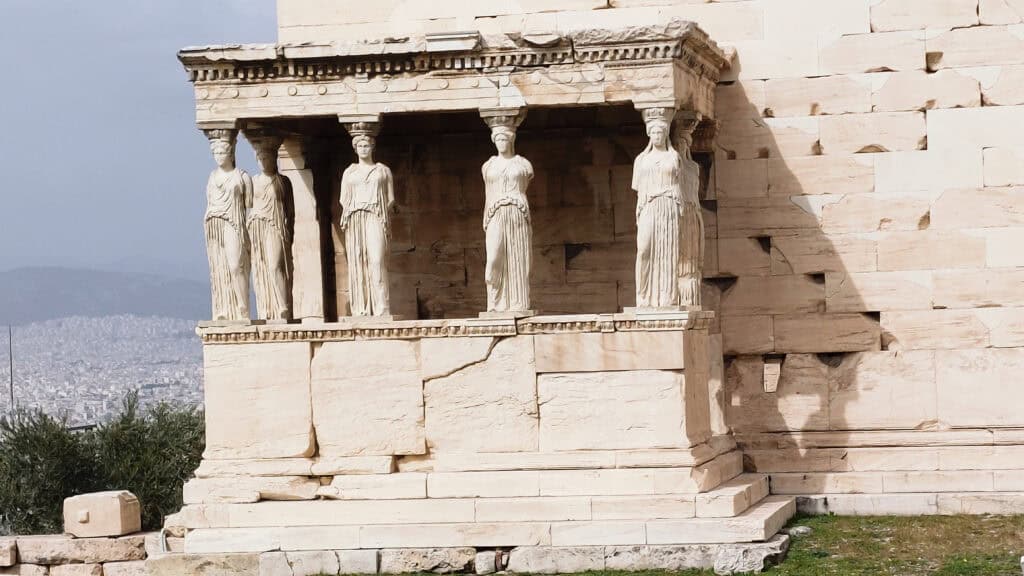
The Erechtheion sits on the north side of the Acropolis and is best known for its porch supported by the Caryatids. These are six sculpted female figures standing in place of columns. Even after centuries of weathering, they’re one of the site’s most striking details, and the originals are beautifully displayed in the Acropolis Museum.
Find the Odeon of Herodes Atticus and Theatre of Dionysus Eleuthereus
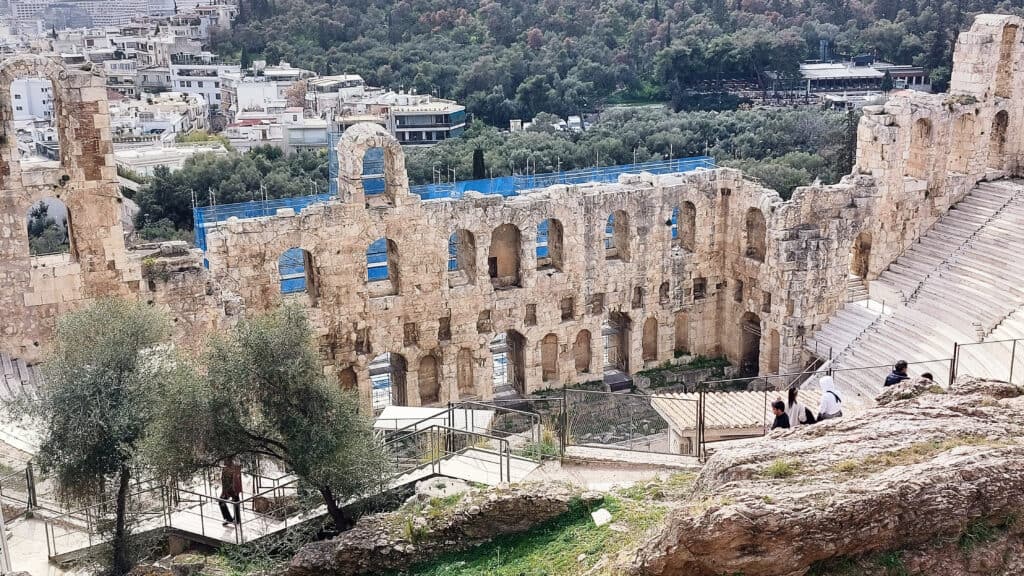
From the Acropolis, you also get a brilliant view of the Odeon of Herodes Atticus, the restored Roman theatre built into the southern slope. It’s still used for performances today, and even if you don’t attend one, the sight of the stone tiers sweeping down toward the city is impressive from above. You can also see the forest of Philopappos Hill, which is another excellent vantage point for city views.
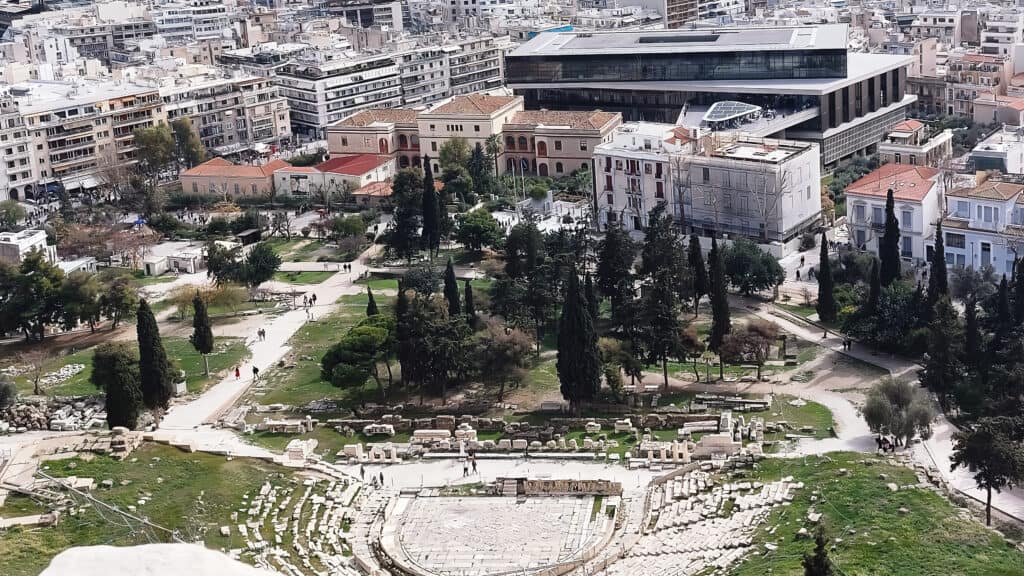
A little further along the slope is the far older Theatre of Dionysus. A weathered semicircle of stone that was once the heart of classical Greek drama. The seating is much lower and more open than the Odeon, but standing above it gives you a real sense of its scale. This is where the plays of Aeschylus, Sophocles and Euripides were first performed. You can also see the Acropolis Museum in the background.
Visit the Acropolis Museum
Just below the hill sits the Acropolis Museum, which is easily one of the best museums in Greece. It’s modern, beautifully designed, and does a brilliant job of explaining the history and context of what you’ve just seen.
Wander the Anafiotika District
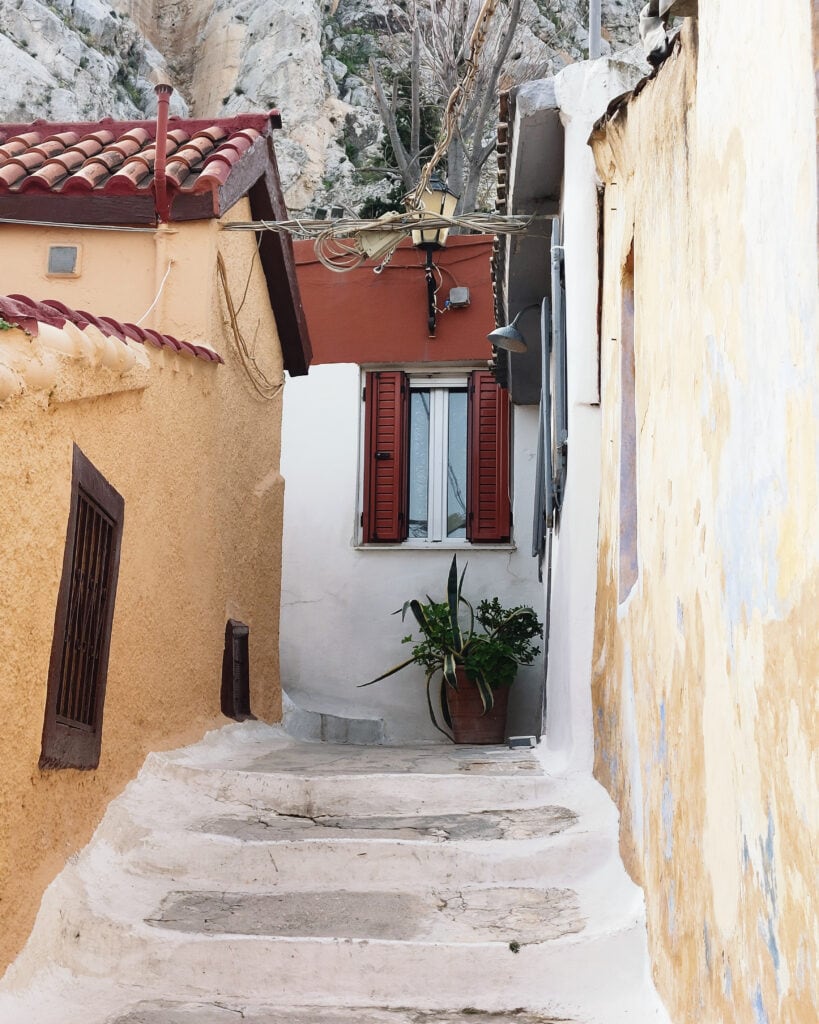
As you wander down from the Acropolis, keep an eye out for Anafiotika (photographed), a pocket-sized neighbourhood tucked into the cliffs directly below the Acropolis, it’s one of the most photogenic corners of Athens. Its narrow steps, faded colours and tangle of plants make it one of the most photogenic corners of Athens.

A

2. Classic Neighbourhoods: Plaka & Monastiraki
Plaka and Monastiraki sit at the foot of the Acropolis and are the heart of Athens’ old town, lively, colourful and always busy, especially in the evenings. Even if you’re not usually drawn to tourist hubs, they’re worth a wander for the atmosphere alone: lantern-lit restaurants, narrow lanes, rooftop bars, street musicians, and the constant buzz of people. You’ll find everything from simple gyros stands to more polished restaurants tucked down quieter side streets.

Here’s what to expect:
- Neoclassical buildings with pastel shutters and balconies.
- Pedestrian lanes lined with tavernas spilling out onto the pavement.
- Rooftops offering those classic Acropolis views.
- Small shops selling ceramics, jewellery and handmade souvenirs.
- The lively square at Monastiraki, a natural meeting point for locals and visitors.
Monastiraki is famous for its ‘flea market’, though most of it is really just permanent shops. The true flea market appears on Sundays.

En Aithria Acropolis bar area inside En Aithria Acropolis rooftop bar view of Acropolis


We tried two very different spots nearby. En Aithria, on the edge of Monastiraki/Plaka, is all about the rooftop terrace, a great place for a drink with an Acropolis view (go for the outlook rather than the cuisine). And a little deeper into the lanes we found Thea by Latifis, a much more traditional Greek restaurant. The food was simple and good, and it felt like the kind of place families go back to rather than somewhere styled for visitors.
Between the rooftop views, the old streets and the endless choice of cafés and tavernas, this part of Athens is ideal for a relaxed evening.
3. Iconic Landmarks: Stadium, Syntagma & Lycabettus
Visit the Panathenaic Stadium
A short walk from the National Garden brings you to the Panathenaic Stadium (Kallimarmaro), entirely built of marble and home to the first modern Olympic Games. You can see a surprising amount from outside, so whether you go in depends on your interest in Olympic history (and your tolerance for midday sun). (we didn’t). If you do, you’ll get an audio guide, a chance to explore the whole area and the chance to visit the museum.
Watch the Changing of the Guard at Syntagma Square
Near Syntagma Square, the Changing of the Guard outside the Hellenic Parliament is a quick, worthwhile stop if you’re passing by on the hour. The choreography and uniforms of the Evzones are far more impressive in person than they appear in photos.

Take the Funciular up Lycabettus Hill
You’ll find another of Athens’ iconic viewpoints at the top of Lycabettus Hill. It’s particularly striking at dusk when the city lights stretch all the way to the sea. Consider taking a single ticket to ride up and then walk down, so you can take your time to enjoy it and take your photos from different viewpoints.
4. Other Ancient Sites Around Plaka and the City Centre
Explore the Ancient Agora, Stoa of Attalos and the Temple of Hephaestus
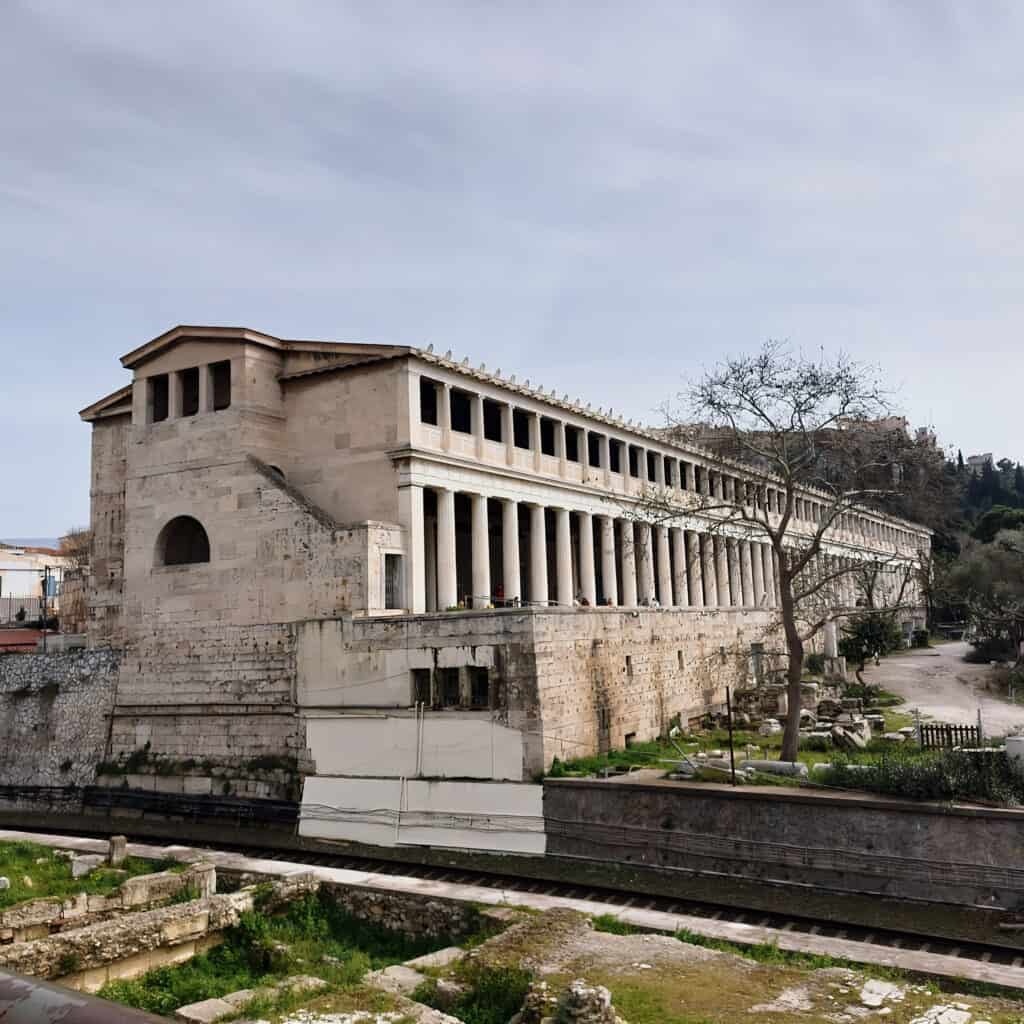
The standout building in the Ancient Agora area is the Stoa of Attalos. It’s a long, elegant colonnade reconstructed in the 1950s to show what an ancient Athenian marketplace once looked like. It’s one of the few places in Athens where you get a real sense of scale and everyday life in the classical city.
Stoa of Attalos, Ancient Agora, Athens Temple of Hephaestus, Ancient Agora, Athens
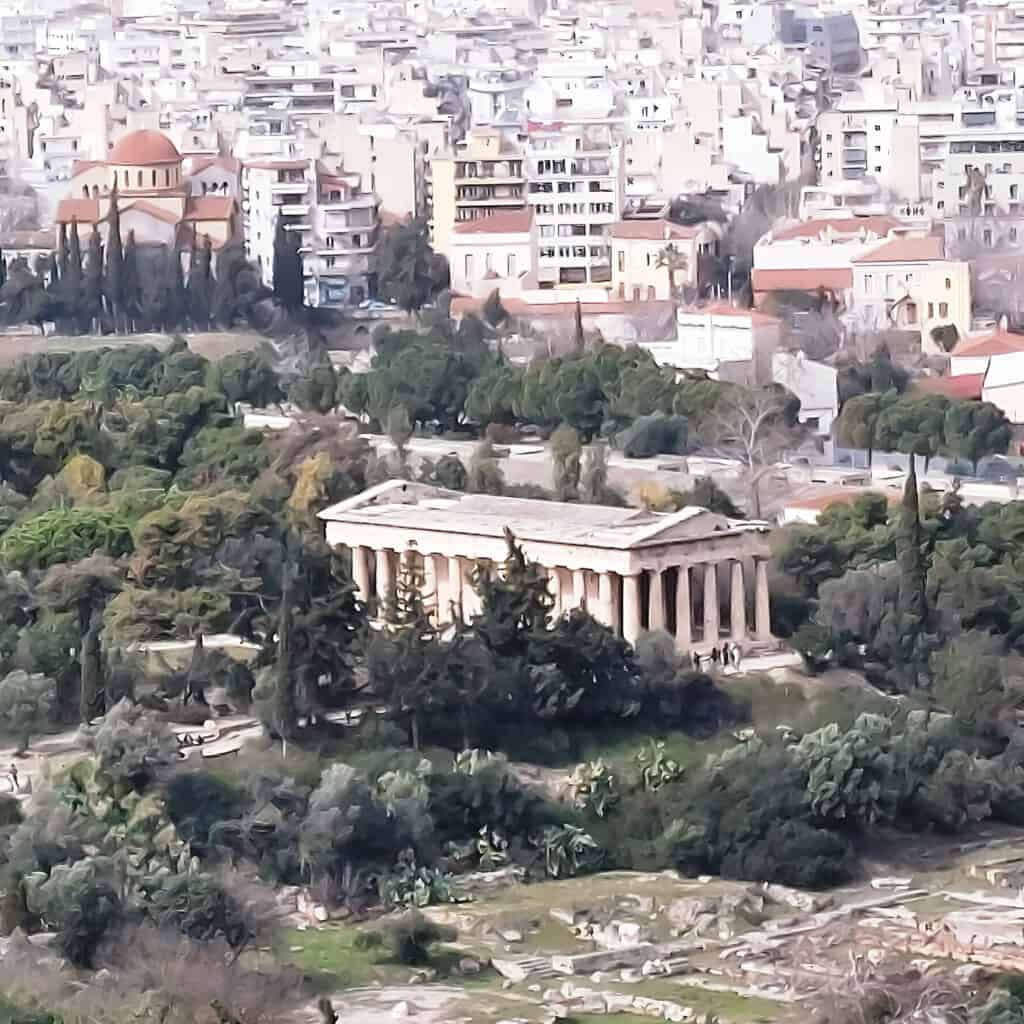
Just uphill sits the Temple of Hephaestus, remarkably well preserved and almost complete. It’s a rare chance to see an ancient Greek temple with its columns, roofline and proportions intact.
Visit the Roman Agora and Hadrian’s Library
A short walk from the Acropolis brings you to several smaller but atmospheric ancient sites that fit easily into any Plaka wander.
- The Roman Agora: a compact but charming, centred around the elegant Tower of the Winds, an octagonal marble structure that once functioned as a water clock and weather vane.
- Hadrian’s Library: The ruins and remains of Emperor Hadrian’s library
- Temple of Olympian Zeus: the sheer scale of the surviving columns is far more impressive in person than photos suggest, and the walk can be combined with the Zappeion and the National Garden.
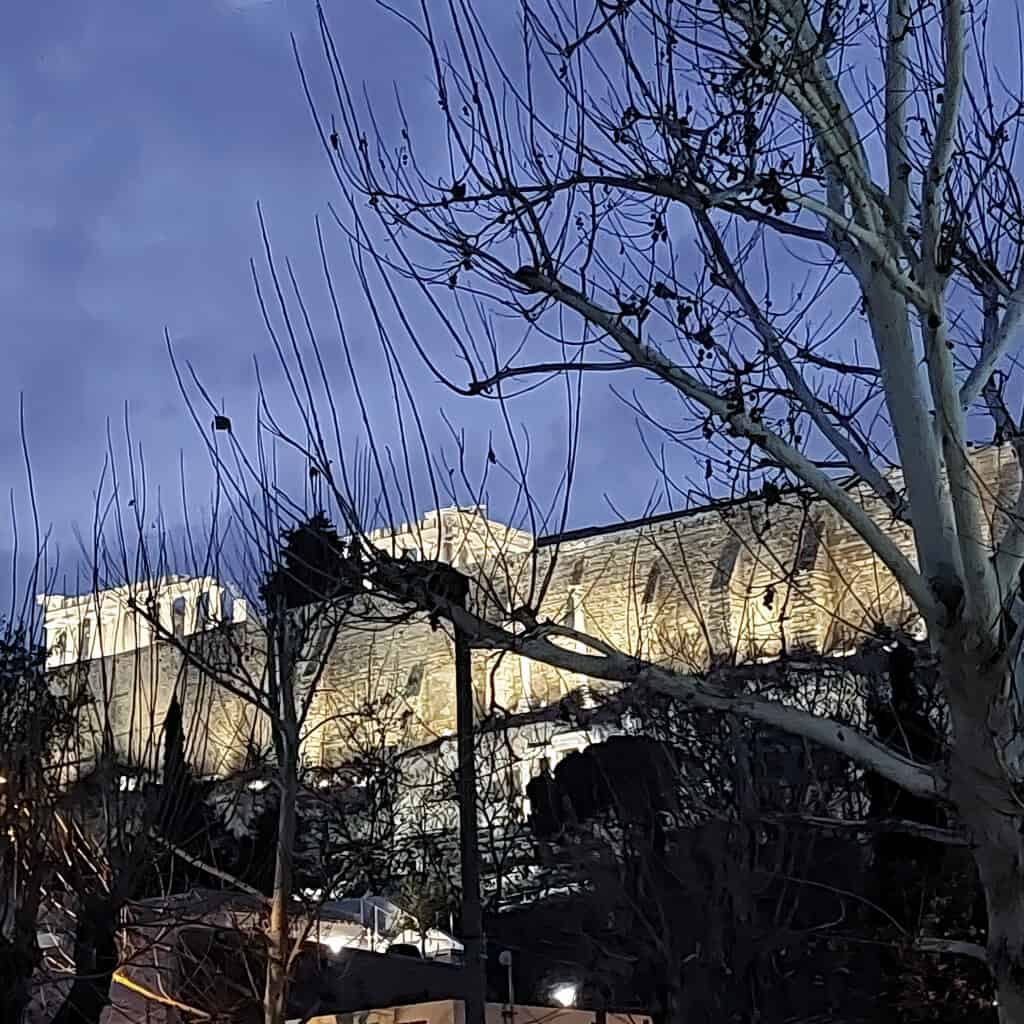
The Acropolis at Night Hadrian’s Arch at Night

If you head towards the main road, you’ll also see Hadrian’s Arch, the monumental gateway marking the ancient boundary between the old Greek city and the newer Roman quarter. It’s especially striking when lit up at dusk, and makes an excellent photo stop even if you’re not visiting the Temple site itself. And if you’re planning a longer trip, my Thessaloniki → Meteora → Athens itinerary shows how to fit everything together.
Map of Classic Athens: Things to Do
I’ve added everything on this map of things to do in Athens
Exploring Beyond the Main Sites
Athens is a huge city, and there’s so much more to it, than the ancient ruins and central Plaka and Monastiraki. I’m sharing plenty more in my Alternative Athens article.
You might also consider going on an E-bike tour or Greek food tour of the city.
Day Trips from Athens
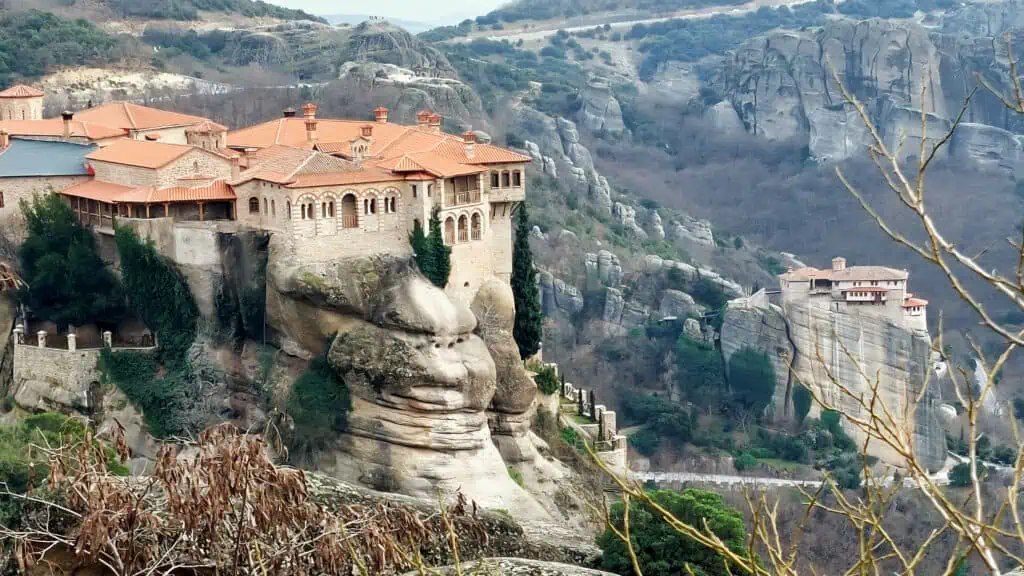
Athens makes an excellent base for exploring northern Greece and some of the closer islands. There’s a choice of , day trips taking you to beaches, islands and historic sites. If you have the time, it’s well worth venturing beyond the city and my top pick, without question, is Meteora.
Visit the Hanging Monasteries of Meteora
Even if you’ve travelled widely in Greece, nothing quite prepares you for Meteora — those monasteries balanced on giant stone pillars look surreal in real life, no matter how many photos you’ve seen.
You can visit Meteora as a long day trip from Athens, and if that’s all the time you have, it’s absolutely still worth it. In this case, I’d recommend joining an organised tour rather than trying to piece it together yourself (especially while the Kalambaka train line remains closed, December 2025). A tour removes the stress of transfers and ensures you actually reach the viewpoints and a couple of monasteries in the limited time available.
If you do have flexibility, Meteora works beautifully as an overnight stop. Staying in Kalambaka or Kastraki gives you time to explore more of the circuit, enjoy the views without the crowds, and catch a spectacular sunset, something day-trippers miss.
I’ve written a full guide here: Visit Meteora: An Unforgettable Trip to Greece’s Cliff-Top Monasteries.
And if you’re planning a wider route through Greece, I’ll be sharing my full Thessaloniki–Meteora–Athens itinerary shortly.
➡️ Athens: Meteora Monasteries Day Trip with Caves and Lunch
If you’re looking for something a little easier to reach, there are plenty of excellent day trips that don’t require navigating train disruptions.
Mycenae, Epidaurus and Nafplio Tour from Athens
This is one of the most popular cultural day trips from Athens, combining major archaeological sites with a charming seaside town. You’ll visit Mycenae, home of the legendary Lion Gate and Agamemnon’s palace; Epidaurus, famous for its beautifully preserved ancient theatre with perfect acoustics; and Nafplio, a Venetian-influenced harbour town ideal for a stroll or gelato break. It’s a full day but a rewarding one if you want a mix of history and scenery.
➡️ Mycenae, Epidaurus and Nafplio Tour from Athens
From Athens: Hydra, Poros, and Aegina Day Cruise with Lunch
If you want an easy island day without the logistics of ferries, this cruise is the simplest way to get a taste of the Saronic Gulf. Hydra offers elegant, car-free lanes and polished cafés; Poros is small, leafy, and perfect for a relaxed wander; while Aegina gives you a taste of pistachio farms, temples, and beaches. Expect a gentle, no-rush day: scenic sailing, brief stops on each island, and lunch served on board.
➡️ From Athens: Hydra, Poros, and Aegina Day Cruise with Lunch
Athens: Mythology of Delphi, Museum and Arachova Guided Tour
Delphi is one of Greece’s most significant ancient sites. It’s the sanctuary where the Oracle once shaped decisions across the ancient world. A guided day trip makes the mythology and history much easier to follow, especially when combined with a visit to the excellent Delphi Archaeological Museum. The tour usually includes a stop in Arachova, a pretty mountain village known for its stone houses and winter ski culture.
➡️ Athens: Mythology of Delphi, Museum and Arachova Guided Tour
Where to Stay in Athens
Athens has an enormous range of accommodation, from simple studios to high-end boutique hotels. We stayed near the Acropolis and found it a great base for walking almost everywhere, but I prefer not to recommend hotels I haven’t personally stayed in.
For a wider search, here’s a map with well-located options across central Athens, covering areas like Plaka, Monastiraki, Koukaki and Syntagma. These neighbourhoods put you close to the main sights, with plenty of cafés and restaurants nearby, so you can quickly find something that suits your trip.
How to Get to Athens
Flying to Athens
Athens is the main international gateway to Greece, with direct flights from across Europe and many long-haul destinations. From the UK, flights run regularly from London and regional airports year-round.
Getting from the Airport to the City Centre
Athens Airport (ATH) is an easy 35–40 minutes from the centre. You have several straightforward options:
• Metro (Line 3):
Direct trains connect the airport to Syntagma and Monastiraki. It’s the simplest and often the fastest option, especially if you’re travelling light.
• Airport Bus (X95 to Syntagma / X96 to Piraeus):
Cheaper than the metro and running 24/7. Useful if you’re staying near Syntagma Square or travelling late.
• Taxi:
A fixed fare applies between the airport and the city centre. It’s the easiest choice if you have luggage or arrive outside peak metro hours.
• Pre-arranged transfer:
Offers door-to-door convenience, especially helpful if you prefer not to navigate public transport after a long flight.
Frequently Asked Questions About Athens
Is Athens worth visiting?
Yes. Athens is one of Europe’s most fascinating capital cities, mixing ancient history with lively neighbourhoods, great food and real everyday character. The Acropolis alone is worth the trip, but the city has far more to offer once you start exploring beyond the classics.
When is the best time to visit Athens?
Spring (April–June) and autumn (September–October) are ideal: warm, bright and comfortable for walking. Summer can be extremely hot, while winter is mild and much quieter, with shorter queues at the main sights. We visited in February, and the weather was perfect for sight-seeing.
Is Athens safe?
Yes, Athens is generally safe for visitors. Like any big city, keep an eye on your belongings in busy areas such as Monastiraki Square and on public transport, but overall it feels welcoming and easy to navigate.
How long should I spend in Athens?
Two to three days is perfect for the main sights at a relaxed pace. You can see the classics in one day, but staying longer gives you time for neighbourhoods, museums, viewpoints and some great food. If you have extra time, add a day trip or combine Athens with a wider route through Greece.
I hope you’ve found this guide to classic Athens useful. If you’re curious about the city beyond the big sights, I’ve explored more Alternative Athens if you’re after a rundown on the industrial parts, street art and craft beer. I also highly recommend Greece’s second city, Thessaloniki
And if you’re planning a longer route through Greece, my Thessaloniki → Meteora → Athens itinerary pulls everything together into an easy route by public transport.
I’d love to hear about your experiences in Athens or help if you have any questions about planning a trip. And if you enjoy practical, real-world travel tips, feel free to join my monthly newsletter.